Some evolutionary innovations are so useful that nature keeps on making them.
There’s the crab; everyone knows nature keeps making crabs. There’s the ability to fly, whether by feathers, membranes, or chitin. And, of course, there’s the indispensable trick of using one’s genitals to scramble the sonar of hunting bats.
No, your eyes are not deceiving you. Some moths have evolved the ability to make noise at bats using their genital structures.
And apparently it’s so useful that this ability has emerged, separately, again and again in different species of hawkmoths.
According to new research, these moths have evolved the ability to scream at bats using their genitals independently as many as seven times over 30 million years – and at least three distinct anatomical mechanisms have emerged, producing different kinds of potentially sonar-jamming ultrasound.
“Collectively,” writes the team in a study led by entomologist Paul Masonick of the Florida Museum of Natural History, “our findings deepen our understanding of defensive bioacoustic adaptations in this iconic predator-prey system.”
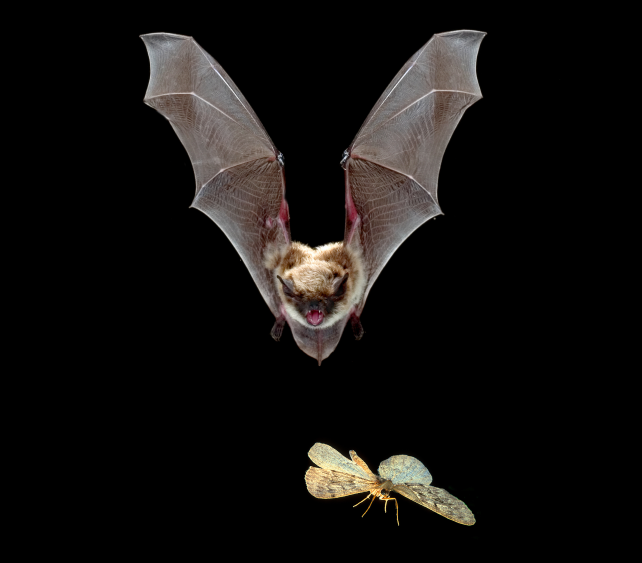
The relationship between predator and prey is one of nature’s most powerful drivers of evolution. The constant threat of death from a particular source – a predator on the prowl for snacks – creates pressure to find ways to avoid ending up on the menu.
We see it time and again – an evolutionary arms race in which predators and prey continually evolve new ways to outwit each other, driving adaptations such as camouflage, toxicity, spikes, armor, and ways to look much bigger and tougher than the reality might be.
For hawkmoths harried by hungry bats, producing sounds that confuse the echolocation their predators use to locate flying prey in the darkness has the potential to be a powerful survival strategy.
But moths don’t have larynxes. So they have to get a little bit more creative.
The trick is a process called stridulation – producing sound by rubbing two body parts together, like the chirps of crickets rubbing their wings, or the hissing of spiders rubbing their legs against each other.
In male hawkmoths, the instruments are specialized scales on a pair of genital structures called valvae. By moving these structures against modified surfaces on their abdomens, the moths can produce bursts of ultrasound.
And, as the researchers discovered, there is more than one way to make genital music.
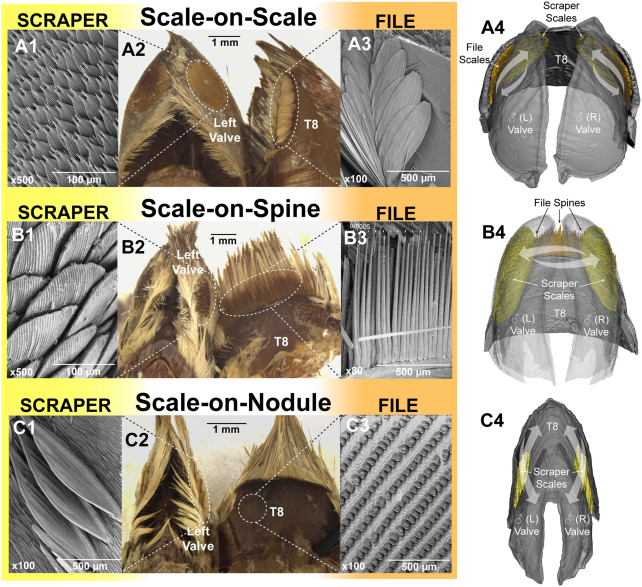
In fact, there are at least three.
Masonick and his colleagues examined the genital structures of male hawkmoths from across the family, using detailed imaging to identify the surfaces responsible for producing their ultrasonic calls.
In some species, specialized scales on the genital structures scrape against other scales on the abdomen. In others, they rub against tiny spines. And in a third group, the scales scrape across little bumps called nodules.
Each mechanism produces its own distinctive ultrasonic sounds – a tiny percussion band that’s beyond the range of human hearing – but when slowed down to bring them into the audible range, they resemble a series of rapid clicks, buzzes, or trills.
The scale-on-scale mechanism tends to produce shorter, more intermittent bursts of ultrasound, while scale-on-spine moths produce longer, more sustained emissions.
The scale-on-nodule moths, meanwhile, seem to have the most varied repertoire, producing sounds that differ considerably even between closely related species.
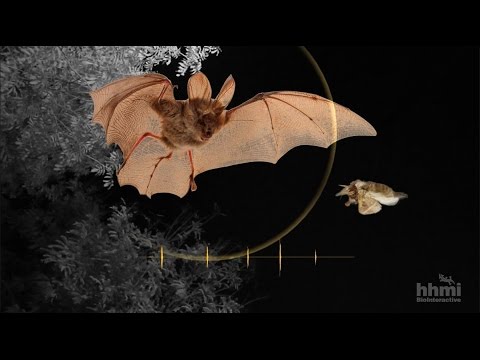
frameborder=”0″ allow=”accelerometer; autoplay; clipboard-write; encrypted-media; gyroscope; picture-in-picture; web-share” referrerpolicy=”strict-origin-when-cross-origin” allowfullscreen>
And, amazingly, these three distinct mechanisms for yelling from the gonads weren’t all inherited from a single, acoustically gifted ancestor.
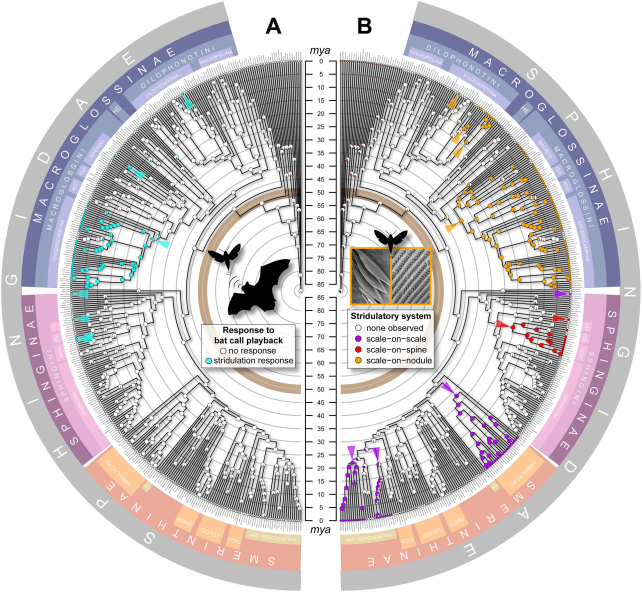
When the researchers mapped the sound-producing structures and behaviors onto the hawkmoth family tree, they found that the ability to sing an ultrasonic genital song in response to hunting bats appears to have repeatedly evolved independently, as many as seven times over the past 30 million years.
Which raises the question: If nature kept reinventing the screaming willy, just how useful is it?
Surprisingly, the answer is: not consistently – at least, maybe not in the way you might expect.
The researchers analyzed recordings of the moths’ ultrasonic performances, measuring how long each burst lasted, its frequency, and how much time the moths spent making noise.
They then compared these measurements with what previous experiments had revealed about the kinds of sounds that can interfere with bat echolocation.
And not all the strange moth songs were up to the task.
The more sustained sounds were most likely to have the acoustic characteristics associated with disrupting bat sonar in a way that could help the moth evade a toothy capture.
But even the shorter bursts may have their uses.
Some hawkmoths have hearing organs that allow them to detect the ultrasonic calls of approaching bats, giving them time to respond with a barrage of noise. That’s when it would be useful to mess with echolocation.
Others, however, are deaf. They can’t hear the bats coming, so they can’t respond to approaching predators in the same way. However, they can still produce ultrasound when touched.
The researchers suggest that shorter bursts might startle a bat as it closes in for the kill, potentially giving the moth a chance to escape. Well, and it would, wouldn’t it? Imagine going in for a tasty snack, and its genitals start yelling at you. You’d back right the hell off.
Another possibility is acoustic mimicry. Some moths use ultrasonic signals to warn bats that they’re toxic or otherwise unpleasant to eat. Hawkmoths, which are generally palatable to bats, may be jumping on the warning bandwagon by making similar sounds.
And there might be another, more appropriate use for the genital sounds, at least in some species.
The variety of sounds produced by the scale-on-nodule mechanism raises the possibility that the sounds could also help moths recognize members of their own species during courtship.
This remains to be tested, but nature is very good at finding new uses for old tricks.
So there you have it – if you can’t avoid turning into dinner, maybe at least you can get a little romance before you go.
The research has been published in Proceedings of the Royal Society B: Biological Sciences.
This article was fact-checked by Rebecca Dyer and edited by Rebecca Dyer. While we pride ourselves on our process, we are only human. If you spot a mistake, please let us know.