





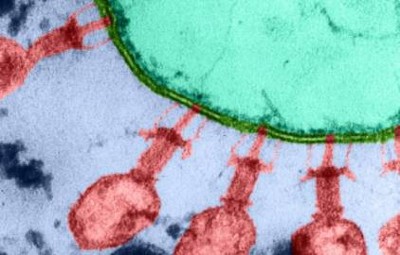
A computer-generated model of the capsid of bacteriophage ΦX174. Credit: Laguna Design/Science Photo Library
Few biological systems have been studied as exhaustively as the phage ΦX174, or phi X. Yet a new study shows that scientists still have loads to learn.
The virus’s genome is a circular single-stranded DNA that features 5,386 nucleotides and encodes 11 proteins. In the 1970s, it became the first ever whole genome to be sequenced1 — and, in the 2000s, it was the first to be chemically synthesized2. The first viral genomes designed by artificial intelligence were versions of, you guessed it, phi X3. Now, researchers have systematically mutated nearly every single nucleotide — another first for a full genome — and determined the consequences4.
Most of these mutations were detrimental to the virus’s survival, but for many of them, it was difficult to pinpoint why. “Even in this super well-studied system, we can’t explain why one-quarter of the mutations kill the virus,” says Ben Lehner, a molecular biologist at the Wellcome Sanger Institute in Hinxton, UK, who co-led the study, which was posted on the bioRxiv preprint server in July.
Cutting-edge AI systems for biology research that have shown promise in identifying harmful mutations struggled to predict the effects of the changes in the phage. The findings underscore the need for more, and better, experimental data to power these biological-AI tools.
Tinkering with tiny components
Lehner and his colleagues created more than 44,000 variants in the virus’s genome by making all possible changes to individual nucleotides (three modifications each, one at a time) and all individual amino acid of its proteins (19 modifications to each).
To measure these mutants’ effects on the fitness of the virus, Lehner, along with molecular biologist Huijin Wei at the Centre for Genomic Regulation in Barcelona, Spain and geneticist Xianghua Li at King’s College London, cultured thousands of viral variants together with Escherichia coli, which is susceptible to phi-X infection, for 80 minutes — enough time for two or three infection cycles. During this time, the variants that multiplied were deemed successful; those with harmful mutations perished.
The results of this competition between mutants, gleaned through DNA sequencing, were a surprise, says Lehner. Half of the single-nucleotide mutations, and 60% of those altering amino acids, were harmful to the phage, a much higher proportion than he expected. And although phi X has been studied for decades and is generally thought to be completely optimized for laboratory conditions, a handful of mutations further improved its fitness.
World’s first AI-designed viruses a step towards AI-generated life
Of the harmful amino-acid mutations, around half were suspected to have disrupted interactions with other proteins (both ones in phi X and others in its E. coli host). One-quarter were in amino acids buried deep in a protein, possibly compromising structural integrity. The remaining ones were a mystery. “There’s hundreds of mutations in here where we haven’t got a clue what they’re doing,” says Lehner.


