




In 1889, Vincent van Gogh watched the sky before sunrise from his room at an asylum in Saint-Rémy, southern France.
In a letter to his brother Theo, he recalled seeing only the morning star above the countryside before dawn, noting how large it appeared.
In The Starry Night, painted that year, blue swirls sweep above a small village. A tall cypress rises on the left, while rings of yellow light surround the stars and crescent Moon.
According to New York’s Museum of Modern Art, the painting drew inspiration from his window view. The village came from other views, however, and the cypress was brought closer. The museum identifies the bright light left of center as Venus, the morning star.
Researchers in South Korea wanted to investigate how closely the arrangement of celestial objects reflected something Van Gogh had actually seen.
Their study suggests that the Moon, Venus, and the central group of stars correspond to the sky visible before dawn around 22 July 1889. The match supports the possibility that Van Gogh incorporated an observed sky into his expressive composition.
Elijah Jeong-hyun Kim, a PhD candidate at Kyung Hee University’s School of Space Research and CEO of South Korean telescope maker SLLAB, led the investigation.
A familiar pattern near the painting’s center had caught his attention: a V-shaped star cluster called the Hyades, in the Bull constellation, Taurus. Earlier research had proposed stars in the Ram constellation, Aries, but the astronomical interpretations had remained unsettled.
There was also a problem with the Moon. The painting is conventionally dated to June 1889, when the Moon around the middle of the month was more than half illuminated. “The strongest evidence is the sky itself,” Kim told ScienceAlert. “The waning gibbous moon around 18 June does not match the slender crescent in the painting.”
To examine these clues together, the team returned to Van Gogh’s landscapes.
During two field trips to France in 2019, they photographed places he had drawn and painted. Comparing buildings, bridges, and landscape features with his pictures helped them estimate how narrowly he had framed the scenery.
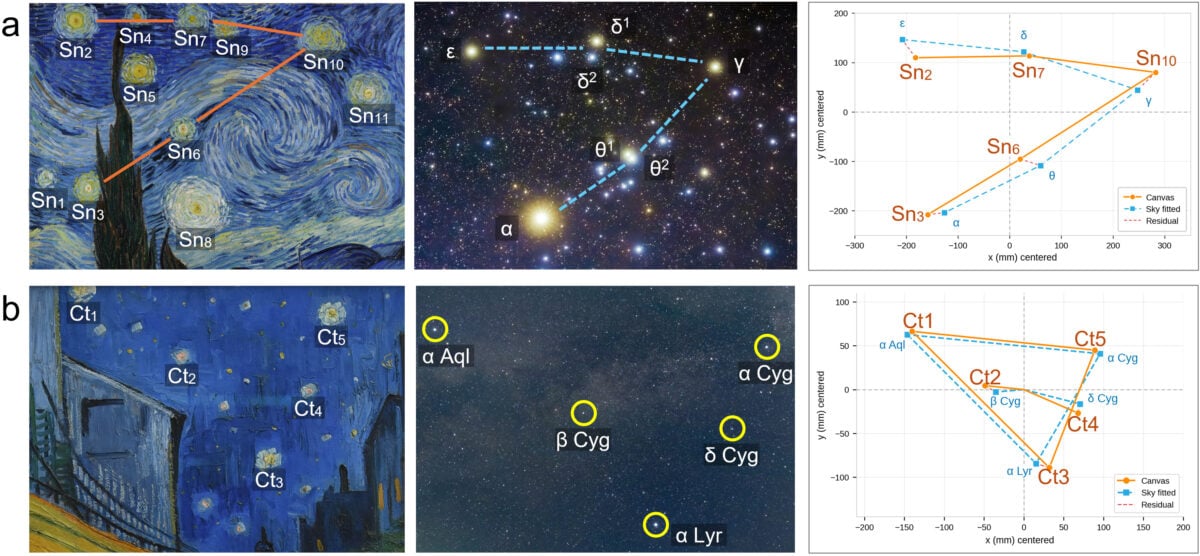
They tested their approach on two night scenes he painted in Arles in 1888. In Café Terrace at Night, they identified a possible match with three bright stars forming the Summer Triangle.
For The Starry Night, they applied a viewing frame derived from an earlier drawing associated with its village landscape to computer reconstructions of the 1889 sky.
Among the June and July dawns when the Moon sat above Venus, as in the painting, June 23 and July 22–23 placed both within the reconstructed frame. Around July 22, the Hyades also occupied the center, producing the closest match to the painting.
The researchers then measured the relative positions of five central stars on the canvas. A mathematical method that rotates, shifts, and uniformly resizes patterns found a close correspondence with the Hyades. For those five selected points, every alternative pairing with the Hyades stars produced a worse fit.
The match was closer in Van Gogh’s later pen drawing of the painting. The star group’s tilt relative to the horizon also agreed with the reconstructed sky.
The researchers suggest that the approach could help art historians reassess how the painting developed. They argue that Van Gogh may still have been working on the canvas in July, after beginning it in June, and that similar comparisons could help investigate the skies depicted in other historical night paintings.
The July interpretation raises questions about the established chronology. Van Gogh mentioned a new starry-sky study in a June 18 letter, but the researchers argue that this does not show he had finished the painting.
They also suggest that an episode of illness usually placed in mid-July began later, leaving open the possibility that he observed the sky around July 22. Letters and historical weather records support their interpretation, but no medical notes from the time show when the illness began.
The astronomical comparison also needs several clues to work together. Other star groups produced close geometric matches, so shape alone cannot identify the painted stars.
The Hyades interpretation gains support from the stars’ relative positions, the arrangement of the Moon and Venus, and the way the Moon, Venus, and the Hyades fit together within the reconstructed frame.
“What our study shows is that the sky in the painting matches, in both observation and shape, the real pre-dawn sky around 22 July. That alone does not pin the completion of the painting down to a single day,” Kim explained.
“I believe Vincent brought together on a single canvas the skies of several days before and after 22 July.”
The research has been published in Scientific Reports.
This article was fact-checked by Fiona MacDonald and edited by Fiona MacDonald. While we pride ourselves on our process, we are only human. If you spot a mistake, please let us know.


