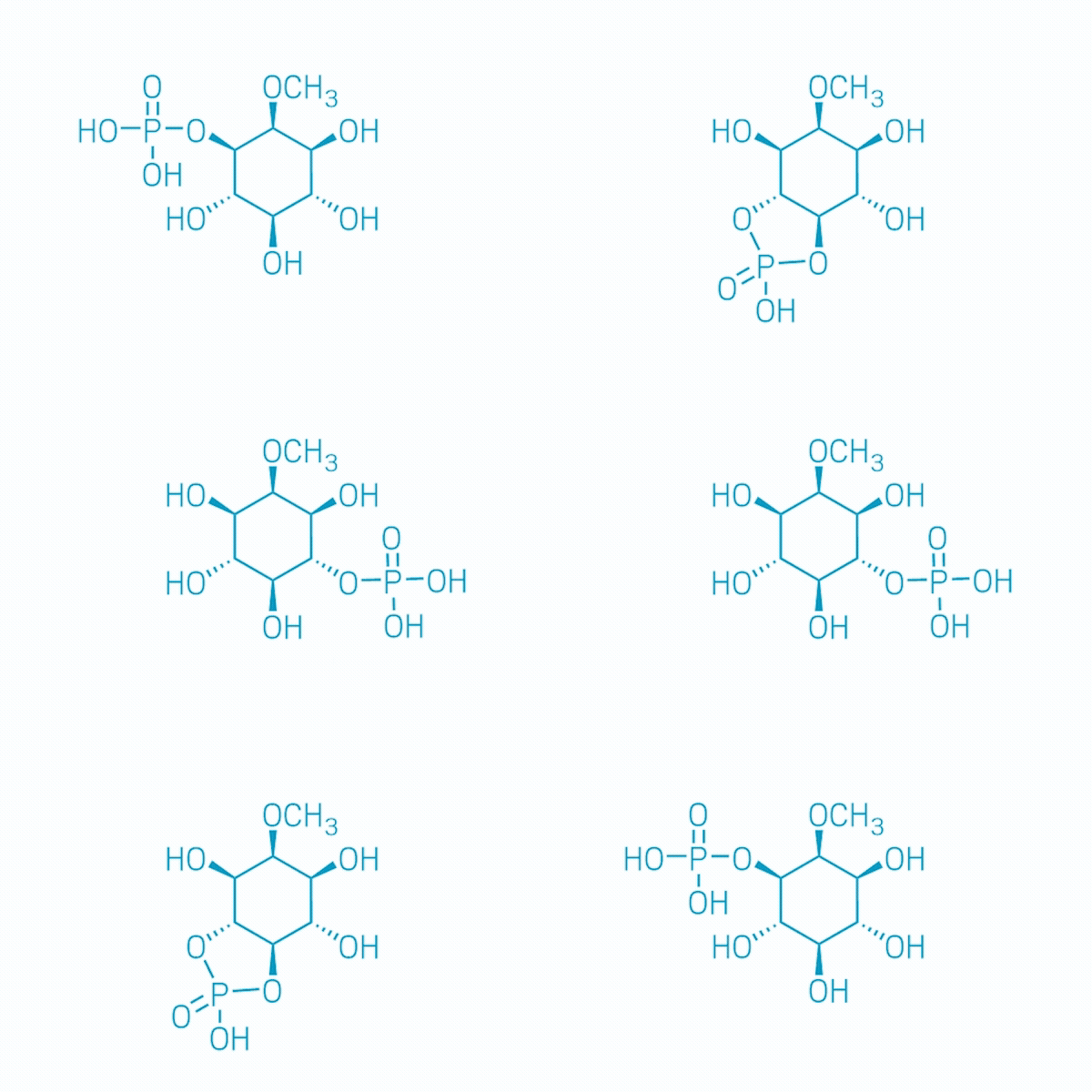

Researchers at the University of Ulm have described the first autonomous walking small-molecule machine: a simple phosphate group (Nat. Chem. 2026, DOI: 10.1038/s41557-026-02240-4). The walker travels along a hydroxy-paved molecular track using an alternating series of cyclization and ring-opening reactions.
“All we have to do is to make sure the amount of fuel stays more or less constant,” says organic chemist Max von Delius, who led the work.
Biology is full of autonomous molecular walkers in the form of motor proteins, but mimicking their activity with synthetic molecules is a big challenge. Autonomous walkers built from DNA have existed for about 2 decades, but small-molecule walkers have lagged behind. Von Delius worked on small-molecule walkers as a PhD student in David Leigh’s lab, then at the University of Edinburgh, but those machines required human intervention for each step.
Von Delius says this project spun out about 5 years ago from another project on dynamic DNA oligomers, which got the team interested in phosphorus chemistry. “In biology the very most important things have to do with P–O bonds and with their breaking and making,” von Delius says. Phosphate bonds form the backbones of nucleic acids. The chemical fuels for biological energy transduction are phosphate based. And the inherent properties of the P–O bond are key to the tiny walker’s operation.
Linear phosphodiesters are extremely stable against hydrolysis. That stability is why DNA is such a great long-term storage medium of genetic information. But phosphodiesters that are part of a five-membered ring are much more susceptible to hydrolysis because they have higher strain.
“The reason why RNA hydrolyzes a lot faster than DNA is because a five-membered ring can form, and that’s really the fundamental mechanism why this walking works,” von Delius says.
The researchers figured out that adding a carbodiimide-based coupling reagent to a glycerol phosphate creates a five-membered ring, which undergoes hydrolysis under strongly acidic conditions. In this way, the phosphate can “step” between the glycerol’s three hydroxy groups. And the exceptional stability of the ring-opened form guarantees that the walker is always attached to the glycerol in at least one place.
About 16 out of every 100 carbodiimide molecules that undergo reaction are translated into motion, von Delius says. That may seem like a low number, but it’s remarkably efficient given that the carbodiimide can also react with the acid. Not every phosphate hydrolysis will lead to a forward movement, and about 5% of the molecules end up in a stable six-membered ring that takes them out of commission.
Without carbodiimide, 90% of the phosphate groups were located at one of the glycerol’s outermost hydroxy units at equilibrium, which takes about 10 weeks to establish. Adding carbodiimide fuel shifted the distribution so that 60% of the phosphates were in the middle, an energetically less favorable spot. It takes about an hour for the fueled system to reach a steady state, von Delius says.
The researchers found that the best way to keep the walker moving was to add fuel in small doses after 15 min to keep the concentration stable. Adding a big excess raised the pH of the solution, which slows the walker.
Having shown that the walker works, the researchers moved on to a slightly larger track: a derivative of the sugar inositol. The sugar’s five exposed hydroxy groups have alternating stereochemistry, which makes it more challenging for the walker to navigate. Nevertheless, chiral high-performance liquid chromatography/mass spectrometry confirmed that, after fueling, the phosphate travels to every position on the molecule within about 10 h.
“Inositol phosphate is a perfect catalyst” for the reaction because the six-membered side product can’t form, von Delius says. He estimates that it would take a couple of days for the inositol system to reach a steady state, but the team never reached that point because of the accumulation of waste products from the carbodiimide reaction.
Beatrice Collins of the University of Bristol, who works on molecular machines but was not involved in this work, says she is impressed by the bipedal stepping mechanism the researchers used. “The macroscopic almost blinds us to how hard [translational motion] is because gravity attaches us to our own tracks. We don’t have gravity at the molecular level,” she says. The bipedal motion is inherent to the design of this walker, which is “terribly clever,” Collins adds. “I love the way that one foot is easy to come off, and the second it takes off, the other one then stays there.”
Von Delius says the team is now working on improving the walker so that it can do directional motion. It is already directional in a limited way, because “it can sense the end of the track from the middle of the track” but not which end is which, he says. The team is also working on making the system work at a pH of 5.5 rather than pH 1. In the long term, von Delius hopes to get the walkers to carry cargo along a polymer track. “We are learning right now in this field of supramolecular chemistry to gain control over time and space, and that’s very exciting.”