



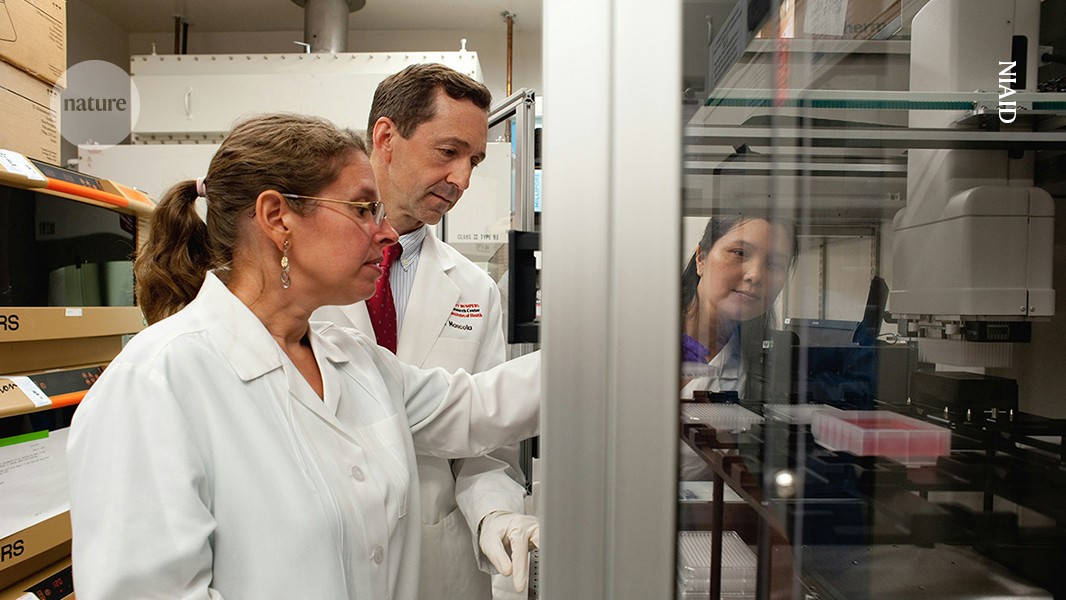
Scientists work in a laboratory at the National Institutes of Allergy and Infectious Diseases, which could lose research projects to the US Department of Defense.Credit: NIAID
The US National Institutes of Health (NIH) is seeking to redirect research projects worth hundreds of millions of dollars from its infectious-diseases institute to military biodefence programmes at the US Department of Defense (DOD), according to two NIH employees.
They confirmed to Nature that the NIH and the DOD, also called the Department of War, have signed an agreement for the arrangement. The NIH is now identifying projects it would transfer to the DOD and aims to complete the agreement by the end of September, when the fiscal year ends and some funds expire, according to a third NIH employee who is a senior official at the agency. (The employees spoke on the condition of anonymity because they are not authorized to speak to the press.)
An NIH spokesperson says, “This partnership will only take place on a project-by-project basis, and all research will be within the scope of NIH’s mission. There is no blanket transfer of funds”.
Exclusive: NIH ousts infectious-disease leaders as COVID scientists face US charges
The senior NIH official said the new arrangement would untangle civilian public-health initiatives from defence priorities. “We’re trying to get research that’s more Department of War-related back to Department of War,” the official said. “When the public hears that NIAID funds biodefence, they think we’re developing bioweapons, and we’re trying to get out of that business.”
Federal law does allow agreements between US agencies to share funding in some circumstances, says Samuel Bagenstos, who until December 2025 was the top lawyer for the NIH’s parent agency, the Department of Health and Human Services. But “what’s not appropriate or legal is saying, ‘Look, DOD needs money, NIH has money, we’re going to take money and send it to the DOD,’” he says. If the administration is using NIH resources to cover military budget shortfalls, “that would be illegal, because that would be using funding not to serve the purposes of NIH, but to serve the purposes of DOD.”
The agreement would establish a pathway to move funding out of the NIH’s National Institute of Allergy and Infectious Diseases (NIAID), the country’s premier infectious-disease research institute, to support defence initiatives and will last 10 years, according to the three sources. The full agreement has not yet been finalized, the sources say.
Biosecurity researchers warn that shifting biomedical research to the military threatens the transparency and clinical translation that define NIH-funded work. “The Department of Defense is just not set up to deliver the scientific innovations we have come to expect and rely on from NIH,” says Gigi Gronvall, a biosecurity specialist at the Johns Hopkins Bloomberg School of Public Health in Baltimore, Maryland.
Bureaucratic churn
The agreement comes as the administration of US president Donald Trump has ousted eight of ten of the NIAID’s top officials and reoriented NIAID away from research that anticipates emerging viral threats and toward basic immunology and domestic chronic illnesses. Nature reported in February that NIAID staff had been instructed to scrub the terms “biodefense” and “pandemic preparedness” from the institute’s website.
The NIAID’s biodefence portfolio includes research aimed at developing vaccines and treatments for weaponized pathogens such as anthrax, smallpox and plague, as well as medical countermeasures to protect against nerve agents and radiation sickness from nuclear detonations.
Saskia Popescu, an infectious-disease epidemiologist at George Mason University in Fairfax, Virginia, says that although biodefence requires military and civilian coordination, moving work away from NIAID risks fragmenting national preparedness for emergencies such as pandemics.
NIH director Jay Bhattacharya defended the arrangement between the two agencies. “Far from siphoning money away from research, this partnership between @NIH and @Dept ofWar focuses on research projects that will drive discoveries to improve the health of American citizens and members of the military,” Bhattacharya wrote in a post on social media platform X.
Operation Prevailing Edge
The reallocation was initiated by NIH leadership, but Robert Kadlec, assistant secretary of defense for nuclear deterrence, chemical and biological defense policy and programs, has been pushing to finalize the deal under a broader biodefence initiative dubbed “Operation Prevailing Edge”, according to two of the three NIH employees.