Digitalising conveyed ore in real-time is proven to improve processing operations, and not just by a few percentage points.
Few processing operations in the minerals industry (and others) utilise proven bulk measurement technology to reduce the impact of feed quality variability in process feed. Feed grades can be increased by 5-20%, metal recoveries can be improved by up to 15%, and products can be increased by 20% for the same plant throughput. These are step changes achieved in real life by mining companies that have adopted high-performance, real-time, representative measurement technologies on primary crushed rock.
Digitalisation: Rocks2Data
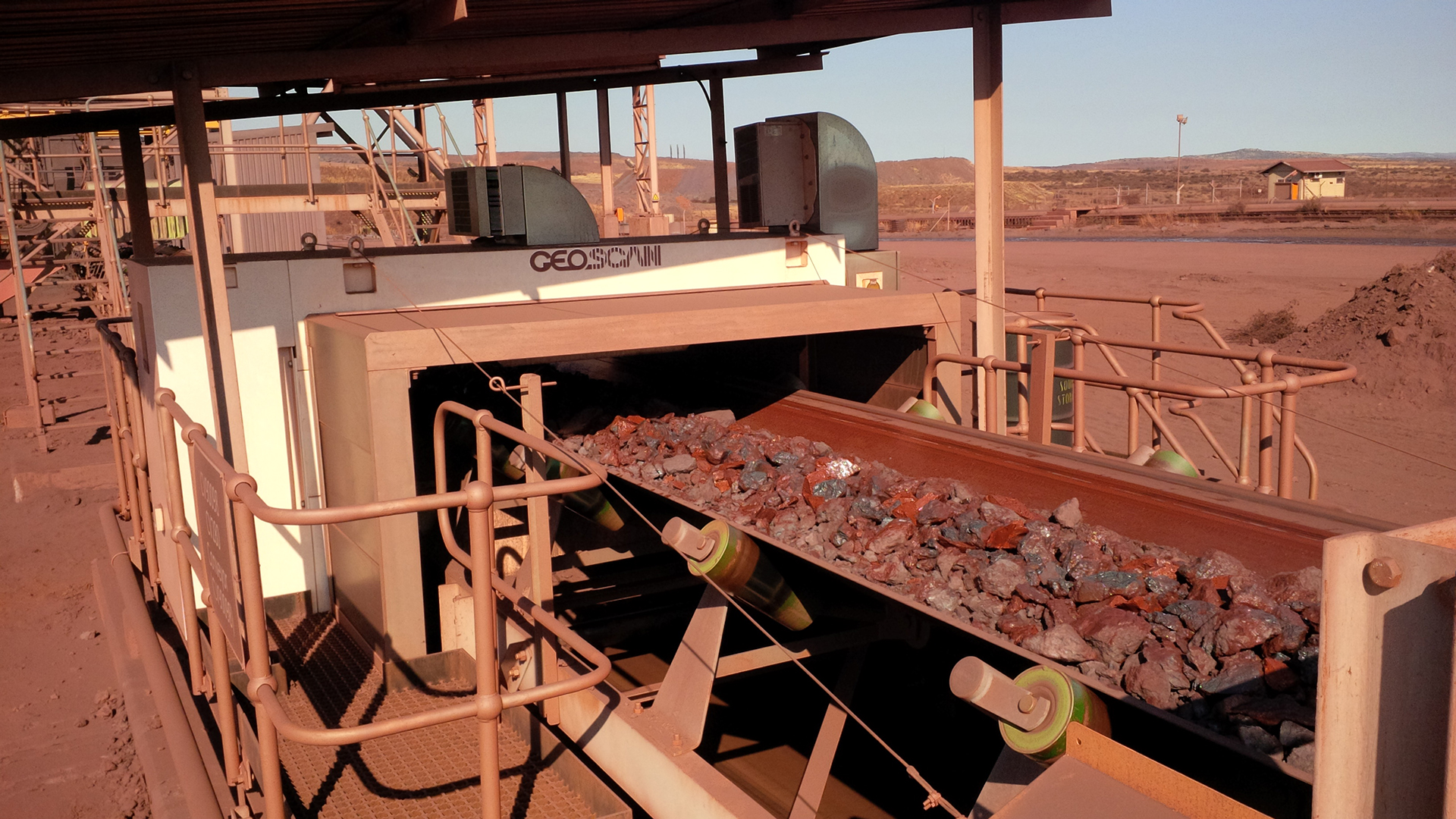
GEOSCAN uses high-specification Prompt Gamma Neutron Activation Analysis (PGNAA) in many commodities and applications and has proven unique in providing high-quality representative measurement data. Measurement for bulk ore sorting in base metals, industrial minerals and PGMs has been particularly successful. Ore grade is controlled by diverting waste parcels from the conveyed flows, controlling blends from different sources, and diverting material that does not need processing.
GEOSCAN GOLD, which is the only system to measure gold grade directly, has been supplied to gold mines in North America, Latin America, Australia, Asia and Africa and is achieving expected performances. A suite of elements is measured over every 30 seconds of conveyed flow, and gold is directly measured over 5-10 minute increments at unmatched precisions (to 0.2 ppm Au).
Representative measurement data is used in feed-forward control, feedback to mining and metal accounting and ore reconciliation, and in applications mentioned above. The analyser measures elements in primary crushed rock (generally up to -350mm) in conveyed flows at <100 tph to >10,000 tph, irrespective of belt speed, particle size, mineralogy, dust, moisture, segregation or layering. The calibrations cater for changes in flow rate.
Digital data synergies
Representative elemental analysis is combined with moisture and next-gen PSD analysis technologies. Scantech’s READIMOIST TBM200 series transmission microwave moisture analysers have proven to be the most effective and reliable in the market, with expected performance usually achieved within two days of commissioning. Fragmentation data (particle size distribution (PSD)) from SizeScan is generated using innovative 3D infrared camera technology and advanced proprietary algorithms. The SizeScan requires only a one-off calibration after installation. Data from SizeScan is generated every two seconds and transmitted directly to the plant control system, which is owned by the site without any access limitations or cost over its long life. All three systems can be installed on a 5-7m long section of conveyor.
ESG and economic benefits
Not all technology users are forthcoming with benefits received, and some are very guarded, believing certain technologies provide competitive advantages. Nonetheless, the following have been achieved and advised:
44,000 t CO2 e/year reduction and $5m/year saving by diverting five million tonnes of product quality iron ore annually on average to bypass a beneficiation plant
40,000 t CO2 e/year saving by diverting 14% of the mine output (not processing waste) from a copper ore conveyor at 1,200 tph feeding a flotation circuit
A 22% increase in plant output after one month of GEOSCAN operation at a phosphate rock processing plant producing phosphoric acid
Prevention of furnace freezing events (savings tens of millions of dollars in lost production) by controlling B4 sinter basicity in iron ore at a steel plant.
The benefits outlined above are not comprehensive as they do not include:
Extensions in tailings dam life by diverting coarse waste instead of generating fine tailings
Additional revenues through higher quality or quantity product output for the same throughput rate
Increased contained metal throughput by diverting lower quality material and replacing it with higher quality feed
Savings in reagent costs, water, electricity, etc, otherwise consumed if the waste had been processed
CAPEX saving in plant design for smaller beneficiation plants, knowing one-third of mine output will bypass processing
Reduced processing costs per tonne of product for non-iron ore examples
Savings on equipment wear and tear
In some cases, additional costs may be incurred, such as additional waste material transportation; however, the net benefits still occur, and paybacks are typically in a few weeks or months.
Due diligence
Effective technology selection requires a good understanding of differentiators between vendors and offered equipment. As the leader in the minerals sector, Scantech can assist mining companies in reducing procurement and operational risk by sharing proven successes, technical papers, case studies published by clients, and unique measurement capabilities. Scantech’s analysers and support systems are customised to commodities, applications, and regions to ensure the highest implementation success rate.
Quality support
Scantech analysers are supported through remote access, which reduces customer costs. None of the systems has wear components, and mechanical maintenance is virtually eliminated. Qualified Scantech service engineers in each region, backed up by a centrally located team of specialist calibration staff, provide any required ongoing operational support.
Please note, this article will also appear in the 19th edition of our quarterly publication.
Terra Balcanica Resources Corp. (CSE:TERA; FRA:UB1), a multi-jurisdictional exploration company focused on supporting the global transition to clean energy, has entered into a non-binding Letter of Intent with a wholly owned subsidiary of Fulcrum Metals Plc. (AIM:FMET).
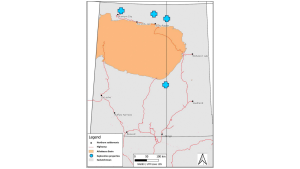
Pursuant to the Agreement, Terra will have the option to acquire a 100% interest in Fulcrum’s Charlot-Neely, Fontaine Lake, Snowbird, and South Pendleton uranium portfolio located in northern Saskatchewan, Canada.
Collectively, these licences encompass 596.71 km2 of highly prospective ground for a uranium discovery.
Uranium portfolio highlights
Proximal to northern and southeastern edges of the Athabasca Basin in northern Saskatchewan, a premium mining district and leading global source of high-grade uranium.
Charlot-Neely is located within the emerging Uranium City district on the northwestern margin of the Basin.
Historical work at the projects has demonstrated evidence of uranium mineralisation along favourable structural trends with prospective target horizons based on electromagnetic conductors.
Future exploration requires the undertaking of a modern systematic geologic fieldwork to determine the uranium potential.
Terra Balcanica CEO, Dr Aleksandar Mišković, commented: “In our pursuit of high-quality assets worldwide, Terra Balcanica has secured an option to acquire a Canadian uranium portfolio covering close to 600 km2 with tremendous potential for discovery.
“In a world transitioning to green energy solutions, the acquisition of these assets provides a more robust and diverse exploration portfolio for Terra.”
He added: “Although there has been an increase in activity in the uranium sector, we are at the early stages of a commodity super-cycle and being able to acquire such a large, advanced uranium portfolio on favourable terms was a clear opportunity for our shareholders.
“It is the right time, jurisdiction, and commodity to augment our advanced Balkan portfolio and to further participate in the changing energy landscape.
“We look forward to working with Fulcrum to apply their technical and jurisdictional expertise to advance these Saskatchewan uranium projects, and we are excited by the addition of a strategic commodity to Terra’s existing polymetallic portfolio.”
A strategic discovery opportunity for Terra Balcanica
The licence portfolio totals 596.71 km2 targeting major NE-SW trending structures along strike from historic uranium mines and projects that have attracted significant investment.
Fig. 1: Regional map of northern Saskatchewan, Canada which is one of the world’s leading sources of high-grade uranium and supplies about 20% of the world’s uranium
Discoveries such as the Arrow (4.3Mt at 0.83% U3O8) and Triple R (2.7Mt at 1.94% U3O 8) have proved the concept of exploring along structures outside of the Athabasca basin.
Key terms of the agreement
On the transaction’s closing, Terra will have a four-year option to acquire 100% of Fulcrum’s owned uranium licences.
In consideration for the four-year option and at the time a definitive agreement is announced by way of news release and subject to a CSE approval, Terra will pay Fulcrum CA$7,500 for exclusivity on execution of signing of the Letter and pay Fulcrum $25,000 less the $7,500 exclusivity payment on execution of closing of the Option Agreement.
Terra Balcanica Resources Corp. (CSE:TERA; FRA:UB1) has provided an update on the Phase I and II exploration drilling within its principal 168km2 Viogor-Zanik project in Bosnia-Herzegovina.
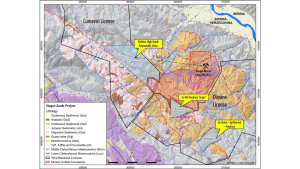
The Company completed approximately 2,200m of drilling along a shallow, high-grade, silver-dominated, intermediate sulfidation polymetallic Ag-Au-Pb-Zn-Sb vein system at the locality known as Chumavichi (Fig. 1 and 2).
This semi-continuous, 7.2km-long structural corridor associated with a low magnetic response was previously largely untested by drilling and hosts altered volcanic tuffs and breccias with occurrences of massive Pb, Zn and Fe sulphides.
At the Company’s second Viogor-Zanik target of Brezani (Fig.1 and 3), Terra discovered a surficial auriferous skarn superimposed on an Ag-Pb-Zn-Au mineralised, NE-shallowing structural system itself overlying porphyry andesites stock from 550 m of depth.
Fig. 1: Geological map of the Viogor-Zanik project illustrating the drilled targets during the Phase II campaign
The target is characterised by overlapping 1.2km wide magnetic and EM anomalies with over 700 metres wide Au-Bi-Zn anomaly at surface and banded skarn outcrops with sphalerite and chalcopyrite.
Similar geophysical signatures are detected at the 4.6 Moz Au Eq. Rogozna Au-Cu skarn project in SW Serbia (https://ibaera.com/rogozna-shanac-resources-increase-to-4-6-moz-au-eq/). The Company completed approximately 1,200m of diamond drilling at Brezani, with additional assays to be released shortly.
Viogor Zanik project highlights
Maiden Chumavichi Ridge drill hole CMVDD001 intercepted 824.2 g/t AgEq. over 4.0m from 29m of depth, including 1,634.4 g/t AgEq. over 2.0 metres
CMVDD003, an 83-metre step-out from CMVDD001, intercepted a vein interval of 465.5 g/t AgEq. over 8.7 metres, including 1196.6 g/t AgEq. over 2.0 metres, and is open at depth
The step-out drill hole CMVDD005 returned 284 g/t AgEq over 10.0m, including 895.8 g/t AgEq over 2.0m (see Fig. 3) approximately 50m west-northwest of CMVDD002
The Chumavichi Ridge drill hole CMVDD004 along the same drill fence 40m northeast of CMVDD005 returned 505.3 g/t AgEq over 11.0 m from 43.0m depth, including 3075.4 g/t AgEq (108.5 oz/t AgEq) over 1.7m
Shallow, polymetallic mineralisation was also intersected 600 m NW of the discovery hole at the Cumavici Ridge, where two drill holes through a new parallel structure returned 531 g/t AgEq over 0.75m (CMV23007), and 355 g/t AgEq over 1.10m (CMV23009)
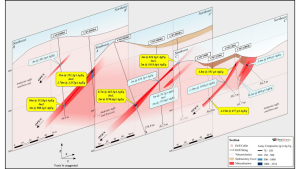
The Phase II drill hole CMV23004 intersected 1,168 g/t AgEq over 1.35 m from 36.2m downhole to add 42m strike length SE of CMVDD002 with mineralisation remaining open and untested down-dip (Fig. 2)
Drillhole CMV23003 intersected 457 g/t AgEq over 4.15m from 43.85m downhole and points to a wider down-dip continuation of the high-grade mineralisation from the previously reported CMV23004 (Fig. 2)
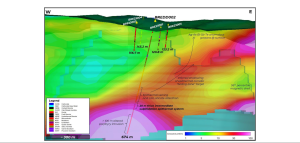
Drill testing of the 650m-wide, conductivity high at the centre of a 1.2km wide anomalously magnetic rock volume at Brezani intercepted 0.61 g/t AuEq over 88.0 m (BREDD002) and 0.58 g/t AuEq over 28.6m (BREDD001). Continuation of this drill hole along the same azimuth and dip to a depth of 674m has intercepted a substantial width of low to intermediate sulphidation epithermal mineralisation and potassically altered porphyritic andesites overprinted by chlorite from 550 m depth (Fig. 3)
Fig. 2: Fence diagram of Phase I and II drilling completed at the Cumavici Ridge target. Polymetallic mineralization intervals are highlighted in red
Terra Balcanica CEO, Dr Aleksandar Mišković, commented: “After a year of systematic targeting followed by approximately 3,400 m of diamond drilling over the last two years, we’re proud to lay claims to two precious metal-rich, polymetallic discoveries at an emerging European mining jurisdiction.
“Our systematic high-grade silver intercepts from two of the five defined Chumavichi corridor targets are indications of its outstanding potential, considering it is located only 7km west of Mineco’s silver mine at Sase. Our recent discovery of similar polymetallic mineralisation at Brezani adds further value to this multi-domain target.”
Fig. 3: Section through the Brezani target illustrating conductivity and the 95th percentile magnetic shell
He continued: “There, a significant mineralised intercept underlies the previously confirmed auriferous skarn starting from surface and overlies a porphyry system which Terra has been targeting at Viogor-Zanik from the very outset.
“We believe the potential of our discovery at Brezani is tremendous considering the shallowing of the epithermal mineralisation along a presumed fault to the northeast and stratigraphic intercept below the boiling horizon, which will be targeted by our future drill programmes. Collectively, this is a thrilling development for Terra as we aim to release assay results from an additional five drill holes at Brezani and prepare for a continued definition of this massive magmatic-hydrothermal system in eastern Bosnia.”
Upcoming results
Laboratory assay results from a section of drill hole BREDD002 below 215 m depth (Fig. 3) are pending QA/QC verification and will be released imminently. Additionally, four more diamond drill holes (BRE23001-004) between 120 and 160 m that tested the surface gold-bearing calc-silicates and magmatic breccias will be released in the coming months.
Critical raw materials (CRM) are of increasing importance for a sustainable future. Editor Maddie Hall discusses the future of CRM production in the Australian state of Queensland, with a spokesperson of the Queensland Government.
Australia is, according to the 2023 Innovate UK report, a top producer of several critical raw materials. The Innovation Platform Editor Maddie Hall spoke with a Queensland Government spokesperson to find out more about Queensland’s plans to continue its excellent production.
Can you outline the Queensland Critical Minerals Strategy and its key objectives? How does the Saint Elmo Vanadium Project align with the strategy, and what other critical mineral projects are a priority for the Queensland Government?
The strategy is about positioning Queensland as a leader in the global critical minerals market and future proofing the next generation of jobs for Queensland through the development of new industries spanning the entire value chain – from mining to the final product – to drive innovation and create jobs.
Several key actions have already been taken, including:
Reducing rent to zero for mineral exploration permits for five years, making Queensland the lowest cost jurisdiction in Australia to hold mineral exploration tenures.
Establishing a dedicated office, Critical Minerals Queensland, that serves as a central point of contact for investors and stakeholders and facilitating growth in Queensland’s critical minerals sector.
Opening the $5m Collaborative Development Program for applications to extract and process residual minerals in mine waste, aligning with our commitment to building a circular economy.
Further to this, $75m in funding has been pledged to establish Critical Minerals Zones, aimed at maximising collaboration opportunities, achieving resource efficiencies, and promoting sustainable development.
The Julia Creek/Richmond Critical Minerals Zone, where the Saint Elmo Vanadium Project is located, is the first of its kind established under the strategy, with plans for more zones in the North West Minerals Province.
The Queensland Government has also committed $75m to the Queensland Resources Common User Facility in Townsville, to support the development, extraction and production of critical minerals.
The strategy ties into other government initiatives, such as the Queensland New Industry Development Strategy, which focuses on critical minerals processing, manufacturing and product development – essential for transitioning to renewable energy technologies.
The $570m Queensland Battery Industry Strategy aims to leverage Queensland’s strengths in critical minerals and advanced manufacturing to accelerate our energy transition and create new economic opportunities.
The $100m Critical Minerals and Battery Technology Fund is designed to support companies to reach commercialisation and accelerate the pit-to-product supply chain to meet the growing demand for clean energy technologies.
Why is vanadium significant and what is its potential?
As Queensland progresses toward its renewable energy targets, batteries, firming, and other storage options will become increasingly important for a reliable system.
It’s the use of vanadium in creating batteries that has put this element front and centre in conversations about renewable energy.
What is the Saint Elmo Vanadium Project?
Multicom Resources Ltd proposes to develop a greenfield, open cut mine, a processing plant to extract vanadium pentoxide, and associated infrastructure about 25km east of Julia Creek. It is expected the mine life will be at least 30 years.
The $470m project is expected to support 200 jobs during construction and about 100 ongoing jobs for a mine that has the capacity to produce up to 20,000 tonnes per annum of vanadium pentoxide.
How is the Queensland Government supporting the project and what is its current status?
The Saint Elmo Vanadium Project is a declared prescribed project under the State Development and Public Works Organisation Act 1971.
A prescribed project declaration allows Queensland’s Coordinator-General to work with local governments and regulators to ensure that there are no unnecessary delays in approvals required for a project.
The Saint Elmo Vanadium Project triggered a controlled action under the federal Environment Protection and Biodiversity Conservation Act 1999 in relation to listed threatened species and communities and was assessed under a single environmental impact statement (EIS) process as per the bilateral agreement with the Queensland Government.
The EIS was assessed by the Queensland Department of Environment, Science and Innovation under the Environmental Protection Act 1994 (EP Act). The EIS assessment report for the project can be accessed via this link.
As part of the EIS process, the Office of the Coordinator-General undertook a social impact assessment under the Strong and Sustainable Resource Communities Act 2017. Conditions were set to require the project to provide benefits for nearby regional communities (Richmond and Julia Creek), including skills development and training and local procurement.
How will the Saint Elmo Vanadium Project contribute to Queensland’s broader energy transition goals? Is it expected to pave the way for additional vanadium projects in Queensland?
The Saint Elmo Vanadium Project remains on target to be one of the first vanadium mines to be established in north-west Queensland. The Office of the Coordinator-General is working with several other vanadium proponents seeking to establish mines in north-west Queensland.
The vanadium projects are at various stages of development and will support Queensland’s transition to a net-zero emissions future and help tap into a burgeoning global market for critical minerals.
Given the importance of critical minerals for meeting broader Queensland Government strategic objectives and recognising access to secure water as a major impediment to project development, the Coordinator-General has directed Sunwater Limited to undertake a strategic assessment of water delivery options under the State Development and Public Works Organisation (Julia Creek-Richmond Critical Minerals Zone Water Delivery Options) Amendment Regulation 2023.
This work is to be completed by Sunwater by mid-2024.
Please note, this article will also appear in the 18th edition of our quarterly publication.
Scandium Canada is developing one of the largest primary sources of scandium in the world.
In the mining-friendly jurisdiction of Québec, Scandium Canada Ltd. is currently developing one of the largest primary sources of scandium in the world, with its Crater Lake Project.
The project is unique as it is one of the only primary scandium deposits in the world and the only one that is as advanced down the development path as it is.
Scandium in Canada
Scandium, number 21 on the periodic table, has been identified as a critical metal by the governments of Canada, the US, and the EU.
Critical metals, such as copper, aluminum, manganese, indium, rare earth elements, helium, lithium, cobalt, graphite, and scandium all play key roles in carbon reduction efforts, and therefore, securing safe national supplies is an important goal for multiple countries.
When combined with aluminum, scandium creates different alloys that hold unique properties. Aluminium-scandium (AlSc) alloys create materials that are lightweight, strong, and corrosion resistant. Scandium is also a good conductor of electricity and heat. Aluminium-scandium (AlSc) wires could replace copper in the wiring of electric motors, significantly reducing the weight.
AlSc alloys are utilised in the manufacturing of high-performance components for aerospace, aircraft, missiles, and satellites. Green energy technology could also benefit from these alloys in electric vehicles (EV) frames and battery casings, as well as wind turbine parts. Scandium-oxide is currently used in solid oxide fuel cells.
Current scandium production is entirely the result of the production of another mineral. Being a by-product has numerous implications in terms of supply consistency, security, and the ability to respond to market demand with increased production.
Today, scandium is mainly obtained from Russia and China. Primary sources of scandium, such as the one found at the Crater Lake Project, are essential to the growth of the aluminium-scandium alloys markets, and the many potential commercial uses of the alloys.
Before industry commits to components that require an aluminium-scandium alloy, a dependable, long-term supply must be available. Crater Lake represents such a source of scandium; a safe, dependable, and long-term supply.
For example, AIRBUS SA has patented aluminum-scandium alloys for both welding of aircraft structures and as AM (advanced manufacturing) powders for 3D printing as a platform lightweighting product. Such a use-case scenario can only be implemented when large commercial quantities become available.
Scandium Canada’s team believes that a stable source of scandium will allow OEM players to begin incorporating Aluminium-scandium components into their product offerings with the confidence that they can access a supply of the AI-Sc alloy for an extended period. In support of this perspective, the company is engaging in discussions with potential end users, with the intention of signing agreements or LOIs for the scandium master alloy (AlSc 2%) it will produce.
Carbon neutrality, and the future
Mr Guy Bourassa, CEO of Scandium Canada, believes that scandium is the metal of the future due to its unique properties and applications that centre around carbon neutrality.
The limited supply has constrained the market utilisation to date. With a dependable supply, the expected potential market is significant. Primary sources of scandium such as the Crater Lake Project are the reliable sources that the sector needs.
Scandium demand projections show a very significant need for new supply to meet 2040 potential demand, current capacity needs to increase by a factor of over 50, which will require the development of primary sources
It is anticipated that the Automotive industry could be a large consumer of aluminium-scandium alloys as the number of parts where the alloys can be incorporated are extensive. Components such as the chassis, battery casing, and heat exchangers are just a few examples. The reduction of weight, especially for EV, and more efficient components will have a significant impact on the performance and range of EVs.
Similarly, the aerospace industry could benefit from the integration of aluminum-scandium alloy parts. Reducing the weight of an aeroplane will significantly reduce its carbon emissions and operating costs.
The potential additional uses are numerous and will contribute positively to the global end goal of a reduction in green house gases
Quebec: A unique mining opportunity
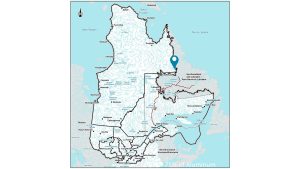
The company’s Crater Lake Project is located in Quebec, about 200km north of the town of Schefferville. The project has significant blue-sky potential both in the amount of scandium-oxide that can be produced as well as the life of the mine.
The project has progressed from an exploration stage to a development stage over the last few years. A preliminary economic assessment (PEA) on the project was released in 2022, a 43-101 resource estimate update was filed in June 2023 and work to complete a pre-feasibility study is currently underway.
The current life of mine is 25 years with over 40 years in potential resources; however, this is based on the resource estimate contained within a 350m long zone in one of multiple showings identified within the 47km² mining rights owned. The project’s full strike zone is 14km in length. The potential for significant growth in the project capacity is untested, as there are multiple additional zones to drill. The company feels it has barely scratched the surface of the project’s full potential.
At present, the resource is open in all directions and at depth where it thickens and gets richer in concentration. The company will run an in-fill drilling programme for the summer 2024 season to convert inferred resources to be measured and indicated in the TG Zone, where the initial mine will be developed.
The Provincial Governments of Quebec, Newfoundland, and Labrador, as well as the Government of Canada currently offer numerous grant programmes specifically for critical minerals projects. These grants are designed to support mine development and construction. The grants cover infrastructure, ground work, and technology implementation. These grants require a percentage of matched funds to be raised by the company. Scandium Canada has submitted applications in for a number of these relevant grants.
Relationship with First Nations
The corporation is aware of and adheres to the principles of the United Nations Declaration on the Rights of Indigenous Peoples as recently ratified by Canada, particularly with regards to obtaining the free, prior, and informed consent of the Indigenous peoples for the development and use of their lands, territories, and other resources.
The corporation recently signed a pre-development agreement with the Naskapi Nation of Kawawachikamach in order to establish a framework, through various undertakings to continue the current relationship in a mutually beneficial manner with regards to the corporation’s activities on the Crater Lake property.
Furthermore, in the spirit of current and future co-operation, the corporation and the Naskapi Nation of Kawawachikamach have negotiated that pre-development agreement to be a binding declaration of the principles they intend to build on for the negotiations of a final agreement – a Socio-Economic Participation Agreement (SEPA), also commonly known as an Impact and Benefit Agreement (IBA) for the property – at the earliest reasonable opportunity and before the commencement of any construction works.
Upcoming catalysts
This year’s focus will be the Pre-Feasibility Study (PFS) and activities that support the PFS completion. On site work will include geotechnical work and infill drilling, as metallurgical pilot tests are being conducted in Lakefield SGS facilities. On site work will begin in early summer 2024.
In addition, the company will continue to seek potential partnerships and pursue ongoing discussions with communities to advance pre-development agreements.
Please note, this article will also appear in the 18th edition of our quarterly publication.
S34I is an innovative European project that seeks to increase Europe’s autonomy in raw materials resources by utilising advanced data-driven techniques for analysing Earth observation (EO) data.
The backbone of Europe’s economy lies in its raw materials. They provide a robust industrial foundation, producing a diverse range of goods and applications that are a part of our daily lives and modern technologies. However, the availability of certain raw materials remains a growing concern both within the EU and throughout the world. It’s essential to ensure reliable and unrestricted access to these materials to maintain a stable and flourishing economy.
European raw materials are crucial
Europe has always been dependent on other regions for its raw materials, which makes it vulnerable. However, a new project called S34I, which was launched in January 2023 and co-ordinated by the University of Oporto, aims to increase Europe’s autonomy in raw materials resources by utilising advanced data-driven techniques for analysing Earth Observation (EO) data.
The project leverages Copernicus and other satellite sensors (including optical and radar) for data collection, while other platforms like airborne, low altitude platforms, ground-based, in-situ techniques/methods, and fieldwork are used to complement Copernicus data or for calibration and validation purposes. The S34I project’s primary focus is on systematically exploring minerals and continually monitoring extraction, closure, and post-closure activities to improve European knowledge and autonomy on raw materials resources. Additionally, the project seeks to improve social acceptance of mining (SLO) and promote better legislation.
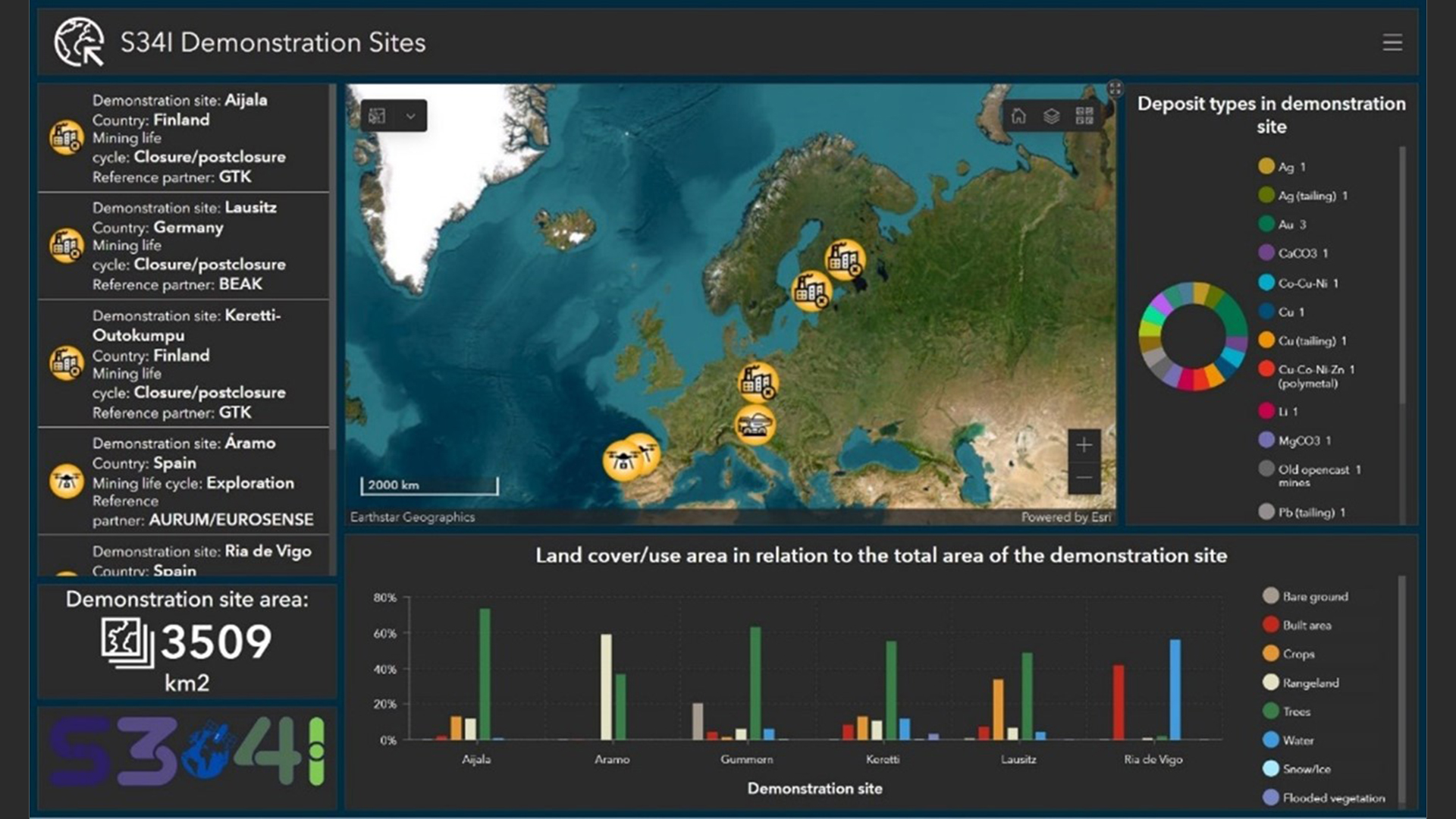
S34I is developing technical experiments and pilot validations/demonstrations for six pilot use cases, including Onshore Exploration, Shallow Water Exploration, Extraction, and Closure/Post-Closure:
Onshore Exploration (Áramo, Spain): Using artificial intelligence (AI)techniques like support vector machine (SVM), random forest (RF), and artificial neural networks (ANN), the project aims to map potential Cobalt (Co) target areas using various satellite-based datasets. This includes leveraging self-organising maps (SOM) for preprocessing exploration datasets and combining geological and remote sensing models to detect hydrothermal alterations associated with Co.
Shallow Water Exploration (Ria de Vigo, Spain): AI/ML techniques are utilised to post-process UHI data to establish a spectral library for ground-truthing and correlate it with onshore EO data. Geological studies help in identifying promising areas for placer deposit occurrences.
Extraction (Gummern, Austria): The project aims to improve volume mapping of mining waste deposits and monitor ground instability using techniques like Structure from Motion (SfM) photogrammetry and InSAR methods, respectively. Additionally, mineral stockpile volume estimation is performed using satellite photogrammetry and 3D-stereo images.
Closure/Post-Closure (Lausitz, Germany and Keretti-Outokumpu, Finland): Advanced AI techniques such as SBAS-InSAR and predictive modelling are employed for ground instability mapping and Acid Mine Drainage (AMD) prediction.
Earth observation data is key
The project’s methodology involves conducting multi-scale and multi-platform analysis of EO data, which is harmonised to meet EU data quality standards. Prototype processing pipelines are currently under development for three service categories: mapping raw materials deposits, providing early warnings for risk reduction, and monitoring environmental changes.
S34I uses advanced AI techniques, such as SBAS-InSAR and predictive modelling, to create a comprehensive view of ground instability mapping and Acid Mine Drainage (AMD) prediction. The project is also paying special attention to enhancing geological integration at the land-sea interface and ensuring open access to research datasets.
Ultimately, the project aims to demonstrate the value of its results to stakeholders by promoting secure and sustainable raw materials supply to Europe while enhancing resilience and reducing dependence on non-EU sources.
S34I is the perfect example of how innovation and technology can help boost Europe’s self-reliance and ensure that it remains a leader in raw materials resources.
Please note, this article will also appear in the 18th edition of our quarterly publication.
The European Commission has signed an agreement with Australia to collaborate on sustainable critical and strategic minerals.
The EU and Australia signed a Memorandum of Understanding (MoU) that will see bilateral cooperation to reinforce critical raw materials supply chains.
The MoU was signed by the EU’s Executive Vice-President and Commissioner for Trade Valdis Dombrovskis, Commissioner for Internal Market, Thierry Breton, and Australia’s Resources and Northern Australia Minister Madeleine King, and Minister for Trade and Tourism Don Farrell.
The collaboration will cover all aspects of the critical and strategic minerals value chain, including exploration, extraction, processing, refining, recycling, and extractive waste processing.
Valdis Dombrovskis commented on the landmark agreements: “Australia is a like-minded partner and a global leader when it comes to critical raw materials.
“This partnership marks a major step forward in our efforts to secure a more sustainable supply of critical raw materials for the EU whilst fostering investment in Australia.
“Our MoU focuses on integrated value chains, boosting research and innovation for both sides as well as sustainable production. This will also help us to deliver the green and digital transition.”
Partnership objectives
This partnership seeks to enable the EU to diversify its supply of materials necessary for green and digital transitions while contributing to the development of Australia’s domestic critical minerals sector.
The partnership will develop projects along the entire value chain in the EU and Australia.
It will also explore cooperation in countries where the EU and Australia have mutual interests, focusing on reducing environmental impacts and benefiting local communities.
Additionally, it promotes innovative and digital technologies and services for mining and other projects along the critical minerals value chain.
Reinforcing critical and strategic minerals supply chains
This MoU enhances cooperation between Australia and the EU in several key areas.
Firstly, it integrates sustainable raw materials value chains by networking, jointly facilitating projects through joint ventures, creating new business models, and promoting trade and investment linkages. This ensures well-functioning, sustainable, and resilient critical supply chains.
Secondly, it encourages cooperation on research and innovation along the raw materials value chains, focusing on mineral knowledge and minimising environmental and climate impacts.
Thirdly, it promotes high environmental, social, and governance standards and practices, as well as improved policy alignment, with full respect for worker conditions and safety, ensuring sustainable and secure production of critical minerals.
Thierry Breton commented: “I trust the signature of this partnership will send a strong message across the entire raw materials ecosystem in the EU and in Australia.
“It will boost cooperation, investments, and business opportunities. We aim for more sustainable and responsible production and real industrial integration of value chains between the EU and Australia, supporting competitiveness.
“We now need to move forward swiftly and work together with governments and the private sector to unlock the full investment and business potential.”
The Bradshaw Research Institute for Minerals and Mining discusses its impressive research agenda that sets out to tackle the complex issues facing mining innovation.
Global consumption of raw materials is set to rise by a further 60% by 2060, having already increased fourfold since 1970, according to the United Nations.
We live in a material world and cannot avoid this reality. A new era for energy with renewable technologies and decarbonisation requires massive amounts of mining, but it also requires new mining methods to address mining’s legacy and future.
According to the International Energy Agency, the amount of metals and minerals required for each kilowatt of generation capacity has risen by 50% since 2010, and electric cars require six times more minerals than traditional combustion engines.
Current mining is increasingly difficult due to the depletion of existing deposits, new locations that are environmentally and socially sensitive, increasing depths of mines, reduced grades, increasing energy and water requirements, and a short supply of relevant skilled workers.
The mining industry is facing increased scrutiny and needs new solutions that understand the interconnected problems to sustainably meet the world’s demand for metal and minerals.
A new research institute is rising to meet the challenges.
BRIMM connects scientists, engineers, and social scientists across the University of British Columbia (UBC) to promote cross-disciplinary research spanning the entire life-cycle of mining, from early exploration to mine closure and rehabilitation.
With more than 300 years of combined expertise from its founder, Dr Peter Bradshaw, Director, Dr John Steen, and members of the Advisory Board, BRIMM has a deep network for making industry and academic connections with groundbreaking research.
Research themes
BRIMM focuses on specific research themes to address the complex variety of issues facing the mining industry.
Research themes: 1. Sustainable energy systems 2. Mining microbiome 3. Water stewardship 4. Natural capital and biodiversity
Each theme is led by leading academics who focus their team on applicable research to deliver economic, social, and environmental benefits for the mining industry.
Sustainable energy systems
Mining consumes massive amounts of energy. The entire mining industry consumes approximately 12 ExaJoules (EJ) per year or 3.5% of total final energy consumption globally, or 1961.47 million barrels of oil equivalent (MBOE).
Comminution in mineral processing alone can use up to 1% of total final energy consumption globally, equivalent to the energy consumed by 221 million typical United Kingdom homes.
The mining industry is under pressure to decarbonise its operations. Mining companies pledged to achieve net-zero emissions targets in the coming decades.
However, this commitment coincides with rising demand for minerals and metals for renewable energy technologies while costs at mining operations are increasing due to declining ore grades and deeper mines. The industry’s energy consumption is expected to rise, complicating efforts to achieve net zero emissions.
This research theme focuses on energy efficiency improvements, renewable power generation, energy storage, renewable-powered transportation, carbon capture, and comprehensive carbon accounting and reporting.
BRIMM’s approach emphasises a systems perspective on energy and carbon, recognising that each mine will require a customised system of technologies to achieve decarbonisation.
The mining microbiome
For 300 years, scientists viewed microorganisms as ubiquitous but harmless or disease agents to be eliminated. But, new research is revealing how these microbes could help us tackle the mining industry’s biggest challenges.
Most copper is refined through furnace smelting, which contributes to air and water pollution. However, about 20% of the world’s copper now comes from hydrometallurgy, which uses strong acids and, increasingly, bacteria that can naturally leach the red metal.
Some bacteria can convert selenium dissolved in water into a solid form, which is easier to keep out of the water cycle.
Rio Tinto has supported multiple research to find biotechnological ways to recover metals from mine-influenced water.
Some microbes can help suppress dust by binding fine sand particles together, making the air safer to breathe; others can help mining companies extract certain metals they weren’t looking for before, like rare earth elements that are essential to many green technologies.
There are an estimated nonillion prokaryotic microorganisms on Earth. This abundance surpasses the number of stars in the known universe, the number of neurons in our brains, and all of our synapses combined.
There is an entire micro-universe to explore, yet research labs have barely developed the capacity to explore and map this new frontier and understand microbes’ capabilities.
To discover and track these organisms, the Canadian government’s Digital Supercluster initiative has formed the cross-industry Mining Microbiome Analytics Platform (M-MAP). Teck, BGC Engineering, Rio Tinto, and Allonnia are participating, as well as the Centre for Excellence in Mining Innovation, Koonkie Canada, Genome BC, and UBC.
The partnership’s goal is to extract DNA from 15,000 mine site water, rock, and soil samples, sequence it, and create an online platform for storing and analysing the data.
Water stewardship
Surface and groundwater are important resources for human life and health. Mining activities have the potential to compromise the safety of these resources.
Mining consumes large quantities of water. Water is critical to every stage of the mining cycle, from exploration to production.
However, the mining industry’s need for water will conflict with communities. Managing and reducing the risks associated with water usage is a top priority for mining companies and communities.
According to the World Economic Forum, a shortage of clean fresh water presents serious global, societal, and economic risks over the next decade. By 2030, the global population is expected to reach 8.5 billion and could face a water shortfall of 40%.
Using global data from the U.S. Geological Survey (USGS), at least 16% of the world’s land-based critical mineral mines, deposits, and districts are located in areas already facing high or extremely high levels of water stress.
BRIMM is in a unique position to focus on water because of the extensive expertise already present across the UBC campus. Recently, a cross-campus cluster was established, the Future Waters Research Excellence Cluster.
Natural capital and biodiversity
An individual mining company’s focus on the lowest-cost models may be missing its largest costs and opportunities.
Sustainability solutions in the mining and forest sectors are usually studied in isolation, which provides a partial picture of mining’s true impact.
Greg Paradis’s research at BRIMM strives to develop a nuanced understanding that balances higher costs against the broader benefits that those investments might offer.
Greg Paradis partnered with Newmont Mining to conduct a year-long study into nature-based decarbonisation opportunities across five Canadian mining sites.
Paradis is taking a holistic approach to carbon-capture strategy, studying not only sequestration techniques but also biodiversity, job creation, and reconciliation opportunities for First Nations communities.
His approach is a multi-dimensional analysis that weighs a wide range of factors to create high-value, low-cost solutions to help mining companies stabilise their carbon-capture portfolios and minimise the cost of their decarbonisation commitments.
Paradis hopes to create a sustainable development framework that balances effectiveness, cost, environmental impact, and social considerations.
A network for success
BRIMM consistently proves the value of its network and multiplied every dollar invested to date by at least tenfold, leveraging small amounts of funding to obtain larger grants to support its research.
In six years, BRIMM has: • Delivered up to 10 times leverage for each invested dollar, resulting in $3.5m in additional research investments in 2023 alone, • Funded 19 leading-edge projects based on four research themes, • Facilitated 1,000 learners from more than 50 countries to participate in cross-disciplinary micro-certificates, • Developed an extensive network of mining experts, including an international board of advisors, to source ground-breaking ideas and provide direction, • Instigated three start-up companies.
An invitation to partner in mining innovation
Universities serve as hotbeds of innovation and entrepreneurship, nurturing a culture that encourages the exploration of new ideas and the creation of spin-off ventures based on cutting-edge research.
Industry collaborations with universities provide companies with access to a pool of talented people, such as researchers, scientists, and students, who can contribute new ideas, perspectives, and skills.
By partnering with universities, companies can tap into this entrepreneurial ecosystem and potentially benefit from the commercialisation of research.
Material resources are finite, but the potential for research and innovation is infinite. Contact BRIMM to work on the future of mining innovation.
Dr Peter Bradshaw
Dr Peter Bradshaw has served the mining industry with distinction for more than forty years as a mine-finder, company builder, and advocate of collaborative research and science, as well as by working effectively with local and Indigenous people.
Dr John Steen
Dr John Steen has served as the BRIMM Director since July 2020. Before that, he spent a year as the BRIMM Ambassador from the Norman B. Keevil Institute of Mining Engineering.
Ali Madiseh
Ali’s research includes the study of various mechanical and energy systems with a specific emphasis on the mining and petroleum industries.
His research team focuses on developing novel solutions for maximising energy efficiency, improving system performance, preventing energy waste, and replacing fossil fuels with renewable energies.
He focuses on geothermal, wind, and solar energy systems in mining, petroleum, and other industries and on developing new waste heat recovery and energy storage systems.
The goal is to use an integrated and interdisciplinary approach to help industries improve their processes, cut their operating costs, and reduce their environmental footprint.
Steve Hallam
Steven Hallam is a University of California Santa Cruz and MIT-trained molecular biologist, microbial ecologist, entrepreneur, and innovator.
With over 20 years of experience in field and laboratory research and innovation at disciplinary interfaces, Hallam is an Associate Professor in the Department of Microbiology and Immunology at the University of British Columbia, Canada, Research Chair in Environmental Genomics and Canadian Institute for Advanced Research Scholar in integrated microbial biodiversity, a programme dedicated to studying the molecular, morphological and community complexity of the microbial world.
Nadja Kunz
Nadja Kunz is an Assistant Professor and Canada Research Chair in Mine Water Management and Stewardship, jointly appointed by the School of Public Policy and Global Affairs and the Norman B Keevil Institute of Mining Engineering at UBC.
Nadja’s research goal is to quantify and mitigate the risks associated with the mining sector’s use of water from the perspective of diverse actors, including companies, investors, governments, Indigenous rights-holders, and communities.
Nadja adopts an interdisciplinary toolkit, ranging from the development of engineering and geospatial models to anticipate potential water-related risks to qualitative field and interview research to identify the constraints and opportunities for transitioning the mining sector towards more sustainable water and waste management practices.
Gregory Paradis
Gregory Paradis is an Assistant Professor of Forest Management in the Department of Forest Resources Management (Faculty of Forestry) at the University of British Columbia (UBC).
He uses a systems approach to modelling interactions between ecosystems, industrial supply chains, governments, and society. His research interests lie at the intersection of forest science, forest economics, forest and industrial engineering, data science, computer science, and operations research.
He obtained his PhD in Forest Science at Université Laval, where he also spent a year as a Postdoctoral Research Fellow. He has a B.Sc. Eng. Forest Engineering and an M.Sc. Forest Engineering from the University of New Brunswick.
Please note, this article will also appear in the 18th edition of our quarterly publication.
The ocean is a vastly important resource with an unfathomably large biodiversity. As humans look to take the minerals we need, it is up to organisations like ISA to ensure no harm comes to the marine environment.
The seabed holds various materials that are becoming increasingly important for the green transition, such as copper, gold, manganese, cobalt, and more. As demand for such materials increases, it is not unreasonable to expect ventures to look to mining these marine environments.
The International Seabed Authority (ISA) is a UN-established international organisation dedicated to the monitoring and protection of global marine environments in mineral-resource related activities.
The Innovation Platform’s Assistant Editor Matt Brundrett sat down with Jaimie Abbott, Communications Specialist at ISA to find out more about their work.
How does ISA help protect marine biodiversity in offshore mining operations?
Under UNCLOS, ISA has the mandate to protect the marine environment from harmful effects that may arise from activities in the area. For the last thirty years, ISA has developed and implemented a regulatory framework that ensures that activities in the area are carried out in a precautionary and environmentally responsible manner.
ISA’s efforts towards ensuring the protection and sustainable use of the area and its resources are demonstrated through the development, implementation, and review of regional environmental management plans (REMPs). REMPs aim to provide the relevant organs of ISA, as well as contractors and their sponsoring States, with proactive, area-based, and other management tools to support informed decision-making processes that balance resource development with conservation. They also provide ISA with a clear and consistent mechanism to identify particular areas thought to be representative of the full range of habitats, biodiversity and ecosystem structures and functions within the relevant management area.
More than ten years ago, ISA established an environmental management plan in the Clarion-Clipperton Zone. The plan includes a network of 13 areas of particular environmental interests covering 1.97 million km2 where no mining will be allowed. Further work is underway to establish similar plans in the Mid-Atlantic Ridge, the Indian Ocean, and the Northwest Pacific Ocean.
Under the exploration regulations, contractors are required to conduct environmental baseline studies, monitoring, and impact assessments.
ISA is also tasked with encouraging and promoting marine scientific research in the area, and in 2020 its 168 Member States unanimously adopted a comprehensive Action Plan for Marine Scientific Research to drive the work in this sphere. The Sustainable Seabed Knowledge Initiative of ISA is a flagship initiative for the implementation of the Action Plan, particularly focusing on generating new deep-sea biodiversity knowledge and enhancing deep-sea biodiversity assessments in support of the protection of the marine environment based on the best available science.
How does the ISA involve local communities in decisions and contribute to protecting their livelihoods?
Since its establishment 30 years ago, ISA’s decision-making process has been taking a multilateral and consensus-based approach, according to the rules and procedures established by UNCLOS and the 1994 Agreement. All state parties to UNCLOS are automatically members of ISA, which currently comprises 168 states and the European Union.
As of May 2024, ISA has 106 observers, including 29 observer states, 32 intergovernmental organisations, and 45 non-governmental organisations. The Assembly, the supreme organ of ISA, is attended by the Member States and observers. All can take the floor and express their views and positions. In addition, several stakeholder consultation processes have been undertaken, including as part of the process for the development of the current draft exploitation regulations (Mining Code) and one for the draft REMP for the northern Mid-Atlantic Ridge.
How does the ISA collaborate with scientists to safeguard deep-sea ecosystems from mining impacts?
In 2020 the ISA adopted an Action Plan for marine scientific research that serves a global agenda to progress deep-sea science.1 It comprises 6 strategic research priorities, including one that focuses specifically on enhancing scientific knowledge and understanding of the potential impacts of activities in the area. Under this strategic research priority, the Secretariat facilitates the further elaboration of scientific approaches and tools for cumulative impact assessments. Its continued work will advance the understanding of cumulative impacts from future exploitation activities and other stressors on different ecosystem components.
Since adopting the Action Plan for marine scientific research, the Secretariat has organised 29 events to promote scientific deep-sea research, encompassing online and in-person workshops, webinars, information series, and side events in global fora involving over 1,000 experts from all over the world. Additionally, 44 strategic partnerships were forged to deliver the MSR Action plan, and since 2020, 19 Member States and the European Union have provided support.
How does the ISA ensure equitable benefits for local populations in mining areas?
Deep-seabed mining represents a frontier of human activity with the potential to unlock vast mineral resources located on the ocean floor beyond national jurisdictions. As technological advancements pave the way for the exploration and extraction of these resources, questions regarding equitable benefit-sharing and environmental sustainability have come to the forefront of international discourse. ISA plays a key role in regulating deep-seabed mining activities and ensuring that the benefits derived from these activities are shared equitably among all members of the international community. Activities under the competence of ISA, including mining activities when they are authorised by member states, take place very far away from land and human communities. The four key points for this are:
Mining areas are not located near local populations: The international legal agreement known as UNCLOS, along with its 1994 Agreement, states that the ocean floor beyond any nation’s borders is owned by everyone on Earth. This idea is specifically mentioned in UNCLOS (Article 136) and more detailed in the 1994 Agreement’s introduction, stating that no single nation or local community owns these ocean resources – they belong to all of humanity. Consequently, the ISA oversees these areas to ensure that everyone benefits fairly rather than focusing on the needs of specific local groups. ISA has been established with the mandate of being the main body for overseeing activities such as seabed mining, if and when it will occur, in these international areas. Additionally, UNCLOS (Article 140) stresses that the benefits of activities in these international seabed areas should reach all humans, regardless of their country’s geographical location and whether they are coastal or landlocked. It also highlights the need to pay special attention to the requirements of developing countries and those not fully independent or self-governing.
Exploitation has not commenced yet: No deep-seabed mining activity has commenced anywhere in the world.
Sharing of benefits contemplates both monetary and non-monetary benefits: UNCLOS and the rules set by the ISA focus on ensuring that benefits from deep-seabed mining, both money and other types, are shared with everyone globally. As part of the development of the exploitation regulations, ISA is creating a Common Heritage Fund to support learning and skill-building about the ocean.
Collective Benefit System with Special Considerations: The ISA is dedicated to managing deep-seabed activities (prospection, exploration and exploitation) so that they benefit all of humanity. Its main goal is to make sure everyone around the world benefits fairly, but it also pays special attention to the needs of developing countries and small island states.
The ISA works to ensure that its approach to sharing benefits is fair, inclusive, and promotes sustainable development worldwide.
Overall, the ISA operates under a detailed set of rules provided by UNCLOS and the 1994 Agreement, which guide it in regulating seabed mining. This regulation aims to distribute both monetary and non-monetary benefits fairly, even though the mining may not occur near local populations.
What can you tell us about the DeepData database and its purpose?
The ISA’s DeepData database was launched in 2019, replacing and consolidating previous iterations of the databases maintained by ISA, namely POLYDAT and the Central Data Repository (CDR). In launching DeepData, ISA made publicly available for the first time the biggest and most complete global repository of environmental data and information collected in areas beyond national jurisdiction.
DeepData contains environmental data, which are publicly available, including biological, physical, and geochemical parameters of the marine ecosystems from the seafloor to the ocean surface. It also contains maps, photographs, videos, graphics, and relevant publications in peer-reviewed journals from ISA contractors. It has since served as an effective tool to facilitate the sharing of environmental data in an open and transparent manner, thereby advancing the scientific understanding of the area.
Today, ISA is the custodian of over ten terabytes of data through DeepData, representing the largest repository of seabed data in the world. Its data inventory has contributed significantly to the management of the area, including the development of REMPs.
ISA’s efforts towards advancing data and information sharing through DeepData were further promoted through strategic partnerships with other UN agencies and scientific organisations. For instance, the Secretariat launched the AREA2030 Initiative in partnership with the International Hydrographic Organization (IHO) to facilitate the high-resolution mapping of the Area by 2030.
ISA is also the first UN organisation to serve as a node for the Ocean Biodiversity Information System (OBIS) of IOC-UNESCO, sharing its biodiversity data with the OBIS network through DeepData. In terms of its contribution to OBIS, DeepData records currently account for over 89,000 occurrence records or 15% of data collected at depths below 3,000m.
What other key achievements or projects can you tell us about, and why are they significant?
ISA has been pioneering women’s empowerment for experts in deep-sea affairs from developing countries. The tangible activities the ISA launches in this domain impact the careers and lives of those experts. For example, ISA Contractors have a legal obligation to provide and fund training opportunities for personnel from developing States and those of ISA.2 This, combined with the other transformative action ISA facilitated in this domain, has enabled to build the capacity of more than 1,000 individuals from developing States since 1994. In addition, to date, 19 contractors pledged to allocate half of their placements in the Contractors Training Programme to women scientists. The women experts participating get training on the most advanced science and technology development in the field of the deep sea. Last year the ISA also launched a global mentoring programme that matches seasoned mentors with mentees from developing states.3 The pairs embarked on a one-year journey during which the mentor guided the mentee in her personal, professional, and scientific development. In the recently established ISA-Capacity Development Alumni Network4 (iCAN), professionals who enjoyed one of the ISA’s women empowerment initiatives shared their stories of how such an initiative transformed their lives, and a few experts were hired afterwards.
Arthur Leichthammer, Geoeconomics Policy Fellow at the Jacques Delors Centre, argues that the EU needs a strategic rethink to safeguard its critical raw materials supply as global competition intensifies.
European Commission President von der Leyen assumed office in 2019 with the European Green Deal as her flagship policy, setting out the path for the EU’s clean energy transition.
Within it, she stressed the strategic importance of achieving resilient and diversified supply chains for sustainable raw materials that form the basis of any industrial process.
As the name suggests, critical raw materials (CRMs) – those resources judged to be of high economic importance and exposed to high supply risk – are of special importance. CRMs are key for strategic sectors of clean technologies, digital, space, and defence utilisation and, as such, fundamental to delivering the ambitions of the Green Deal’s net-zero targets.
They make electronics, motors, generators, and batteries. For instance, rare earth elements are essential for the manufacturing of wind turbines, solar panels, and electronic devices.
At the same time, lithium and cobalt are crucial for battery production, powering electric vehicles and energy storage systems.
CRM and the green transition
As the green transition progresses, the demand for CRMs will radically increase. For instance, the EU’s lithium demand is expected to increase twelve-fold by 2030.
As it stands, the EU’s current CRM supply will not suffice to cover this surge. The EU is not alone in its decarbonisation efforts, as economies worldwide have committed to net-zero targets.
The International Energy Agency (IEA) estimates that the global energy sector’s need for critical minerals could quadruple by 2040. To satisfy this increased demand, the IEA estimates that by 2030, 388 new mining sites will have to be opened.
As demand is projected to outgrow supply growth, global competition is becoming increasingly fierce, and reliable CRM supply chains are emerging as cornerstones of the new renewable industrial ecosystem.
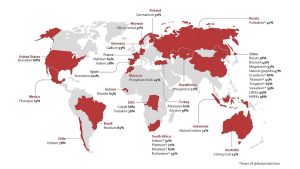
The European Union does not produce or refine nearly the volume of CRMs it requires for its industrial production. As such, the EU heavily relies on imports. More problematically, it relies on a handful of countries for key CRMs, both in production and refinement. This exposes it to supply disruptions and price volatility, amplifying vulnerabilities in critical sectors.
First and foremost, the dependency on China has emerged as a key concern for the EU. Not only is China a key producer in a range of CRMs, but perhaps more importantly, it has established itself as the primary centre for the refinement of most key minerals, processing 40% copper, 60% lithium, 70% cobalt, and close to 100% of the graphite used worldwide. The EU, for instance, imports close to 100% of its rare earths.
The great power competition between the US and China and the ensuing trade war is likely to accelerate the politicisation of critical raw materials.
As the West attempts to decrease China’s strategic stranglehold on CRM value chains, China is becoming increasingly assertive in both defending and utilising its strategic position in the CRM value chain.
In 2020, China became the country with the most restrictions on mineral exports.
In 2023 alone, China introduced rare-earth export restrictions for several types of graphite and doubled down with a new trade ban on rare-earth production equipment. Both restrictions were implemented, citing national economic security interests.
This follows the earlier export permit requirement for gallium and germanium, which were required to make chips last August, in a retaliatory move following the Dutch trade restrictions on advanced semiconductor equipment.
Fig 1: The concentration of the EU’s critical raw materials imports (Figure adapted from: European Commission (2020) Action Plan on Critical Raw Materials)
The EU’s first stab at reducing its dependencies
While the EU has long tried to secure reliable CRM supplies, adopting its ‘raw materials initiative’ in 2008, the described geopolitical developments, the supply chain disruptions of the Covid pandemic, and Russia’s invasion of Ukraine have propelled the issue of energy and supply chain resilience forward with force.
Aiming to diversify and foster new supply chains and reduce critical chokeholds of CRMs, the EU put forward its Critical Raw Materials Act (CRMA), finalising the legislative process in March 2024. The legislative framework aims to enhance the EU’s CRM supply via increased domestic capacities and international agreements, seeks to improve the EU’s supply chain monitoring, and improve the sustainability of CRM sourcing.
The CRMA sets out three key milestones for the EU’s domestic capacities by 2030:
10% of annual consumption derived from locally extracted materials
40% processed in the EU
25% derived from recycled materials.
Key to enhancing the EU’s domestic production, processing, and recycling capacities is a Strategic Projects framework that grants accelerated permitting procedures and is supposed to ease access to financial support.
Under the framework, firms apply for Strategic Project designation from a Critical Raw Material Board, which is hosted and funded by the Commission.
Once granted, projects receive European public interest status and streamlined planning and development processes. Authorities must decide on resource extraction projects within 24 months and processing or recycling projects within 12 months, with limited contingency time for complex applications.
It further foresees that financial risks are shared between project promoters, member states, and public financial institutions, involving partners like the European Investment Bank Group to provide recommendations on project preparation and financial assistance.
Furthermore, the Act empowers the EU to set environmental standards and screening criteria for raw materials mined, refined, and recycled within the European Union.
The CRMA also posits that a maximum of 65% of a strategic raw material at any relevant stage of processing should originate from a single third country. To enhance such reshoring efforts and reduce overly concentrated dependencies on single states, DG GROW is setting up a panel which, in co-ordination with the member states, will attempt to build on current raw materials partnerships and facilitate infrastructure projects.
Already having exempted the vast majority of CRMs from tariffs via its expansive network of free trade agreements and WTO provisions, strategic partnerships are becoming crucial for the EU to secure additional CRM supplies from trading partners.
Big ambitions – wrong tools
The new legislation provides a much-needed move to up the ante for the EU to address its dependencies.
However, it is likely to fall short of its ambitions for two reasons.
First, the predominant focus on accelerating permitting processes is unlikely to increase the speed of mining investments significantly. The exploration and construction phases of mining projects take several years, with the average mine taking around 15 years from exploration to completion.
So, even if the Act succeeds in chipping off a couple of months in the process by cutting bureaucratic red tape, it will take a long time for European mining projects to reduce European dependencies in a meaningful way.
Second, the Act lacks the financial power of comparable programmes, such as the US Inflation Reduction Act, which allocated over $8.5bn for CRM projects, or the significant financial means available to Chinese state-owned enterprises.
CRM projects are characterised by their need for hefty investments over extended periods and large downside risks regarding permitting and social and environmental risks. On the other hand, CRMs are subject to high price volatility, as seen in the collapse in lithium prices over the last ten months, increasing investment uncertainty.
While the CRMA foresees provisions for firms to lock in prices at which they can sell their resources, it is unclear how this would look in detail and how it would be financed. Without greater financial reassurances, firms are likely to continue their reluctance to make the required investments.
Further, the Act misses out on generating new incentives for additional incentives to crowd in private risk capital, for example, via tax credits.
Amidst the inability to pledge significant funds on a European level, it is left to national capitals to generate investments towards the long-term supply of the needed materials.
Germany, France, and Italy all pledged national financial resources via dedicated funds, Germany and Italy committing one billion each and France two billion euros. In the summer of 2023, they also created a working group to co-ordinate better future possibilities to source critical raw materials collectively. This has the potential to foster projects akin to the Important Projects of Common European Interest (IPCEIs), which allows multiple member states to channel state aid into technology projects of common European interest.
A national approach, however, risks underinvestment for member states with limited fiscal headspace. The production of CRMs is a European public good, supporting the EU’s economy and its resilience.
To achieve the ambitious targets set out in the CRMA and to generate sufficient production capacities, the development of CRM value chains across the EU must be strengthened.
The next Commission needs a strategic rethink on critical raw materials
To turn the ambitious political ambitions of the CRMA into actionable policy, the EU must step up financing. Having made European Investment Bank financing eligible for all steps of the CRM value chain in July 2023 is an important first step. The EU taxonomy, as of now, only includes the recycling of critical raw materials.
Adding mining and refining under the condition of high environmental standards could help generate private investment.
However, without additional public financial support in the form of equity and guarantee support that could underwrite greater investment, it is unlikely to channel greater financial resources to CRM projects.
More importantly, even if significant financial resources could be leveraged to support domestic extraction, it will realistically only make a small contribution to enhanced resilience.
A reliable import strategy from a diversified pool of international partners will continue to be critical in satisfying European demand. As such, the next Commission should focus on four things.
First, it will be essential to pursue strategies according to specific prioritisation according to individual CRMs. What is needed is a detailed analysis of what materials should be domestically sourced, for which CRMs international partnerships can be developed, and for which the EU can build a diversified supply network.
Indiscriminately pursuing the EU’s significant involvement in all parts of the value chain for all CRMs will not be possible due to capacity restrictions, long lead times, and insufficient financial backing.
Second, in the next legislative cycle, EU instruments should be equipped with enough financial prowess to accelerate research and development in processing and recycling facilities with a focus on sustainable practices. To that end, the EU should develop available funding instruments.
Horizon Europe, for example, facilitates early-stage financing to develop sustainable mining and CRM substitution. Leveraging additional financial means should be used to support the development of low-carbon technological efforts beyond those initial investment needs and allow such ventures to scale.
Third, pursuing more diversified CRM partnerships and co-operation agreements will be crucial. The EU has been busy signing agreements with Canada, the DRC, and Zambia and committed to establishing future ones, as last seen in the joint statement with Australia on energy cooperation in early April 2024.
Following up on initial ideas of forming an international ‘Critical Raw Materials Club’, the EU joined the Minerals Security Partnership (MSP), initiated by the US and which includes partners such as South Korea and the UK. In April 2024, the MSP members alongside Kazakhstan, Namibia, Ukraine, and Uzbekistan announced the launch of the MSP Forum, pledging greater co-operation regarding CRMs.
The Forum sets out a project group aimed at supporting the implementation of CRM projects and policy dialogue to enhance the regulatory framework for sustainable sourcing projects.
However, the EU is playing catch-up. China has been developing its CRM network with significant investments for the past two decades, firmly establishing Chinese companies throughout supply and value chains. This has led to substantial control over upstream activities, including mining and primary smelting and refining processes.
The EU can make up for lost time by offering more attractive partnership conditions. Mineral-rich countries have increasingly been affirmative about gaining a larger share of the value chain within their economies.
Since 2022, more than a dozen African countries have imposed export restrictions or bans on CRMs, while over the last decade global export restrictions have quintupled.
The EU should thus convince third states of increased co-operation via expansive co-investment with a focus on increasing upstream activities and supporting third states with advanced mineral processing technologies, developed via concerted R&D efforts, and targeting those CRMs the EU has limited potential to develop domestically.
The extraction and processing of CRMs often entail significant environmental and social impacts. There have been widespread reports of mines across the globe in which both human rights and environmental standards have been disregarded. With the newly agreed Corporate Sustainability Due Diligence Directive (CSDDD) that introduces comprehensive human rights and environmental due diligence obligations throughout value chains or the Carbon Border Adjustment Mechanism (CBAM), facilitating sustainable technology and practices will not only underline the EU’s global climate agenda and offer third states additional incentives to pursue partnerships with the EU.
It will be legally imperative and costly to ignore.
Fourth, the next Commission should attempt to influence corporate supply behaviour, something the CRMA omits. Private European firms currently underinvest in supply chain resilience and do not yet see diversification as a priority. The EU should build on the mechanism introduced in its Net-Zero Industry Act, which incentivised member states to recognise non-price considerations, making subsidies reliant on diversification or placing a larger emphasis on resilience criteria for public procurement scoring for CRM projects.
Securing reliable and secure critical raw material supply chains will be a decisive factor in determining Europe’s industrial future. As European capitals increasingly recognise the importance of CRMs, the Critical Raw Materials Act constitutes an important step towards remedying the unfolding supply challenges.
However, as it stands, it is insufficient. Following June’s European election, the newly constituted Commission will have to overcome the member states current reluctance to pool greater financial means on a European level, which is fundamental to achieving greater domestic production and offering attractive and sustainable international partnerships.
Please note, this article will also appear in the 18th edition of our quarterly publication.