Tag: The Innovation Platform Issue 18

  • Concord University launches materials and REE Analysis Center

    Concord University launches materials and REE Analysis Center

    [ad_1]

    The Analysis Center is developing innovative new materials-characterisation technology and expanding the suite of analytical techniques available regionally to support REE resource exploration and workforce development.

    Since 2022, the Concord Materials and Rare Earth Element Analysis Center has gone from concept to implementation, initiated with more than $800,000 in federal and state funding in the first two years and with additional funding pending. The project is managed by geoscience professors Dr Stephen Kuehn and Dr Joseph Allen and by chemistry professor Dr Rodney Tigaa. The team brings together expertise in regional geology, materials characterisation, and development of REE-based technologies.

    Extracting rare earth elements from coalfields

    Rare earth elements (REEs) are widely used in numerous high-technology applications and are subject to growing demand. National and industry interests also seek to diversify REE supply chains.

    One source of great interest is the extraction of REEs from coal and from the byproducts of coal mining and use, including waste rock, coal ash, acid mine drainage, and treatment residues. The coalfields of the Appalachian region in the eastern US are a key target of exploration for REE resource development.

    These potential resources are centred around the states of Kentucky and West Virginia, along with several bordering states, and the central portion historically had the highest levels of coal production.

    In 2017, a U.S. Department of Energy report outlined three major requirements for the economic development of REEs from coalfields:

    1. Location and identification of sources with the highest REE concentrations,
    2. Characterisation of where and in what forms those REEs are present to inform extraction techniques, and
    3. Development of improved technologies to recover and concentrate REEs from the raw source materials.

    Meeting these goals depends in part on effective, reliable, and routine analytical methods to quantify the spatial distributions and REE abundances in large volumes of natural and produced materials, including both solids and liquids. Optical, X-ray, and mass-spectrometry, along with electron microscopy, are among the most commonly used techniques for this testing. As the potential resources are spread across large geographic areas of coal fields, scaling up pilot efforts to wide-scale, systematic exploration and development will be analytically intensive.

    The Analysis Center: Providing infrastructure and expertise

    The Concord Materials and Rare Earth Element Analysis Center is ideally located to help meet the increasing need for materials characterisation. The Center is located in southern West Virginia, close to Appalachian metallurgical coal fields, meaning that samples could be collected from mine sites and then delivered to the lab on the same day.

    The Center also builds on existing facilities and available expertise. Concord University has been on a path to expand instrumentation in support of education, research, and economic development for two decades. Major goals of the new Center include advancing the capabilities of microanalytical instrumentation through new hardware and software innovations, expanding the availability of additional analytical tools and techniques, supporting natural resource exploration and development, and building the next-generation workforce.

    The new Ge diffracting crystalrare

    By establishing core infrastructure, the Center will further enhance economic development by attracting and supporting new research enterprises and facilitating the development of regional REE natural resources.

    Since 2010, Concord University has operated the only electron probe microanalysis (EPMA) laboratory in West Virginia, which serves as a cornerstone of the multi-instrument Analysis Center. An EPMA is a specialised type of scanning electron microscope capable of imaging and high-precision X-ray spectroscopy at target dimensions as small as 1/1000th of a millimetre.

    Developing technologies

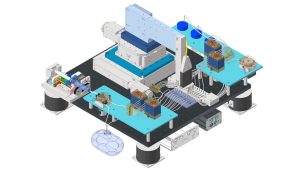
    As part of the Center’s goal of advancing analytical instrumentation, a series of EPMA hardware and software innovations are planned and under development for 2024-2026. In February this year, the Center accepted delivery of one of the first of these innovations, a high-performance X-ray-diffracting crystal manufactured from pure Germanium.

    The new Ge diffracting crystal enhances X-ray spectroscopy capabilities by providing greater signal intensity, better separation of closely-spaced REE X-ray spectral lines, and suppression of spectral interferences. This results in improved element specificity and lower limits of detection, both of which are needed to quantify REE concentrations in coalfield materials. The Ge crystal was manufactured by Rigaku Innovative Technologies of Auburn Hills, Michigan and installed by Advanced Microbeam Inc. of Vienna, Ohio. This is the first end-client installation of this new hardware.

    Detailed testing, qualification, and method development are underway and will be summarised in a presentation, ‘Improved EPMA Analysis of Rare Earth and Trace Elements Using a New Precision Germanium WDS Crystal,’ scheduled for delivery at the Microscopy and Microanalysis 2024 conference in Cleveland, Ohio in late July.

    A collaborative, comprehensive learning environment

    Concord University students and faculty, visiting researchers, and industry users can utilise existing Concord Materials and Rare Earth Element Analysis Center capabilities now. They will be able to take advantage of additional capabilities as they come online incrementally.

    We welcome collaborations to demonstrate commercial applications of the new analytical capabilities and hope to bring some of the prototype hardware-software advancements to market in co-operation with key partners.

    Since Concord University is also a teaching institution, the analytical instruments are frequently used for university coursework in geology, chemistry, and physics, as well as for collaborative student, faculty, and industry research projects. This provides students with first-hand experiences with major analytical instrumentation, basic materials research, and development, which build in-demand skills for direct entry to the workforce or advanced graduate-level study.

    Please note, this article will also appear in the 18th edition of our quarterly publication.

    [ad_2]

    Source link

  • A lack of mining innovation threatens the energy transition

    A lack of mining innovation threatens the energy transition

    [ad_1]

    The Bradshaw Research Institute for Minerals and Mining discusses its impressive research agenda that sets out to tackle the complex issues facing mining innovation.

    Global consumption of raw materials is set to rise by a further 60% by 2060, having already increased fourfold since 1970, according to the United Nations.

    We live in a material world and cannot avoid this reality. A new era for energy with renewable technologies and decarbonisation requires massive amounts of mining, but it also requires new mining methods to address mining’s legacy and future.

    According to the International Energy Agency, the amount of metals and minerals required for each kilowatt of generation capacity has risen by 50% since 2010, and electric cars require six times more minerals than traditional combustion engines.

    One wind turbine requires 4.7 tons of copper and 335 tons of steel, and to meet net-zero emissions goals until 2050, the world will need as much copper as humanity has mined since 1900.

    Current mining is increasingly difficult due to the depletion of existing deposits, new locations that are environmentally and socially sensitive, increasing depths of mines, reduced grades, increasing energy and water requirements, and a short supply of relevant skilled workers.

    The mining industry is facing increased scrutiny and needs new solutions that understand the interconnected problems to sustainably meet the world’s demand for metal and minerals.

    A new research institute is rising to meet the challenges.

    A new research legacy for mining

    The Bradshaw Research Institute for Minerals and Mining (BRIMM) was founded in 2017 to create a new legacy for the mining industry.

    BRIMM connects scientists, engineers, and social scientists across the University of British Columbia (UBC) to promote cross-disciplinary research spanning the entire life-cycle of mining, from early exploration to mine closure and rehabilitation.

    With more than 300 years of combined expertise from its founder, Dr Peter Bradshaw, Director, Dr John Steen, and members of the Advisory Board, BRIMM has a deep network for making industry and academic connections with groundbreaking research.

    Research themes

    BRIMM focuses on specific research themes to address the complex variety of issues facing the mining industry.

    Research themes:
    1. Sustainable energy systems
    2. Mining microbiome
    3. Water stewardship
    4. Natural capital and biodiversity

    Each theme is led by leading academics who focus their team on applicable research to deliver economic, social, and environmental benefits for the mining industry.

    Sustainable energy systems

    Mining consumes massive amounts of energy. The entire mining industry consumes approximately 12 ExaJoules (EJ) per year or 3.5% of total final energy consumption globally, or 1961.47 million barrels of oil equivalent (MBOE).

    Comminution in mineral processing alone can use up to 1% of total final energy consumption globally, equivalent to the energy consumed by 221 million typical United Kingdom homes.

    The mining industry is under pressure to decarbonise its operations. Mining companies pledged to achieve net-zero emissions targets in the coming decades.

    However, this commitment coincides with rising demand for minerals and metals for renewable energy technologies while costs at mining operations are increasing due to declining ore grades and deeper mines. The industry’s energy consumption is expected to rise, complicating efforts to achieve net zero emissions.

    According to estimates from S&P Global Clean Energy Technology, the mining sector could use up to 180 TWh of additional clean energy from the current levels.

    This research theme focuses on energy efficiency improvements, renewable power generation, energy storage, renewable-powered transportation, carbon capture, and comprehensive carbon accounting and reporting.

    BRIMM’s approach emphasises a systems perspective on energy and carbon, recognising that each mine will require a customised system of technologies to achieve decarbonisation.

    The mining microbiome

    For 300 years, scientists viewed microorganisms as ubiquitous but harmless or disease agents to be eliminated. But, new research is revealing how these microbes could help us tackle the mining industry’s biggest challenges.

    Most copper is refined through furnace smelting, which contributes to air and water pollution. However, about 20% of the world’s copper now comes from hydrometallurgy, which uses strong acids and, increasingly, bacteria that can naturally leach the red metal.

    Some bacteria can convert selenium dissolved in water into a solid form, which is easier to keep out of the water cycle.

    Rio Tinto has supported multiple research to find biotechnological ways to recover metals from mine-influenced water.

    Some microbes can help suppress dust by binding fine sand particles together, making the air safer to breathe; others can help mining companies extract certain metals they weren’t looking for before, like rare earth elements that are essential to many green technologies.

    There are an estimated nonillion prokaryotic microorganisms on Earth. This abundance surpasses the number of stars in the known universe, the number of neurons in our brains, and all of our synapses combined.

    There is an entire micro-universe to explore, yet research labs have barely developed the capacity to explore and map this new frontier and understand microbes’ capabilities.

    To discover and track these organisms, the Canadian government’s Digital Supercluster initiative has formed the cross-industry Mining Microbiome Analytics Platform (M-MAP). Teck, BGC Engineering, Rio Tinto, and Allonnia are participating, as well as the Centre for Excellence in Mining Innovation, Koonkie Canada, Genome BC, and UBC.

    The partnership’s goal is to extract DNA from 15,000 mine site water, rock, and soil samples, sequence it, and create an online platform for storing and analysing the data.

    Water stewardship

    Surface and groundwater are important resources for human life and health. Mining activities have the potential to compromise the safety of these resources.

    Mining consumes large quantities of water. Water is critical to every stage of the mining cycle, from exploration to production.

    The copper mining industry alone withdrew over 1.3 billion m3 of water in 2006, half of the water that London, England, consumes every day.

    However, the mining industry’s need for water will conflict with communities. Managing and reducing the risks associated with water usage is a top priority for mining companies and communities.

    According to the World Economic Forum, a shortage of clean fresh water presents serious global, societal, and economic risks over the next decade. By 2030, the global population is expected to reach 8.5 billion and could face a water shortfall of 40%.

    Using global data from the U.S. Geological Survey (USGS), at least 16% of the world’s land-based critical mineral mines, deposits, and districts are located in areas already facing high or extremely high levels of water stress.

    BRIMM is in a unique position to focus on water because of the extensive expertise already present across the UBC campus. Recently, a cross-campus cluster was established, the Future Waters Research Excellence Cluster.

    Natural capital and biodiversity

    An individual mining company’s focus on the lowest-cost models may be missing its largest costs and opportunities.

    Sustainability solutions in the mining and forest sectors are usually studied in isolation, which provides a partial picture of mining’s true impact.

    Greg Paradis’s research at BRIMM strives to develop a nuanced understanding that balances higher costs against the broader benefits that those investments might offer.

    Greg Paradis partnered with Newmont Mining to conduct a year-long study into nature-based decarbonisation opportunities across five Canadian mining sites.

    Paradis is taking a holistic approach to carbon-capture strategy, studying not only sequestration techniques but also biodiversity, job creation, and reconciliation opportunities for First Nations communities.

    His approach is a multi-dimensional analysis that weighs a wide range of factors to create high-value, low-cost solutions to help mining companies stabilise their carbon-capture portfolios and minimise the cost of their decarbonisation commitments.

    Paradis hopes to create a sustainable development framework that balances effectiveness, cost, environmental impact, and social considerations.

    A network for success

    BRIMM consistently proves the value of its network and multiplied every dollar invested to date by at least tenfold, leveraging small amounts of funding to obtain larger grants to support its research.

    In six years, BRIMM has:
    •   Delivered up to 10 times leverage for each invested dollar, resulting in $3.5m in additional research investments in 2023 alone,
    •   Funded 19 leading-edge projects based on four research themes,
    •   Facilitated 1,000 learners from more than 50 countries to participate in cross-disciplinary micro-certificates,
    •   Developed an extensive network of mining experts, including an international board of advisors, to source ground-breaking ideas and provide direction,
    •   Instigated three start-up companies.

    An invitation to partner in mining innovation

    Universities serve as hotbeds of innovation and entrepreneurship, nurturing a culture that encourages the exploration of new ideas and the creation of spin-off ventures based on cutting-edge research.

    Industry collaborations with universities provide companies with access to a pool of talented people, such as researchers, scientists, and students, who can contribute new ideas, perspectives, and skills.

    By partnering with universities, companies can tap into this entrepreneurial ecosystem and potentially benefit from the commercialisation of research.

    Material resources are finite, but the potential for research and innovation is infinite. Contact BRIMM to work on the future of mining innovation.

    Dr Peter Bradshaw

    Dr Peter Bradshaw has served the mining industry with distinction for more than forty years as a mine-finder, company builder, and advocate of collaborative research and science, as well as by working effectively with local and Indigenous people.

    Dr John Steen

    Dr John Steen has served as the BRIMM Director since July 2020. Before that, he spent a year as the BRIMM Ambassador from the Norman B. Keevil Institute of Mining Engineering.

    Ali Madiseh

    Ali’s research includes the study of various mechanical and energy systems with a specific emphasis on the mining and petroleum industries.

    His research team focuses on developing novel solutions for maximising energy efficiency, improving system performance, preventing energy waste, and replacing fossil fuels with renewable energies.

    He focuses on geothermal, wind, and solar energy systems in mining, petroleum, and other industries and on developing new waste heat recovery and energy storage systems.

    The goal is to use an integrated and interdisciplinary approach to help industries improve their processes, cut their operating costs, and reduce their environmental footprint.

    Steve Hallam

    Steven Hallam is a University of California Santa Cruz and MIT-trained molecular biologist, microbial ecologist, entrepreneur, and innovator.

    With over 20 years of experience in field and laboratory research and innovation at disciplinary interfaces, Hallam is an Associate Professor in the Department of Microbiology and Immunology at the University of British Columbia, Canada, Research Chair in Environmental Genomics and Canadian Institute for Advanced Research Scholar in integrated microbial biodiversity, a programme dedicated to studying the molecular, morphological and community complexity of the microbial world.

    Nadja Kunz

    Nadja Kunz is an Assistant Professor and Canada Research Chair in Mine Water Management and Stewardship, jointly appointed by the School of Public Policy and Global Affairs and the Norman B Keevil Institute of Mining Engineering at UBC.

    Nadja’s research goal is to quantify and mitigate the risks associated with the mining sector’s use of water from the perspective of diverse actors, including companies, investors, governments, Indigenous rights-holders, and communities.

    Nadja adopts an interdisciplinary toolkit, ranging from the development of engineering and geospatial models to anticipate potential water-related risks to qualitative field and interview research to identify the constraints and opportunities for transitioning the mining sector towards more sustainable water and waste management practices.

    Gregory Paradis

    Gregory Paradis is an Assistant Professor of Forest Management in the Department of Forest Resources Management (Faculty of Forestry) at the University of British Columbia (UBC).

    He uses a systems approach to modelling interactions between ecosystems, industrial supply chains, governments, and society. His research interests lie at the intersection of forest science, forest economics, forest and industrial engineering, data science, computer science, and operations research.

    He obtained his PhD in Forest Science at Université Laval, where he also spent a year as a Postdoctoral Research Fellow. He has a B.Sc. Eng. Forest Engineering and an M.Sc. Forest Engineering from the University of New Brunswick.

    Please note, this article will also appear in the 18th edition of our quarterly publication.

    [ad_2]

    Source link

  • Synergy of recycling technologies for a circular plastics industry

    Synergy of recycling technologies for a circular plastics industry

    [ad_1]

    To achieve a circular plastics industry, no ‘one-size-fits-all’ solution will do, but a combination of different approaches will be required.

    In 2022, 400.3 Mt of plastics were produced worldwide (Source: Plastics Europe). Unsurprisingly, consumers and legislative authorities are demanding change and more careful use of resources to achieve a plastics industry that is as climate-neutral as possible. The Institute for Materials Technology and Plastics Processing (IWK, part of OST-Eastern Switzerland University of Applied Sciences) is working on contributing to this goal.

    The competence spectrum of the IWK is divided into the following eight research fields: Injection Moulding/PUR, Compounding/Extrusion, Composite Technology/Lightweight Construction, Joining Technology, Metal Manufacturing Technologies, 3D-printing/Additive Manufacturing, Simulation & Design, and Material Analysis & Component Testing.

    The ambition for all the competence areas is to combine science and practice for innovative industrial-oriented, close-to-production solutions and, through that, address the current challenges of the plastics industry with optimised materials, material combinations and production technologies.

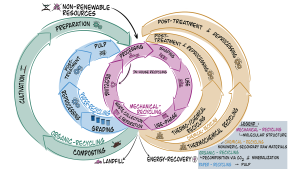
    Alongside reduction and reuse, recycling is one of the most important strategies for achieving the goal of a circular and sustainable plastics economy. The Compounding and Extrusion team at the IWK, led by Professor Daniel Schwendemann, focuses on a holistic approach to identifying the most suitable pathway for circularity for each customer-specific application. In the upcoming paragraphs, some exemplary projects are presented. Each of them explores a different recycling route based on the following graphic.

    Mechanical recycling – Is it possible to close the loop or even upcycle?

    Mechanical recycling is a well-established process in the plastics industry in which products at their end of life are collected, cleaned, sorted, and converted into new raw materials again. While the ideal scenario would be a cradle-to-cradle material flow or even an upcycling of the used material, for most of the applications, mechanical recycling is either associated with down-cycling or there are no recycling streams at all.

    circular plastics industry
    Fig. 1: Plastic Recycling Loops

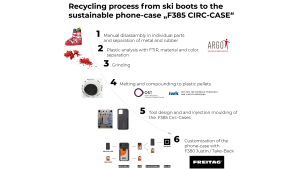
    The F385 CIRC-CASE IPHONE®, a phone cover made from discarded ski boots, which was developed in co-operation of IWK with FREITAG®, is one of the projects addressing this issue and demonstrates that a closed loop circle for old TPU ski boots is feasible.

    In the first step, the ski boots are collected and sorted at ARGO in Davos (a workshop for people with disabilities). The boots are disassembled, and all metal parts are separated. Afterwards, the polymer type is detected with the help of FTIR, and the parts are sorted by colour and shredded in a mill. The obtained flakes are then processed in the compounder at the IWK to remove possible residual contamination and to receive homogenous pellets.

    The iPhone covers, which are then produced via injection moulding, are made of 100% recycled TPU and can be recycled again at their end-of-life within Freitag’s established Take-Back system.

    In addition to creating a closed material loop, the project also shows the potential of local production since the whole value creation takes place within 150km around Zurich in Switzerland.

    One of the major challenges in mechanical recycling is odour reduction, especially for polyolefin materials like PE and PP. In a project with Tide Ocean SA and the IWK, possible process optimisations and material modifications were evaluated. The goal was for the ocean-bound rPE and rPP material from Tide Ocean SA to fulfil the high requirements of the automotive industry standard VDA270.

    plastics
    Fig. 2: Recycling process – From ski boots to iPhone case

    As part of a defined set of experiments, different screw configurations, degassing options, activation concepts, and the application of an entertainer for the removal of volatile organic compounds (VOC; source of odour development) were tested. As a result, material and process optimisation concepts were developed to meet the requirements of VDA270.

    In addition to this project, Tide Ocean SA and IWK developed an innovative upcycling process and quality standards for collecting, sorting, compounding, and injection moulding that allows the production of high-quality products from ocean-bound rPET. The granules can replace virgin plastics without loss of quality in a variety of production processes, including 3D printing, textile fabrication, and injection moulding.

    An example of successful co-operation is a watch from Maurice Lacroix, in which the bezel, housing, crown, end, and closure parts are made from recycled ocean-bound rPET material.

    Organic recycling – What is the impact of bioplastics?

    The use of bioplastics to replace conventional fossil-based materials is by now state-of-the-art in the plastics industry. However, bioplastics are also associated with various controversies, including competition with food and unclear disposal/recycling routes. The FluidSolids AG is tackling this by offering materials based on secondary resources that are 100% home-compostable. Together with the IWK, the compounding process was optimised, and scale-up was achieved. Disposable cutlery made of FluidSolids material can be found in Swiss supermarkets today.

    Paper recycling – Paper as a replacement for plastics?

    Especially in the field of packaging, regulations and consumers are pushing for a reduction in the use of plastics and a change to alternative materials. In that context, paper and paper-based materials are gaining increasing importance and potential for the polymer industry. However, replacing plastics with paper is not trivial since the material and processing properties are completely different.

    Founded by the ‘Neue Regionalpolitik’ (NRP) of the canton Fribourg, the IWK, together with the iRAP (Haute école d’ingénierie et d’architecture Fribourg) and 11 companies investigated the feasibility of the potential of paper in plastic processes. Existing paper-based materials were analysed, and their processability was tested successfully (injection moulding, extrusion, thermoforming).

    Challenges and needed adaptions regarding tools, material composition, and process parameters were identified and translated into the next steps, which are currently being worked on in follow-up projects. The project showed that while paper-based materials will certainly not replace plastics in all (packaging) applications, they are a useful addition to the existing material and property portfolio.

    Chemical recycling – the future?

    Chemical recycling is one of the big hopes for a circular plastics industry since it offers the possibility of recycling mixed plastic waste and getting recycled materials with virgin properties, something that is (currently) not possible with mechanical recycling.

    There is a variety of chemical recycling processes available, but none of them are on a commercial scale yet. This makes a final comparison between chemical and mechanical recycling regarding their environmental impact nearly impossible. However, it must be expected that chemical recycling will most likely have a higher energy demand and should, therefore, only be installed as a complementary recycling route to mechanical recycling, for example, in textile recycling, where mechanical recycling is difficult due to the often-high cotton content.

    Fig. 3: Maurice Lacroix Aikon Tide Blue Black (Source: Maurice Lacroix; #tide)

    Summarising: the plastics industry has several possible pathways toward circularity. No ‘circle’ should be favoured above another one without considering the boundary conditions of the individual application. All the more, the synergies between the existing as well as emerging recycling technologies can act as a positive driver for sustainability.

    Please note, this article will also appear in the 18th edition of our quarterly publication.
    [ad_2]

    Source link

  • Localised solutions to plastic waste to drive a circular economy

    Localised solutions to plastic waste to drive a circular economy

    [ad_1]

    Plastic waste is a vast and increasingly urgent issue. The Alliance to End Plastic Waste discusses the urgency of the issue and what must be done to tackle it.

    Just over a century since the first fully synthetic plastic was patented, the material is now ubiquitous in daily life. Plastic serves many purposes in essential industries, whether it be to prolong the shelf life of perishable food, enable safe and effective medical care, reduce the weight of and improve performance in automotives, and more.

    However, plastic consumption has become intrinsically correlated with economic growth and, coupled with the lack of waste management for 2.7 billion people, the ensuing waste has become a serious challenge. Today, plastic production is 460 million tonnes per year, up from two million tonnes in 1950. Of this, 360 million tonnes of plastic waste are generated annually, with 70% remaining uncollected, either leaking into the environment, dumped in landfills, or, even worse, openly burned.

    One solution to eliminate plastic pollution is to establish collection and then disposal into properly managed landfills or use as waste-to-energy in the incineration of organic waste. A more visionary approach, however, is to create a circular economy for plastics.

    Conceptualised by the Ellen MacArthur Foundation, a circular economy involves a shift from the current linear model of take-make-dispose to one that encourages reduce-reuse-recycle. In a circular economy model, materials and products are kept in use and circulation for as long as possible, ensuring that plastic waste is not simply disposed of but valorised. The economic case is clear: according to the UN Environment Programme’s (UNEP) Global Waste Management Outlook 2024, a circular economy approach will see a projected annual net gain of $108.1bn. Perhaps more importantly, a circular economy will enable a significantly lower carbon footprint and hence contribution to mitigate climate change.

    Global overview of plastic waste management by region
    Global overview of plastic waste management by region

    Recycling is the engine that drives circularity

    The first levers in transitioning to a circular economy are to reduce plastic usage where there is a low benefit to society (for example, over-packaging) and to establish multiple rather than single-use where possible.

    These will mitigate but will not eliminate the challenge of post-use waste. Recycling will also be a strong component of the circular economy for plastics, helping to extend the economic value of existing items. Keeping existing materials in the loop reduces the need for new raw materials, cuts down overall greenhouse gas emissions, and reduces plastic production. Ultimately, renewable sources of energy and feedstock will be utilised, creating an increasingly bio-based, green economy.

    However, current plastic recycling rates in most countries are far lower than needed to achieve full circularity, with over 60% of countries recycling less than 10% of all plastic waste generated. This can be attributed to underdeveloped or inadequate waste management capacity, exacerbated by factors driving growth in plastic consumption – individual wealth, urbanisation, population growth, and the lightweight, versatility, performance, and low cost of plastics versus other materials.

    Without robust waste management systems in place, much plastic waste remains uncollected, resulting in environmental leakage. The collection of clean and sortable waste is also a key to enabling recycling at scale. Often, plastic waste is not cleaned and segregated at the source, which leads to contamination and the need for downstream sorting, impacting the efficiency and quality of the resulting recycled plastic, as well as the economics of recycling.

    No silver bullet solution for countries tackling plastic waste

    Addressing this management challenge must be approached with the understanding that there is no one-size-fits-all solution to plastic waste. Effective solutions build on each country’s strengths and focus on interventions with the most significant potential for positive impact.

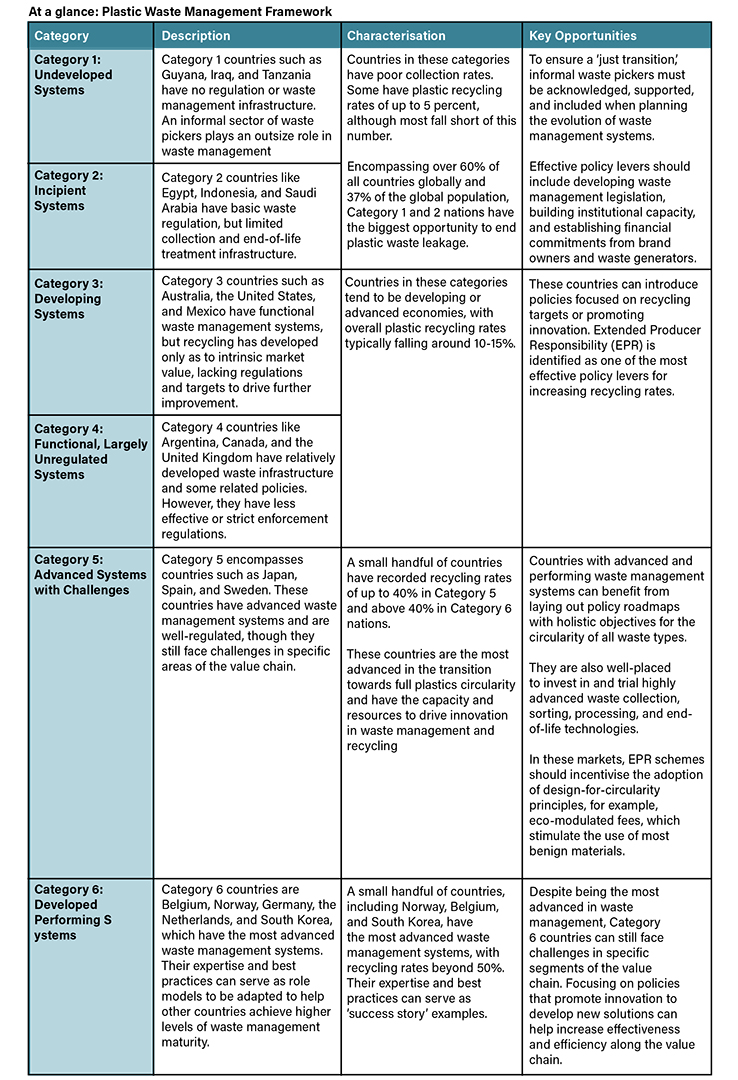
    To support these efforts, the Plastic Waste Management Framework outlines 27 actions and policies that can reduce plastic waste leakage and increase recycling rates. Developed by the Alliance to End Plastic Waste with the support of Roland Berger, the study, based on a meta-analysis of 192 countries, identified six categories of waste management and recycling maturities globally.

    The efficacy of Extended Producer Responsibility

    Opportunities for improvement exist at every stage of maturity, but in particular, Category 3 and 4 countries such as the UK, the US, and Canada can significantly increase plastic recycling rates through thoughtfully developed and well-implemented EPR schemes.

    Defined as an environmental policy approach in which a producer’s responsibility for a product is extended to the post-consumer stage of its life cycle, EPR has proven to be one of the most effective policy instruments for increasing recycling rates and transitioning into a circular economy. EPR helps enforce shared responsibility across the plastic value chain, including brands and retailers and promotes sustainable design, the financing of waste management infrastructure, and effective collection and recycling. There have been instances where recycling rates for packaging and items such as Waste from Electrical and Electronic Equipment (WEEE), tyres, and batteries saw increases of up to 15-25% over a 10-15-year period.

    Public-private collaboration is crucial in operationalising an EPR system that is efficient, financially sustainable, and technically feasible. EPR schemes work best when co-designed, driving alignment across the entire spectrum of the value chain, including brand owners, waste collectors, recyclers, municipalities, and regulators.

    Whilst the scheme is likely to be industry-led, governments should provide reliable oversight to ensure transparency and accountability and establish a level playing field across all participants and alternative materials to encourage the adoption of the best environmental approach. The maintenance of EPR systems across the value chain often faces resourcing constraints. Authorities must ensure that collected fees are ring-fenced and funnelled back solely into resource management, including improving waste management and recycling solutions.

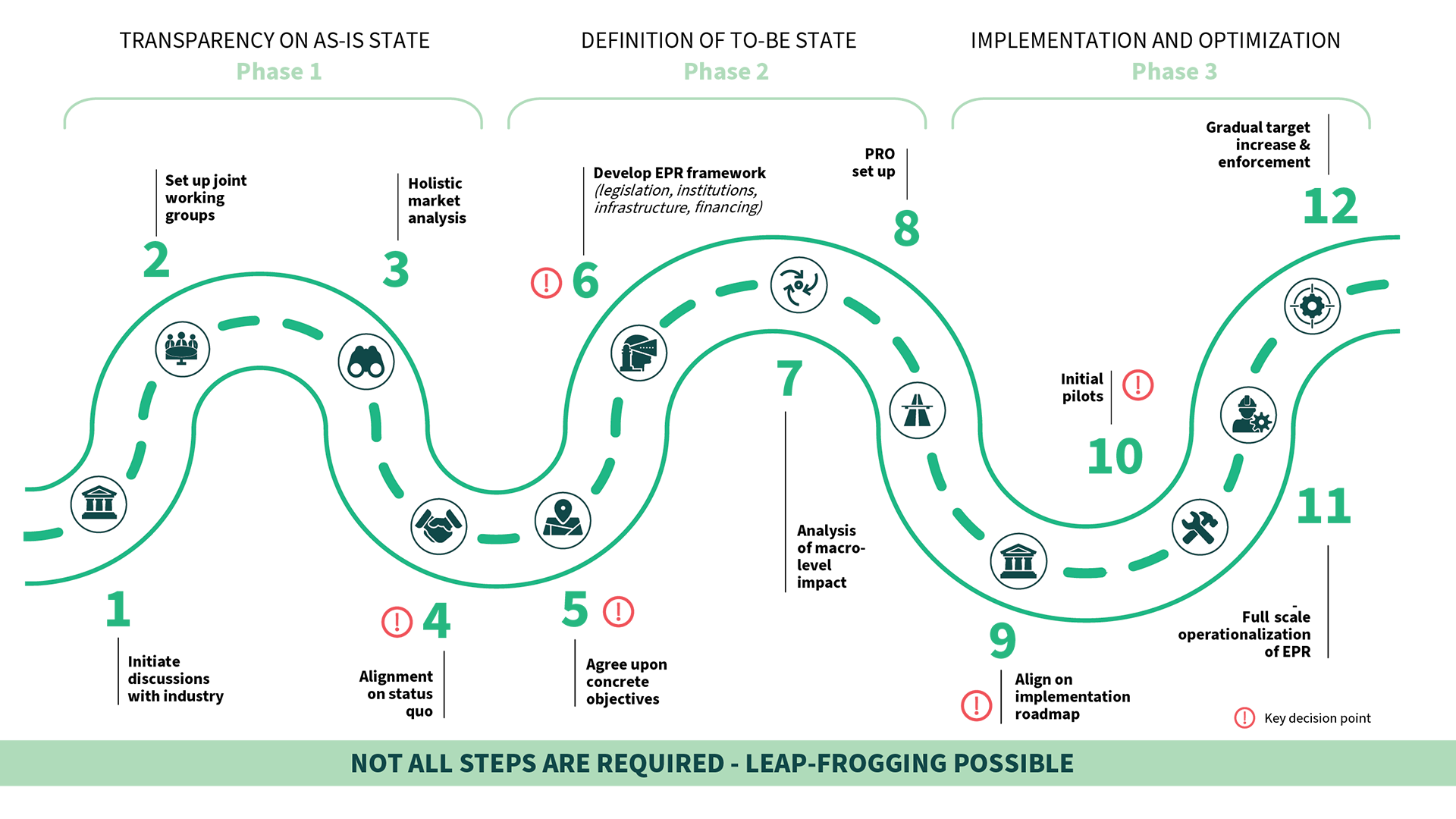
    EPR implementation roadmap

    For early-stage countries that are less well-equipped to ensure legitimate use of funds and manage complex and comprehensive legislations, EPR schemes may have to be voluntary. Alternatives such as plastic credits or green bonds could be deployed. With greater maturity, schemes should also become mandatory to ensure equal applicability to all players and to level the playing field. Most advanced schemes should adopt eco-modulated fees in which the cost of EPR to a brand or retailer varies according to the cost of post-use management of the packaging and products they put onto the market.

    An effective way to fulfil the obligation to manage packaging and products after use is a Deposit Return System (DRS), which requires consumers to pay a deposit when purchasing a single-use or reusable/refillable container and receive a refund once the container is returned. Schemes are also emerging in which there is no deposit, but a fee is levied if the article is not returned within a specified period.

    In the US, states with DRS systems for PET beverage bottles account for 27% of the US population but provide 61% of all PET bottle recycling in the country. The approach has been successfully implemented in Europe, North America, and Australia and can be voluntary or mandated. To date its most common use is limited to beverage bottles such as polyethylene terephthalate (PET) bottles, as well as non-plastic packaging, including aluminium cans and glass bottles, but extension to other materials is increasingly common, and include supporting reuse/refill as well as recycling.

    With the latest draft of European Union legislation on packaging and packaging waste mandating the introduction of DRS in all EU countries by 2029 (unless they reach a 90% collection rate for beverage packaging), DRS is increasingly in focus for many countries within the European Union. Countries like Romania, Ireland, Hungary, Austria, Greece, and Poland have recently passed DRS legislation, with the UK also set to implement its own DRS system. To enable effective implementation, it is important to determine the appropriate deposit amount as it strongly influences the return rates, in particular at the start of a scheme where it is important to create consumer habits.

    Closing the loop with innovative technologies

    Category 6 countries, which include Germany, Norway, Belgium, the Netherlands, and South Korea, are the most advanced in the transition towards full plastic circularity. However, this journey cannot end here. These nations possess the capacity and resources required to drive innovation and pioneer new technology and capital-intensive solutions to address every aspect and different application of post-use plastic. Recycling rates are entirely dependent on the ability to efficiently provide streams of feedstock of suitable quality, in particular for mechanical recycling. Where collection of segregated feedstock through take-back schemes, including DRS, is not feasible, sorting becomes critical, for example, for the recycling streams collected from household waste. Primary sorting of plastics using optical and spectroscopy for detection and pneumatic sorting at municipal materials recycling facilities (MRFs) are already well established. However, the demand for high-quality recyclates will only be met by more granular sorting, which requires secondary sorting facilities to be established, taking feedstock from a network of primary MRFs and utilising increasingly sophisticated detection and sorting technologies, enabled by digitalisation and deployment of AI.

    Digital watermarks on packaging

    Some companies are already trialling advancements in sorting technologies, such as the use of digital watermarks and artificial intelligence-enabled object recognition to digitalise supply chains, further enhancing existing waste management systems.

    One such instance of this is the HolyGrail 2.0 project. Driven by AIM – European Brands Association, and powered by the Alliance to End Plastic Waste, HolyGrail utilises digital watermarks – postage stamp-sized codes that carry information about the packaging material, printed on plastic packaging, and imperceptible to the naked eye.

    Recent trials indicate a 99% detection rate and a 93-95% purity of sorted materials. When adopted at scale, these digital watermarks can potentially differentiate each different type of plastic article and packaging that enters the market. This enables highly specific sorting and identification of material attributes such as the types of polymer, additives, and adhesives used, plus conformance with standards such as food-contact regulations, recyclability norms, etc.

    Access to such sophisticated sorting and information will enable step-changes in the quality of recycled products, although it will take time to establish the infrastructure and logistics to fully materialise the benefits.

    Thinking even more strategically, such digital identification at every point in the value chain, from retailer to consumer to collector to recycler, provides a sort of digital passport. In addition to being used by retailers and consumers, this would provide accurate information on actual recycling rates at the level of specific products and brands, which would inform businesses and governments on the effectiveness of their systems, focus the efforts of Producer Responsibility Organisations (PROs), and enable the determination of eco-modulated EPR fees based on real recycling rate data.

    Catalysing the impact needed to advance circularity

    One organisation cannot solve the plastic waste problem alone. Only a collaborative, co-ordinated, and sustained effort by governments, industry, and civil society can prevent or mitigate plastic waste at scale. By convening stakeholders across the plastic value chain, the Alliance to End Plastic Waste supports and collaborates with partners across geographies with varying levels of waste management capabilities to implement workable solutions that can bring about systems change.

    Gathering the technological, economic, and social lessons from our projects in countries spanning the categories of waste management capabilities derived from the Framework, the Alliance has developed a series of Solution Model playbooks that serve as blueprints for systems change. These playbooks draw on real-world learnings to document what is possible and what is needed to increase plastic recycling rates.

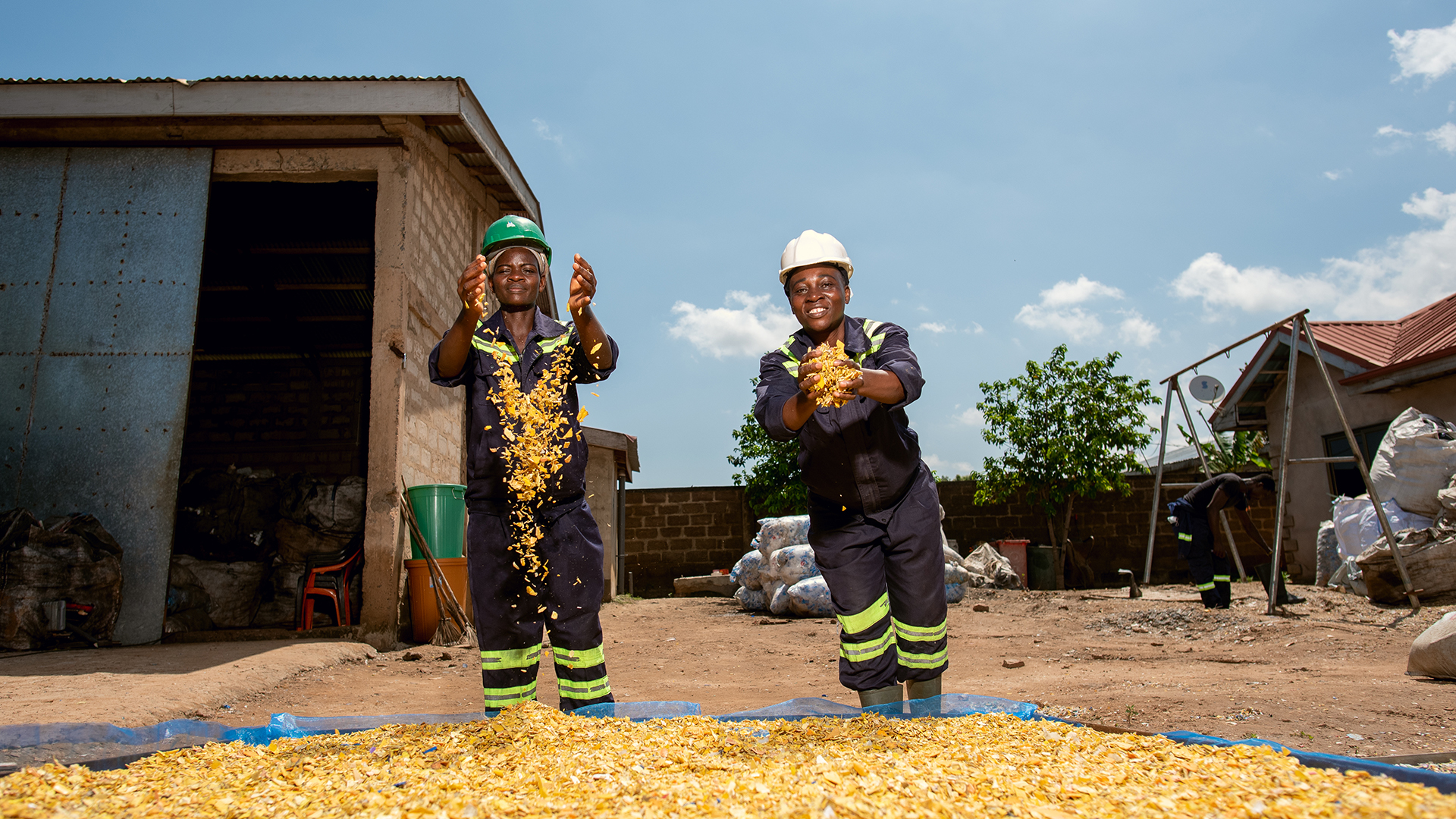
    ASASE Foundation in Ghana

    From policy levers to ecosystem conditions, business models, and innovation, Solution Model playbooks identify the enabling conditions for success to encourage other organisations to adapt and replicate the best practices outlined. The intent is to inform, inspire, and collaborate with a wider network of partners to further develop, strengthen, and scale these Solution Models, catalysing the impact of reducing unmanaged waste and capturing value from this waste to create social benefit and mitigate climate impact.

    UNEP has affirmed its intent to finalise the draft of the International Legally Binding Instrument on Plastic Pollution by the end of the Fifth Intergovernmental Negotiating Committee (INC-5) which concludes in December this year. As we move to tackle the pervasive issue of plastic waste and transition towards full plastic circularity, a nuanced approach tailored to each country’s circumstances is the key to unlocking the plastic waste problem.

    What we do today matters, and there is no better time to act than now. Through collaborative efforts, innovative solutions, and effective regulation, nations worldwide can forge a path towards a more circular future.

    Please note, this article will also appear in the 18th edition of our quarterly publication.

    [ad_2]

    Source link

  • Optimising green fuel cells in the fight for sustainability

    Optimising green fuel cells in the fight for sustainability

    [ad_1]

    Bramble Energy recently completed an APC-funded project to optimise fuel cell stack construction, advancing hydrogen in the fight for sustainability.

    In a recent press release, Bramble Energy disclosed the success of a project that developed their Printed Circuit Board Fuel Cell technology, leading to the development of an optimised fuel cell stack assembly capable of producing up to 2,000 50kW stacks per year.

    The Innovation Platform’s Assistant Editor, Matt Brundrett, sat down with Dr Tom Mason, CEO of Bramble Energy, to discuss hydrogen power and its future, along with Bramble’s place in it.

    Hydrogen holds immense potential for clean energy applications but also faces challenges. What is the best way to address these challenges?

    The biggest challenge we’re facing now is cost reduction. Efforts are centred on reducing the cost of hydrogen production and distribution to make it more competitive against conventional fuels. To do this, technological innovation is paramount, and more investment in research and development is needed to improve hydrogen production technologies, such as electrolysis.

    Looking at the EPO-IRENA ‘Innovation trends in electrolysers for hydrogen production’ report, investment costs for electrolyser plants can be slashed by up to 40% in the short term and 80% in the long term through various strategies. Whether it’s through improved design, economies of scale, material substitution, enhanced efficiency, or operational flexibility, if we can make electrolysis cheaper, we can make green hydrogen cheaper and more accessible on a large scale. This affordability will not only drive widespread adoption of hydrogen fuel as a clean energy carrier but also facilitate its integration into various sectors, including transportation, industry, and energy storage.

    However, we also need the cost of renewables to fall further to work with electrolysis technologies. Again, more R&D is needed to drive costs down, such as developing next-generation solar panels with higher efficiency and lower manufacturing costs or more efficient wind turbine designs.

    Policy support is vital here – with government policies and incentives playing a crucial role in driving down the cost of renewables – but it is also needed to promote the adoption of hydrogen fuel cells and encourage investment in infrastructure and technology development. Supportive policies such as subsidies, tax incentives, and regulations all help drive innovation in the renewable energy sector.

    As the hydrogen economy continues to evolve, there are concerns regarding the sustainability and scalability of hydrogen production methods. What is being done to minimise any environmental impacts that the creation of hydrogen and hydrogen fuel cells may have?

    Currently, 98% of the world’s hydrogen production is grey – the environmental impact of which is huge given the release of CO2. With the urgency of addressing climate change and transitioning to a low-carbon economy, there’s a growing recognition that we need to phase out grey in favour of green.

    To scale up the production of green hydrogen – which should be the ultimate goal – we need continual innovation and collaboration between policymakers, public institutions, and private investors. Also, looking at the changes in electrolysis technology, there needs to be more focus on the use and development of electrolyser types that are not reliant on precious metals and difficult materials so that we do not create more issues later down the road. And the same goes for fuel cell technology.

    Bramble’s recent press release mentions its commitment to creating commercially viable solutions for the transportation sector. Considering the infrastructure required for the widespread adoption of hydrogen fuel cell vehicles, what strategies is Bramble Energy employing to facilitate the development of hydrogen refuelling stations and infrastructure?

    Bramble Energy sees the development of the hydrogen economy as a vital piece of a clean energy future, which is why our PCB-X™ Platform technology works not only with the development of fuel cells but electrolysers as well. Our goal is to work to deliver an end-to-end solution to further close the gap that currently hinders the successful integration of these clean energy solutions into mainstream use.

    fuel cells

    We also choose to work with prominent OEMs and the global markets who have made strides in supporting these innovations but are also developing the required infrastructure concurrently.

    Hydrogen fuel cells are often touted as a key technology for decarbonising hard-to-abate sectors such as heavy industry and long-haul transportation. How does Bramble Energy envision the role of hydrogen fuel cells in these sectors, and what are the main challenges to be addressed in scaling up hydrogen adoption outside of the automotive industry?

    Hydrogen has the ability to completely revolutionise the way in which we transport goods and people across the globe. Because of its centralised refuelling nature, hydrogen fuel cells could also be deployed at rail, marine, and aero depots. But there is no silver bullet technology. As such, I think we need to place importance on developing fuel cells for the correct applications and where they make the most sense.

    It’s also important to remember that since the inception of commercial hydrogen fuel cell products, the landscape has been dominated by industry costs, which—as mentioned—are the largest barrier to widespread adoption. Simply put, even in hard-to-abate sectors such as transportation, until costs are aggressively slashed, they will continue to stand in the way of implementing hydrogen technologies at scale.

    The cost of hydrogen fuel cells has been decreasing, but it remains higher than conventional technologies. How can the cost of hydrogen fuel cells be reduced further to make them more viable?

    Bramble Energy’s main offering focus is decreasing the cost of manufacturing hydrogen fuel cells. This target has defined and continues to define Bramble Energy’s business to date.

    Bramble Energy’s PCB-based fuel cell technology aims to solve this problem by using a revolutionary approach to the design, materials selection, and manufacturing routes not only for fuel cells – the engines of the hydrogen economy – but also for the production of hydrogen through electrolysis.

    By using a standardised Printed Circuit Board (PCB) material set, we’re able to achieve an inherent cost advantage compared to the competition. Firstly, we have the enormous economies of scale inherent within these materials, and secondly, we’re able to utilise a pre-existing manufacturing route – which means no CAPEX investment is required.

    Collaboration and policy support are essential for the success of the hydrogen economy. How does Bramble Energy engage with policymakers, industry stakeholders, and research institutions to advocate for policies that promote the development and adoption of hydrogen fuel cell technology?

    As a spin-out of two world-leading institutions, Bramble Energy recognises the importance of the work being carried out at institutions globally to develop groundbreaking technology and highlight the threat of climate change.

    As such, we’ve delivered and continue to work with the government on projects that help shape and further policy focused on the development of the hydrogen economy.

    Prominent industry players are making substantial strides in fuel cell technology and also have the global reach to deploy at scale, which is why we form partnerships with identified partners to remove those existing barriers to mass deployment.

    Please note, this article will also appear in the 18th edition of our quarterly publication.

    [ad_2]

    Source link

  • Castrol ON EV Thermal Fluids help prevent thermal propagation

    Castrol ON EV Thermal Fluids help prevent thermal propagation

    [ad_1]

    The shift to electrification across the automotive sector has intensified moves to improve battery system technologies to facilitate mainstream EV adoption.

    The selection of a thermal management system is key as it dictates the operational limits of the battery pack and its performance under failure scenarios. Castrol have carried out significant research into the thermal propagation of battery modules with different thermal management approaches to develop their range of Castrol ON EV Thermal Fluids for immersion cooling.

    This latest work compared battery cooling via indirect water-glycol baseplate cooling with the increasingly popular immersion cooling. Indirect cooling with water-glycol is already well established as the major cooling concept used in today’s EV architectures, due to considerable technology carryover from internal combustion engine cooling systems. However, immersion cooling is now being seen as more effective in tackling temperature management requirements during fast charging of new-generation EVs and improving performance of premium EVs.

    Much of the previous work within the industry of immersion cooling has focused on cylindrical cells given their ease in adopting immersion cooling. However, Castrol’s latest work focused on demonstrating immersion cooling’s performance under failure scenarios with prismatic cells considering their use by major automakers such as VW, Tesla, Stellantis.

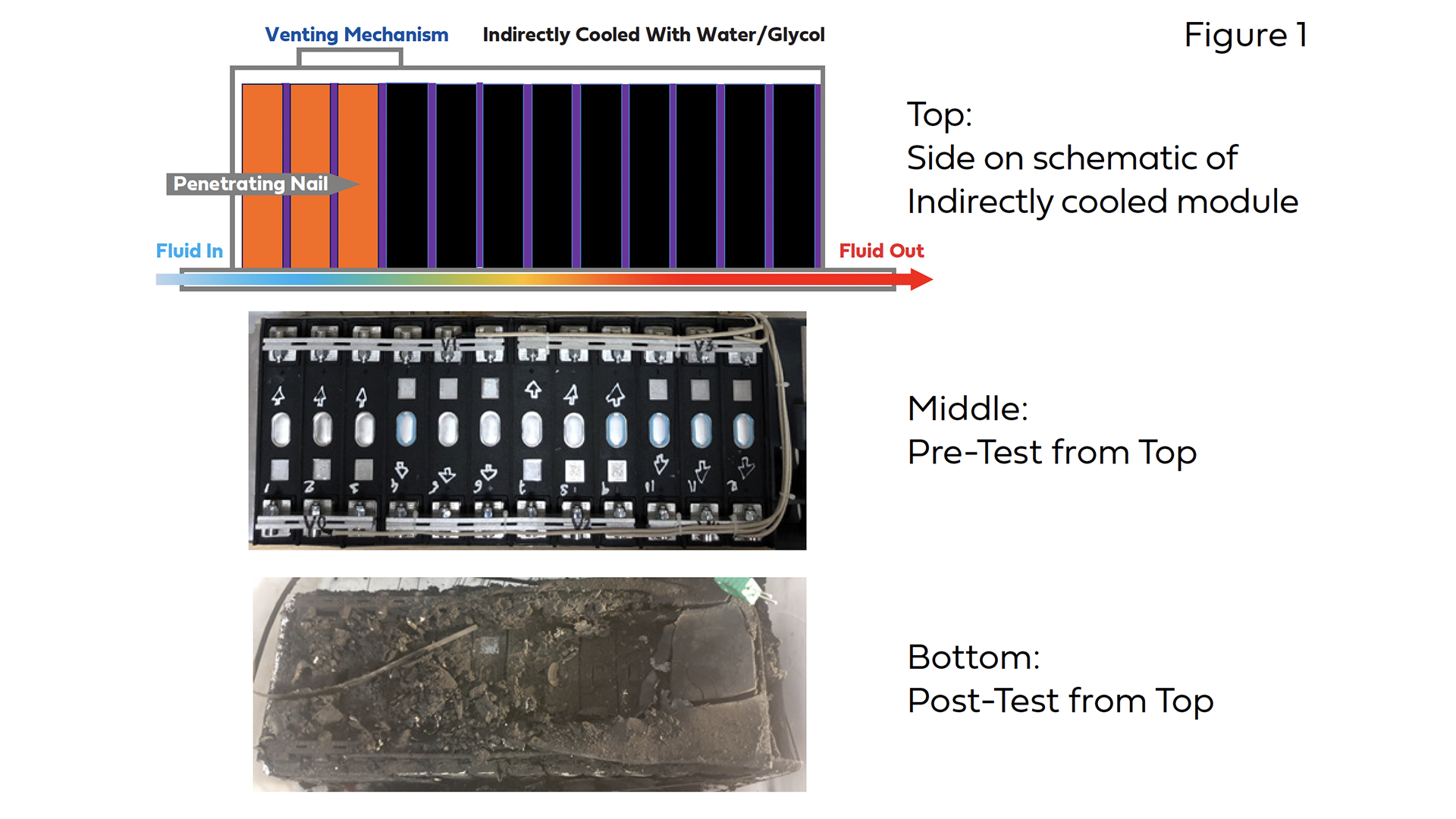
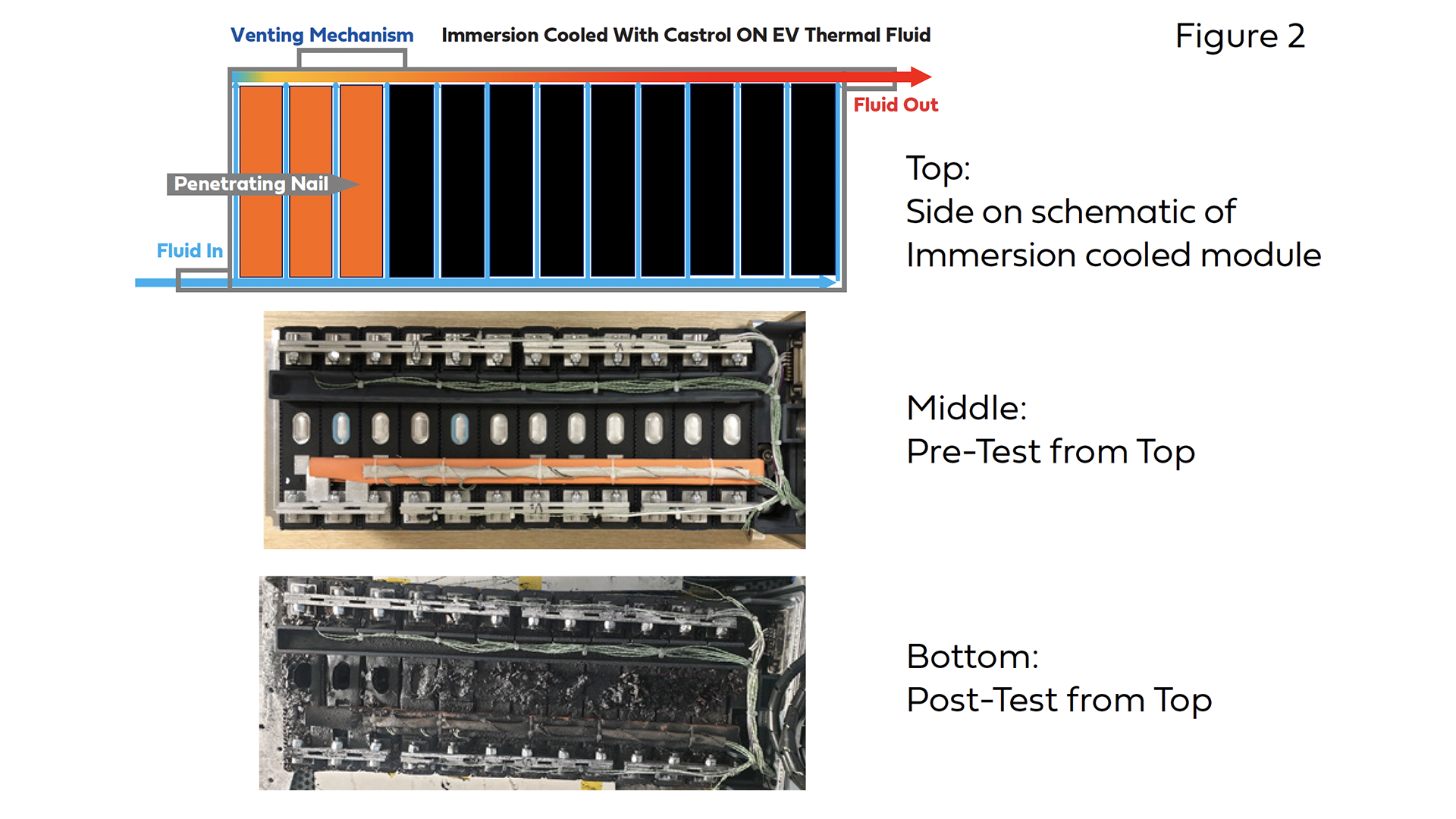
    To demonstrate the effectiveness of immersion cooling with prismatic cells, an indirectly and an immersion cooled module were designed, consisting of 12 x 50Ah NMC prismatic cells each with a 2mm intercell distance. In the case of indirect cooling, this gap is filled with an aerogel material, whilst in the case of immersion cooling Castrol ON EV Thermal Fluid is circulated between the cells. By using the same intercell distance the two approaches can be compared based on the same volumetric energy density, which is a key metric for battery packs as it equates to the range of an EV.

    To determine the performance of each approach under an extreme failure scenario, a nail penetration method was used to initiate the thermal runaway of the 3 cells at the end of the module.

    Thermal runaway can lead to thermal propagation, where heat from the damaged cell or cells is transferred via convection and conduction to adjacent cells, a process that can potentially lead to the destruction of the entire battery pack.

    During testing, the indirect minimodule suffered a catastrophic failure where the whole module was destroyed.

    The two adjacent cells to the punctured 3 entered thermal runaway within a minute, with the remaining cells in the module sequentially entering thermal runaway as the propagation continued across the module; the whole process took just 15 minutes.

    By contrast, the immersion cooled module proved effective in mitigating thermal propagation, with no cells entering thermal runaway except the 3 punctured cells, as evidenced by measurements during and after the test. This was attributed to the improved heat dissipation possible with immersion cooling. Effective heat dissipation is

    a combination of vent gas management and the fluid conducting heat away from the damaged cell.

    Castrol ON EV Thermal Fluids are developed to help avoid the risk of thermal propagation by directly cooling the individual cells, where high temperatures can cause irreversible failure as a result of overcharging or short-circuiting. With immersion cooled systems, thermal events of individual cells are better thermally managed.

    Therefore, if they occur, they can be quenched at source –unlike in indirectly cooled systems.

    Castrol ON Thermal Fluid is part of a family of Castrol ON products, which include Castrol ON EV Transmission Fluids and Castrol ON EV Greases. Castrol’s e-Mobility team continues to optimise thermal management performance through joint co-engineering programmes with partners, anticipating the multi-faceted technical challenges resulting from ever-increasing demands for greater battery and powertrain performance.

    Please note, this article will also appear in the 18th edition of our quarterly publication.
    [ad_2]

    Source link

  • Working for the benefit of the marine environment

    Working for the benefit of the marine environment

    [ad_1]

    The ocean is a vastly important resource with an unfathomably large biodiversity. As humans look to take the minerals we need, it is up to organisations like ISA to ensure no harm comes to the marine environment.

    The seabed holds various materials that are becoming increasingly important for the green transition, such as copper, gold, manganese, cobalt, and more. As demand for such materials increases, it is not unreasonable to expect ventures to look to mining these marine environments.

    The International Seabed Authority (ISA) is a UN-established international organisation dedicated to the monitoring and protection of global marine environments in mineral-resource related activities.

    The Innovation Platform’s Assistant Editor Matt Brundrett sat down with Jaimie Abbott, Communications Specialist at ISA to find out more about their work.

    How does ISA help protect marine biodiversity in offshore mining operations?

    Under UNCLOS, ISA has the mandate to protect the marine environment from harmful effects that may arise from activities in the area. For the last thirty years, ISA has developed and implemented a regulatory framework that ensures that activities in the area are carried out in a precautionary and environmentally responsible manner.

    ISA’s efforts towards ensuring the protection and sustainable use of the area and its resources are demonstrated through the development, implementation, and review of regional environmental management plans (REMPs). REMPs aim to provide the relevant organs of ISA, as well as contractors and their sponsoring States, with proactive, area-based, and other management tools to support informed decision-making processes that balance resource development with conservation. They also provide ISA with a clear and consistent mechanism to identify particular areas thought to be representative of the full range of habitats, biodiversity and ecosystem structures and functions within the relevant management area.

    More than ten years ago, ISA established an environmental management plan in the Clarion-Clipperton Zone. The plan includes a network of 13 areas of particular environmental interests covering 1.97 million km2 where no mining will be allowed. Further work is underway to establish similar plans in the Mid-Atlantic Ridge, the Indian Ocean, and the Northwest Pacific Ocean.

    Under the exploration regulations, contractors are required to conduct environmental baseline studies, monitoring, and impact assessments.

    ISA is also tasked with encouraging and promoting marine scientific research in the area, and in 2020 its 168 Member States unanimously adopted a comprehensive Action Plan for Marine Scientific Research to drive the work in this sphere. The Sustainable Seabed Knowledge Initiative of ISA is a flagship initiative for the implementation of the Action Plan, particularly focusing on generating new deep-sea biodiversity knowledge and enhancing deep-sea biodiversity assessments in support of the protection of the marine environment based on the best available science.

    How does the ISA involve local communities in decisions and contribute to protecting their livelihoods?

    Since its establishment 30 years ago, ISA’s decision-making process has been taking a multilateral and consensus-based approach, according to the rules and procedures established by UNCLOS and the 1994 Agreement. All state parties to UNCLOS are automatically members of ISA, which currently comprises 168 states and the European Union.

    As of May 2024, ISA has 106 observers, including 29 observer states, 32 intergovernmental organisations, and 45 non-governmental organisations. The Assembly, the supreme organ of ISA, is attended by the Member States and observers. All can take the floor and express their views and positions. In addition, several stakeholder consultation processes have been undertaken, including as part of the process for the development of the current draft exploitation regulations (Mining Code) and one for the draft REMP for the northern Mid-Atlantic Ridge.

    © shutterstock/SHIN-db

    How does the ISA collaborate with scientists to safeguard deep-sea ecosystems from mining impacts?

    In 2020 the ISA adopted an Action Plan for marine scientific research that serves a global agenda to progress deep-sea science.1  It comprises 6 strategic research priorities, including one that focuses specifically on enhancing scientific knowledge and understanding of the potential impacts of activities in the area. Under this strategic research priority, the Secretariat facilitates the further elaboration of scientific approaches and tools for cumulative impact assessments. Its continued work will advance the understanding of cumulative impacts from future exploitation activities and other stressors on different ecosystem components.

    Since adopting the Action Plan for marine scientific research, the Secretariat has organised 29 events to promote scientific deep-sea research, encompassing online and in-person workshops, webinars, information series, and side events in global fora involving over 1,000 experts from all over the world. Additionally, 44 strategic partnerships were forged to deliver the MSR Action plan, and since 2020, 19 Member States and the European Union have provided support.

    How does the ISA ensure equitable benefits for local populations in mining areas?

    Deep-seabed mining represents a frontier of human activity with the potential to unlock vast mineral resources located on the ocean floor beyond national jurisdictions. As technological advancements pave the way for the exploration and extraction of these resources, questions regarding equitable benefit-sharing and environmental sustainability have come to the forefront of international discourse. ISA plays a key role in regulating deep-seabed mining activities and ensuring that the benefits derived from these activities are shared equitably among all members of the international community. Activities under the competence of ISA, including mining activities when they are authorised by member states, take place very far away from land and human communities. The four key points for this are:

    1. Mining areas are not located near local populations:
      The international legal agreement known as UNCLOS, along with its 1994 Agreement, states that the ocean floor beyond any nation’s borders is owned by everyone on Earth. This idea is specifically mentioned in UNCLOS (Article 136) and more detailed in the 1994 Agreement’s introduction, stating that no single nation or local community owns these ocean resources – they belong to all of humanity. Consequently, the ISA oversees these areas to ensure that everyone benefits fairly rather than focusing on the needs of specific local groups. ISA has been established with the mandate of being the main body for overseeing activities such as seabed mining, if and when it will occur, in these international areas. Additionally, UNCLOS (Article 140) stresses that the benefits of activities in these international seabed areas should reach all humans, regardless of their country’s geographical location and whether they are coastal or landlocked. It also highlights the need to pay special attention to the requirements of developing countries and those not fully independent or self-governing.
    2. Exploitation has not commenced yet:
      No deep-seabed mining activity has commenced anywhere in the world.
    3. Sharing of benefits contemplates both monetary and non-monetary benefits:
      UNCLOS and the rules set by the ISA focus on ensuring that benefits from deep-seabed mining, both money and other types, are shared with everyone globally.  As part of the development of the exploitation regulations, ISA is creating a Common Heritage Fund to support learning and skill-building about the ocean.
    4. Collective Benefit System with Special Considerations:
      The ISA is dedicated to managing deep-seabed activities (prospection, exploration and exploitation) so that they benefit all of humanity. Its main goal is to make sure everyone around the world benefits fairly, but it also pays special attention to the needs of developing countries and small island states.

    The ISA works to ensure that its approach to sharing benefits is fair, inclusive, and promotes sustainable development worldwide.

    Overall, the ISA operates under a detailed set of rules provided by UNCLOS and the 1994 Agreement, which guide it in regulating seabed mining. This regulation aims to distribute both monetary and non-monetary benefits fairly, even though the mining may not occur near local populations.

    What can you tell us about the DeepData database and its purpose?

    The ISA’s DeepData database was launched in 2019, replacing and consolidating previous iterations of the databases maintained by ISA, namely POLYDAT and the Central Data Repository (CDR). In launching DeepData, ISA made publicly available for the first time the biggest and most complete global repository of environmental data and information collected in areas beyond national jurisdiction.

    DeepData contains environmental data, which are publicly available, including biological, physical, and geochemical parameters of the marine ecosystems from the seafloor to the ocean surface. It also contains maps, photographs, videos, graphics, and relevant publications in peer-reviewed journals from ISA contractors. It has since served as an effective tool to facilitate the sharing of environmental data in an open and transparent manner, thereby advancing the scientific understanding of the area.

    Today, ISA is the custodian of over ten terabytes of data through DeepData, representing the largest repository of seabed data in the world. Its data inventory has contributed significantly to the management of the area, including the development of REMPs.

    ISA’s efforts towards advancing data and information sharing through DeepData were further promoted through strategic partnerships with other UN agencies and scientific organisations. For instance, the Secretariat launched the AREA2030 Initiative in partnership with the International Hydrographic Organization (IHO) to facilitate the high-resolution mapping of the Area by 2030.

    ISA is also the first UN organisation to serve as a node for the Ocean Biodiversity Information System (OBIS) of IOC-UNESCO, sharing its biodiversity data with the OBIS network through DeepData. In terms of its contribution to OBIS, DeepData records currently account for over 89,000 occurrence records or 15% of data collected at depths below 3,000m.

    What other key achievements or projects can you tell us about, and why are they significant?

    ISA has been pioneering women’s empowerment for experts in deep-sea affairs from developing countries. The tangible activities the ISA launches in this domain impact the careers and lives of those experts. For example, ISA Contractors have a legal obligation to provide and fund training opportunities for personnel from developing States and those of ISA.2  This, combined with the other transformative action ISA facilitated in this domain, has enabled to build the capacity of more than 1,000 individuals from developing States since 1994. In addition, to date, 19 contractors pledged to allocate half of their placements in the Contractors Training Programme to women scientists. The women experts participating get training on the most advanced science and technology development in the field of the deep sea. Last year the ISA also launched a global mentoring programme that matches seasoned mentors with mentees from developing states.3  The pairs embarked on a one-year journey during which the mentor guided the mentee in her personal, professional, and scientific development. In the recently established ISA-Capacity Development Alumni Network4  (iCAN), professionals who enjoyed one of the ISA’s women empowerment initiatives shared their stories of how such an initiative transformed their lives, and a few experts were hired afterwards.

    References

    1. ISA | Marine Scientific Research
    2. ISA | Contractor Training Programme
    3. ISA | WIDSR She Mentoring Programme
    4. ISA | Capacity Alumni Network

    Please note, this article will also appear in the 18th edition of our quarterly publication.
    [ad_2]

    Source link

  • Exploring CCUS technologies for a net zero future

    Exploring CCUS technologies for a net zero future

    [ad_1]

    The ConsenCUS Project is set to lead the way in electricity-based CCUS technologies to enable a sustainable future.

    Carbon is one of the most important elements in the world. From providing energy to being in the very food that sustains us, it is abundant everywhere. However, when providing us with energy or materials, we also produce carbon emissions that change our climate.

    The 2050 net zero carbon targets are, therefore, vital to humanity’s continued existence, and to mitigating the damage that we have already started to cause our planet.

    As such, there are many initiatives, programmes, and innovations aimed at reducing carbon emissions. Yet, not as many focus on being completely carbon neutral.

    The ConsenCUS project

    A consortium comprised of nineteen partners in academia and industry, ConsenCUS is a project in Carbon Capture, Utilisation, and Storage (CCUS) that aims to achieve true net zero carbon technologies and make them widely available for industry everywhere.

    consencus project
    Serious games help people understand the various aspects of CCUS

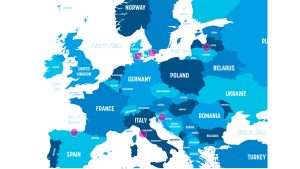
    The locations of these partners include: The Netherlands, Denmark, United Kingdom, Romania, Greece, China, and Canada. They have come together with €13m of funding over four years under the Horizon 2020 programme.

    They aim to achieve this by ConsenCUS: CarbOn Neutral cluSters through Electricity-based iNnovations in Capture, Utilisation and Storage.

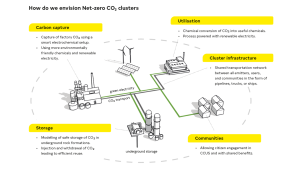
    An example of this is their net-zero Carbon Cluster approach, planning for regions that employ CCUS technologies and bringing together industries, users, storage, and local communities to not only reduce carbon emissions, but bring them down to net zero. The core ingredients of these Clusters will be as follows:

    Carbon capture and utilisation

    Using environmentally friendly chemicals and, crucially, renewable electricity, carbon emissions will be captured in industry, such as within factories. Water-soluble potassium hydroxide will be used as a sorbent to capture carbon dioxide molecules, and will be easy to separate again using a ‘pH swing.’

    From there, the carbon dioxide molecules can be electrochemically converted into much more useful and less harmful chemicals, such as potassium formate. Potassium formate can be used as a preservative, or can be used in protein or fuel production.

    Using (renewable) electricity for both the CO2 capture and conversion process allows for an overall net-zero carbon process, which does not rely on residual or fossil heat like competitive technologies.

    Carbon dioxide storage and transportation

    With the amount of carbon dioxide currently being produced, it is unlikely that all of it will be able to be converted into more useful things. This is what makes carbon storage important, as it still cannot just simply be released into the atmosphere.

    The subsurface is under investigation to make storage areas for carbon dioxide, and is showing promising results. ConsenCUS is modelling whether certain types of rock may be suitable for permanent, but also temporary carbon dioxide storage, in case there will be a need for it in the future.

    All these aspects will be connected safely and efficiently via secure transportation networks between the emitters, users, and communities, utilising pipelines, trucks or ships. Planning such infrastructure for two clusters (North-West and South-East Europe) is one of the key activities in ConsenCUS.

    Community engagement

    To understand what citizens within the Net Zero Carbon Clusters think about CCUS as a technology, an array of community events are being organised in the Netherlands, Denmark, the UK, Greece, and Romania.

    ccus technologies, cosencus project
    How the ConsenCUS consortium envisions net-zero CO2 clusters

    The goals of the community events are to understand the awareness, concerns, and needs of community members concerning the ConsenCUS project’s industrial innovations and CCUS developments more generally. Furthermore, insights and knowledge of community members will help better understand what social, economic, and environmental benefits, risks, and impacts CCUS can have for communities.

    To learn from and understand different communities’ perspectives about CCUS, one of the methods used is a conversation game called PlayDecide. The game is useful when introducing and discussing complex issues and technologies with groups of people who do not have in-depth technical information about a topic.

    ccus technologies
    Possible net-zero-CO2 scenarios for industry employing CCU or CCS with point source or direct air capture. Blue blocks represent centralised CO2 emissions (e.g., industrial plant, power plant) or decentralised CO2 emissions (e.g., aeroplane)

    Results from the project

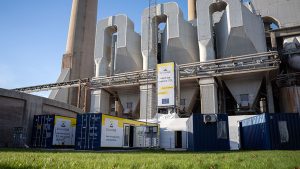
    In 2023, the ConsenCUS demonstration plant was opened at Aalborg Portland’s cement factory in Aalborg, Denmark. This demonstration plant is designed to capture up to 100kg of CO2 per hour and has already shown that carbon dioxide emissions can successfully be captured and converted into formate or formic acid, all through using renewable electricity. This monumental achievement shows that this technology is not only viable, but also has the potential to be scaled up.

    More optimisation will be done on this plant, as it moves to two more sites within two different industries that need to get to net-zero emissions: The oil refinery site of OMV Petrom near Ploiesti, Romania, and Grecian Magnesite in Yerakini, Greece, who along with Aalborg Portland, have all committed to developing and utilising these techniques for a better, carbon-neutral future. The focus for the second and third demonstration campaigns is to reach competitive specific energy consumption (again, with electricity rather than heat-based), the proposed scale, and to demonstrate versatility with respect to the flue gas of different industries.

    consencus project
    The ConsenCUS pilot plant at Aalborg Portland’s cement plant

    The information from this demonstration plant will also inform engagement with local communities and the impact of CCUS upon them.

    Also in 2023, the first Policy Paper was published based on the findings so far. This paper goes over the preliminary outcomes of the ConsenCUS project, and discusses the considerations to be made when deploying CCUS technologies throughout the EU. These considerations are as follows:

    1. The resource and energy use associated with different CO2 capture and conversion processes is different, and therefore should be a key criterion for both policy and permitting.
    2. CCUS pathways (including sub-surface usage) must be fit for eventual operation in a net-zero world.
    3. Any impact assessment of CCUS strategies should include Scope 2 and 3 emissions from the entire CCUS chain.
    4. The CCUS technology pipeline must include multiple scalable, modular capture technologies, given the variety of emitters and industries where CCUS will play a role in decarbonisation.
    5. Shared CO2 transport and storage infrastructure must be subject to rigorous standards and models for sharing liability from CO2 sources and end-users connected to the infrastructure.
    6. Member States should be mandated to set out a comprehensive strategy and funding framework for research and development, innovation, and deployment of CCUS, fostering innovation and learning-by-doing.
    7. The involvement of local communities and stakeholders, including through capacity-building activities, should be a key requirement of CCUS projects.

    These considerations show a commitment to both net zero carbon technologies, but also ensuring that the people and environment in surrounding areas are happy and involved with ConsenCUS’ work.

    The ConsenCUS project is in its final stages now, and with an active demonstration plant and developing policies, is confident that it can lead the way in CCUS technology and make the world a better place.

    Want to learn more about our results? Come to the European Water Technology Week (September 24, Leeuwarden, NL) or save the date for our final ConsenCUS conference, 25-26 February, 2025, Brussels, BE).

    This project has received funding from the European Union’s Horizon 2020 research and innovation programme under grant agreement No 101022484

    Please note, this article will also appear in the 18th edition of our quarterly publication.

    [ad_2]

    Source link

  • Why the stormwater runoff matters

    Why the stormwater runoff matters

    [ad_1]

    D4Runoff is a Horizon Europe-funded project developing a novel framework to detect, prevent and reduce pollution in urban stormwater runoff.

    Thousands of chemicals are used every day in urban areas, and many of them end up on surfaces in the urban landscape. When it rains in cities, the resulting urban stormwater runoff washes the surfaces and transports pollutants to the natural receiving waters, where they pose a risk to public health and damage to ecosystems.

    In addition to heavy metals and other legacy pollutants, Contaminants of Emerging Concern (CECs), such as endocrine-disrupting compounds, pharmaceuticals and microplastics, are detected in urban runoff. However, regulation and monitoring programmes that aim to mitigate diffuse pollution cover only a small subset of contaminants. As a consequence, most municipalities and water companies have limited knowledge of which chemical compounds are present in the stormwater runoff.

    The EU Green Deal includes the Zero Pollution Action Plan, in which the European Union has prioritised air, soil, and water pollution. The D4RUNOFF project, supported by Horizon Europe, develops a novel framework to detect and deal with urban runoff pollution by CECs.

    The threefold D4RUNOFF approach

    First, the project develops novel detection methods capable of providing a ‘chemical fingerprint’ for each water sample based on signals from known pollutants and unknown compounds that are not (yet) included in monitoring programmes. This will allow comparison of the chemical composition of urban runoff from cities across Europe and identify priority pollutants present in the samples.

    stormwater runoff
    Fig. 1: Sampling sites for collection of urban runoff to be analysed with workflows developed in the project

    Next, we perform an analysis of sources, fate, as well as the effectiveness of present-day state-of-the-art Nature-based Solutions (NbS). Using GIS and AI tools emphasises the existence, importance and urgency of the ‘CECs problem.’ The project provides knowledge and tools to improve the accuracy and effectiveness of policies by providing detailed insights into the distribution and impacts of CECs across urban landscapes. By using real-time data and predictive analytics, D4RUNOFF helps to pinpoint areas most at risk and in urgent need of attention. This approach not only streamlines the regulatory process but also ensures that interventions are timely and based on sound science.

    Secondly, D4RUNOFF remarks on the necessity/advantage of adopting NbS to mitigate the impact of CECs. By cataloguing effective NbS and pairing them with specific urban scenarios, the project aids decision-makers in choosing the most appropriate, sustainable, and cost-effective methods to prevent or reduce urban pollution.

    Thirdly, D4RUNOFF advocates the integration of these solutions into local and national regulations, promoting a shift towards more resilient and environmentally friendly urban landscapes.

    D4RUNOFF recommendations are likely to encourage policymakers to consider updating environmental regulations to incorporate continuous monitoring and proactive management of pollutants through technological control and natural mitigation means.

    The research, innovating and engaging with policymakers and society is done in three case study cities: Odense in Denmark, Santander in Spain and Pontedera in Italy. In these case study areas, we will demonstrate the combined approaches and their effects, optimise the framework and provide guidelines for other cities and the EU Commission. The framework will be introduced in the municipal climate adaptation strategies, or it may even be leading the way to a concept for a municipal pollution strategy. These are all important steps forward to meet the Zero Pollution Action Plan.

    Fig. 2: 3D model of the first generation of Raman-based measuring device prototype

    Improving knowledge optimise decisions: Detection and monitoring

    Anthropogenic chemicals enter our urban environment through the use of building materials, vehicles, medicine, pet flea remedies, and many other sources. The introduction of new chemicals into our environment is a continuous process as the result of industrial innovation.

    This prompts the scientific community to investigate. Analytical chemists race to keep track of these chemicals, while environmental scientists study how they move around and how they affect ecosystems. Exposure scientists investigate their interactions with living organisms. Meanwhile, potential health risks are assessed by toxicologists and epidemiologists.

    Consequently, environmental engineers and policymakers work to manage, reduce and regulate chemicals in order to prevent and reduce pollution from urban stormwater runoff.

    As innovation accelerates, this cycle becomes shorter. There’s an urgent need for a comprehensive assessment of the environmental cycle of emerging contaminants and a better understanding of key transport and fate mechanisms in order to minimise human exposure to their effects.

    In order to make informed decisions regarding the status of runoff water and the performance of NbS, it is essential to provide the decision-makers with accurate and real-time data.

    To do so, D4Runoff develops novel screening methodologies and automated instruments for in-situ monitoring of pollutants in runoff, including microplastics, pesticides, heavy metals and hazardous tyre wear chemicals. These devices are platforms integrating the latest technologies: microfluidics, nanomaterials, electrochemical and Raman sensors and advanced machine learning data analysis.

    Overall, D4Runoff results put the holistic CEC lifecycle view into practice, from lab to action.

    Applying Nature-based Solutions

    In combination with NbS, conventional urban drainage systems can improve their capacity, efficiency, and lifespan, resulting in hybrid systems.

    An exhaustive review of drainage techniques has resulted in the D4RUNOFF library, from which the parametric design of different NbS has been developed. These sustainable techniques have been prioritised with selected multi-criteria decision analysis (MCDA) methods, resulting in a ranking of NbS led by constructed wetlands and green roofs. The consideration of economic, environmental, and social criteria, together with the expertise in each technique, ensures the sustainability and viability of the final decision. The next step is to locate areas of opportunity for NbS using a Geographical Information System (GIS) that identifies the suitable places within the urban environment that meet the conditions for NbS implementation and proposes the best hybrid solutions for urban drainage in a given district.

    Getting help from artificial intelligence

    How can digital solutions and artificial intelligence (AI) revolutionise our ability to prevent runoff water pollution?

    With D4RUNOFF’s innovative AI digital solutions, we are reshaping how the urban runoff is managed.

    The innovation scope is to develop a smart platform that harnesses the power of cutting-edge technology and AI to connect the D4RUNOFF detection methods, sensors and risk mapping to prevent and reduce water pollution with NbS technology.

    D4RUNOFF platform design will enable stakeholders to access the system accordingly. A green consultant, for example, can select the most effective NbS for each problem spot. At the same time, another section maps out pollution risks on the map, guiding the city managers to target the efforts where they are needed most. By collecting online data on pollutants and improving knowledge of pollution from different land uses and/or neighbourhoods of the city, the system can provide assistance to all stakeholders, including citizens, to be part of the solution by introducing NbS in their streets.

    The Policy Making Support System helps city managers, and policymakers identify critical areas within the regulatory framework where interventions are needed to improve the monitoring of CECs and prevent pollution by promoting specific NbS in the urban planning and regulatory process.

    The technical architecture of the D4RUNOFF platform seamlessly integrates technologies for efficient data processing, including the Calculation Engine and Data Gathering modules. These modules store crucial information and data from real sites across Europe. Together, they form a powerful tool, blending advanced science with tangible results for greener, cleaner cities.

    Serving the EU’s Green Goals, Policy and Strategy: Diffuse pollution management

    In line with the EU’s ambitious commitment to the Zero Pollution Action Plan and The EU Water Frame Directive, the D4RUNOFF project represents an innovative and forward-looking approach to urban pollution management.

    The project aims to streamline the development and implementation of robust methods to assess the risks and costs of pollution and the benefits and drawbacks of solutions by developing novel chemical detection methods, monitoring, and forecasting tools.

    Robust metrics are also essential to evaluating the legislative framework’s actual implementation, such as providing evidence to ban unnecessary chemicals and setting surveillance thresholds to promote prevention.

    Foresight and knowledge: The core of D4RUNOFF

    At its core, the D4RUNOFF project employs foresight as a method to enhance preparedness for the unexpected, particularly the challenges posed by climate change.

    It delivers comprehensive knowledge of CECs, covering their sources, fate and transport, which can be used to identify priority pollutants that are not regulated today.

    This knowledge serves as a valuable policy improvement tool, informing strategic decisions in environmental engineering and policy science. It embraces synergy and collaboration at multiple levels of institutional decision-making (EU, national, regional, and local) and multiple stakeholders (citizens, industry, authorities, etc.).

    Indeed, the D4RUNOFF project does not operate in isolation. It is tightly linked to sister projects and crosscuts multiple targets set by policies.

    D4RUNOFF outcomes go beyond the CEC and urban runoff: approach, knowledge, metrics, and tools will help enforce closely related strategies to tackle the complexities of efforts to reduce pollution in public services (a goal of the next EU Urban Wastewater Treatment Directive, UWWTD), and address the challenges of plastic and textile regulations and soil policy.

    Through collaboration, the project promotes a holistic approach to the twin challenges of water quality and ecosystem health, emphasising the need for up-to-date knowledge and advanced metrics of contaminants.

    Today’s urban wastewater systems, designed 30 to 60 years ago for a different era, are now facing the pressing demands of new requirements, like those set by the next UWWTD. The D4Runoff metrics and decision support tools provide helpful knowledge and foresight into next-generation UWWT technologies and strategies for massive renewal investment as those going to be mobilised by the €1tr European Sustainable Investment Plan for a climate-neutral economy.

    D4Runoff tools also open up to better inclusion of just transition criteria to balance environmental goals with social agendas (of which NbS could be a cornerstone).

    Conclusions

    D4RUNOFF helps bridge the gap between technological advances and regulatory practice, influencing environmental regulation and policy-making through its scientific output, engaging key stakeholders at all levels of representation, and providing innovative decision-support tools to deal with diffuse pollution in urban stormwater runoff.

    The scientific findings from the project’s chemical and biological research are bringing a ‘CECs problem’ to the fore.

    By providing policymakers with accurate, data-driven evidence, the project will foster a proactive regulatory environment that prioritises ecological intelligence and facilitate the adoption of proactive, forward-looking regulations to include current and forthcoming CEC remediation into next-generation wastewater systems in our cities.

    The intelligent tools to encourage the integration of NbS into planning and design on a day-to-day basis help to get more from investments for cost-effective reduction of pollution. These solutions are particularly important in areas where traditional infrastructure may not address the complex dynamics of stormwater runoff and pollutant dispersion, adding a social value.

    In conclusion, D4RUNOFF project embodies the essence of the EU’s environmental strategy – informed by science, driven by policy and motivated by the vision of a healthier, more sustainable future for all.

    Join us at  d4runoff.eu to preserve our environment and safeguard our communities. Stay tuned for the coming groundbreaking results!

    Please note, this article will also appear in the 18th edition of our quarterly publication.

    [ad_2]

    Source link

  • Quantum coatings that prevent infection

    Quantum coatings that prevent infection

    [ad_1]

    Rather than treat people post-infection, Spectrum Blue is looking to treat surfaces with quantum coatings to prevent infection from taking place.

    According to epidemiologists, humanity has entered the post-antibiotic era, in which therapeutic options are fewer and fewer due to the decrease in the number of effective antibiotics.¹  This resistance also extends to disinfectant agents.

    Climate change is making conditions for pathogen transmission more prevalent, and rising ambient carbon dioxide correlates with increased viral aerostability and infection risk.

    In our homes, mould is linked to allergies and childhood asthma and causes a monumental financial drain on the real estate sector, causing double-digit drops in property resale value.

    In the hospital environment, when patients, visitors, or healthcare workers touch contaminated surfaces, they can transmit the microbes to another person or themselves. In the healthcare environment, many assume surfaces that look clean are safe, yet this is not always the case.

    Protective strategies

    Protective strategies can involve a combination of preventive measures, such as wearing masks or not touching surfaces and, more importantly, cleaning and decontamination methods.

    When disinfecting a surface or decontaminating a facility, the efficacy of a disinfectant product is measured by its log reduction, also commonly known as log kills.

    The term comes from the logarithm scale, which is used to indicate the percentage of dead bacteria. The term ‘log reduction’ indicates a ten-fold reduction, which means that with every step, the number of bacteria present is reduced by 90%.

    Of course, the log reduction is only effective during the contact time of the cleaning agent with the surface containing the bacteria. Once the active ingredient in the cleaning agent has evaporated or been rinsed, the bacteria can return to multiplying.

    Bacteria can control and overcome the effect of disinfectants in different ways, such as restricted permeability of the cell wall, the expression of efflux systems, enzymatic degradation, changes in target sites, and the formation of biofilms.²

    Unfortunately, as previously mentioned, bacteria also have a tremendous ability to respond to chemical stress caused by biocides, where overuse and improper use of disinfectants can be reflected in a reduced susceptibility of micro-organisms.

    Hence, the log reduction is reduced, leading to the need to increase contact time for effectiveness. This poses an issue when using non-persistent cleaning agents as many repeat applications become necessary, increasing personnel exposure to chemicals3 as well as raising operational costs.

    All this means that the ideal solution would have to be persistent and would continue the log reduction indefinitely, impeding biofilm formation.

    Prevention through coating surfaces

    Surface contact is a huge source of contamination and the spread of infections. We share our bacteria and viruses by touching doorknobs, TV controls, tables, chairs, beds, etc.

    infection prevention
    © shutterstock/sdecoret

    The microclimate of the medical area provides the bacteria with the survival environment, and the surfaces of the medical habitat provide the material support on which the bacteria will survive.⁴

    Biofilm formation constitutes an alternative lifestyle in which micro-organisms adopt a multicellular behaviour that facilitates and prolongs survival in diverse environmental niches. Biofilms form on biotic and abiotic surfaces both in the environment and in the healthcare setting. In hospital wards, the formation of biofilms on walls, ceilings, vents, and medical equipment enables pathogens to persist as reservoirs that can readily spread to patients.⁵

    Surfaces such as tall walls or ceilings⁶ , usually more difficult to access and clean, are ideal locations for biofilm formation7  and pathogen shedding. Airborne micro-particles and dust also frequently accumulate on the ceiling, and in damp locations where there is condensation, water droplets (containing bacteria) are formed and fall on work surfaces.

    The convection flow caused by our body heat8  or other appliances plays a fundamental role in contaminating the air and surfaces, and transporting pathogens through the hospital environment, especially the ceilings.

    Thus, transforming walls and ceilings into persistent cleaning agents would not only stop the formation of biofilm but also decrease the active pathogen load in the air.

    This approach has been taken with the development of loaded antimicrobial coatings, such as paints that release silver or copper ions, various biocides and fungicides, or photocatalytic coatings that, when exposed to ultraviolet light, generate free radicals that have an antimicrobial effect.

    The first group of coatings, those that release various biocidal agents, has two significant issues. First, they can become depleted and react with many cleaning agents. Second, the substances they release also impact the health of patients and healthcare staff.

    The second group of coatings, those that have a photocatalytic effect, had one major issue: They needed UV light, a rare and generally unwanted type of light spectrum inside buildings.

    This is where technology has evolved the development of compounds that have electrochemical and photocatalytic effects in visible light as well as in the dark. This is where quantum coatings like the Q-field pigment are needed.

    Q-field: What are quantum coatings?

    Q-field is a family of patented pigments that use quantum effects to enable coatings to become a persistent log reduction agent without depleting from the substrate, without entering the bacteria, virus, or, most importantly, human beings.

    At a quantum level, Q-field microparticles are stimulated by ambient electromagnetic waves to generate surface plasmons and give surfaces a positive charge.

    quantum coatings

    With Q-field, the wall or ceiling receives a microscopic force field that deactivates pathogens and stops biofilm and mould from growing.

    Once in contact with ambient moisture, this positive charge creates a layer of OH groups that hug the surface of the coated materials. These OH groups hydrolyse the protein structures of viruses, rendering them harmless.

    quantum coatings

    When bacteria attempts surface attachment, the first step in biofilm formation, its electrostatic-sensitive membrane gets broken, and its metabolism is stopped by the OH groups. This is a mechanism that bacteria cannot grow resistant to.

    Can we succeed in making safe spaces in our society?

    According to the World Health Organization, most countries in the world have not implemented an Infection Prevention and Control programme or an operational plan.⁹  In 2022, only four (3.8%) of the 106 participating countries met all the minimum requirements for Infection Prevention and Control.

    Quantum coatings are not poisonous and have a long-lasting effect — a significant improvement in the built environment, materials, and equipment.

    If a critical area of surfaces in public buildings, hospitals, nursing homes, elderly homes, restaurants, and hotels were coated, we would have better protection against epidemics and infections.

    To have safer spaces, we must also manage all the places that are coated or protected and when such areas should be maintained.

    Parallel to this, data on where and how epidemics migrate geographically should be analysed so that we learn more about which public areas should be made safe.

    This is why the inventors of Q-field, Spectrum Blue, also introduced an information system (software) to document, manage and map safe spaces in society. This system is designed to support healthcare providers in collaborating and improving infection prevention and control, digitising pathogen surveillance, enabling them to monitor, audit and receive feedback, improve guidelines, and provide education and training to staff.

    References

    1. MDPI | Origin of Antibiotics and Antibiotic Resistance, and Their Impacts on Drug Development: A Narrative Review
    2. NCBI | Reduced Susceptibility and Increased Resistance of Bacteria against Disinfectants: A Systematic Review
    3. Oxford Academic | An Overview of Cleaning Agents’ Health Hazards and Occupational Injuries and Diseases Attributed to Them in Sweden
    4. NCBI | Mechanisms and Impact of Biofilms and Targeting of Biofilms Using Bioactive Compounds—A Review
    5. NCBI | Bacterial Biofilms: Development, Dispersal, and Therapeutic Strategies in the Dawn of the Postantibiotic Era
    6. EurekAlert! | Pathogens, including multi-drug resistant “superbugs”, found on floors, ceilings and door handles of hospital toilets, UK study finds
    7. Toilet microbiome
    8. Taylor and Francis Online | Experimental and numerical study on the thermal plumes of a standing and lying human in an operating room
    9. WHO | Global report on infection prevention and control

    Please note, this article will also appear in the 18th edition of our quarterly publication.
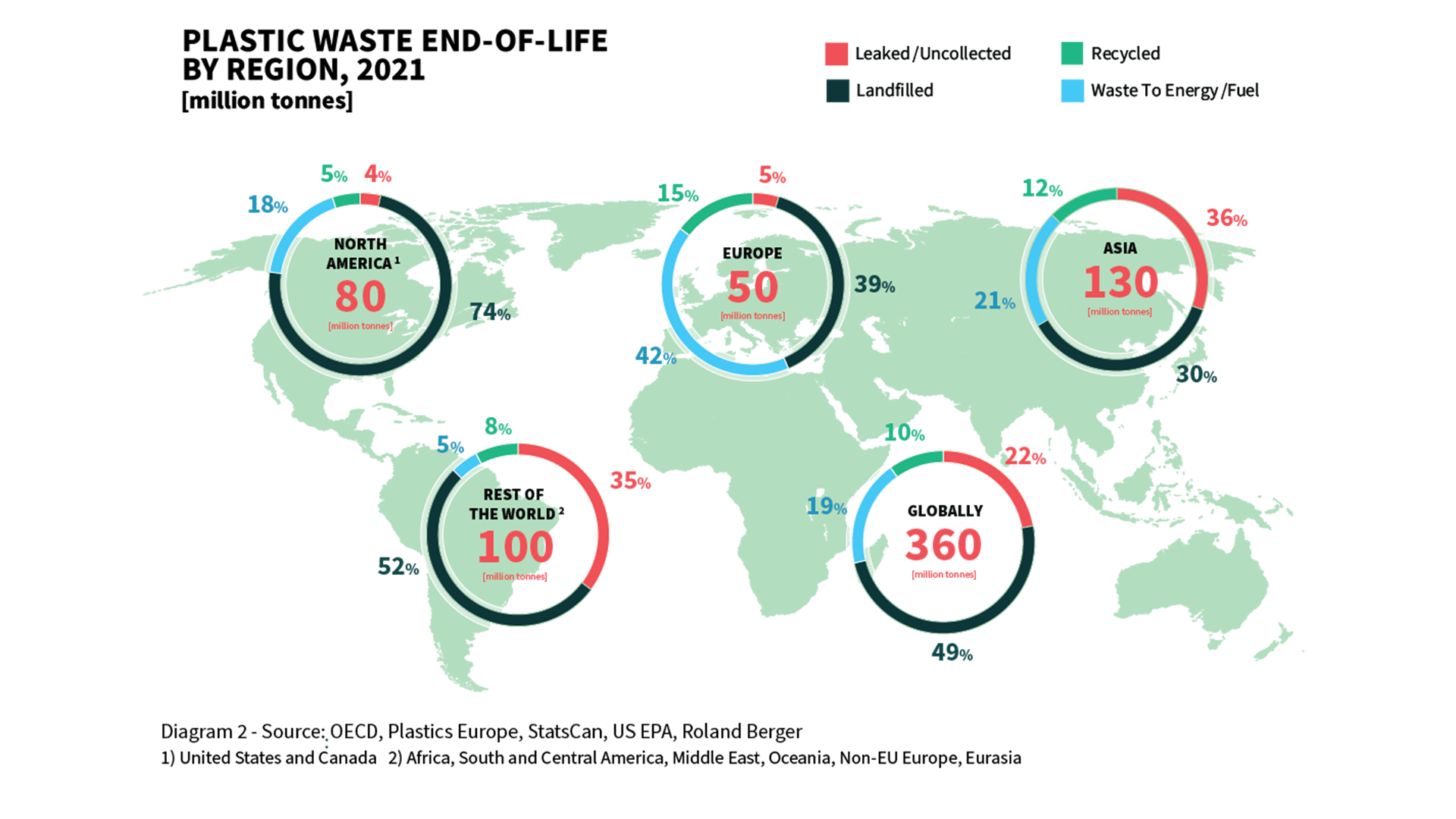
    [ad_2]

    Source link