
Dark Mode Light Mode
Building better brain models | Opinion
The Incredible, Elegant DNA Repair System Makes Gene Editing Work
Chemistry, medicine, materials and the technology shaping tomorrow — the best science stories from trusted sources, every day.

The Incredible, Elegant DNA Repair System Makes Gene Editing Work

The Incredible, Elegant DNA Repair System Makes Gene Editing Work The Incredible, Elegant DNA Repair System Makes Gene Editing Work


Humans have debated the meaning of life for many millennia, but from evolution’s perspective, it is simple: Preserve the genome. Of course, mutation is allowed, as is the genetic mixing and matching of sexual reproduction, to create variety and evolutionary diversity. But we all exist because a viable lineage of DNA has persisted for 4 billion years. The genome’s policy is typically, “If the code works, don’t change it.”

You’d think, then, that cells would keep their DNA under lock and key, protected from the elements like the precious blueprint it is. But this isn’t possible. DNA is a working document. Cells need near-constant access to these instructions for making the molecules required by life. The huge, complex molecular structure is therefore exposed to nonstop assault by the by-products of everyday cellular metabolism, as well as environmental factors, such as radiation (including ultraviolet and X-ray), alcohol, pesticides, and more.

“DNA damage occurs all the time,” said Björn Schumacher, a molecular biologist at the University of Cologne. “[DNA] contains all the information for building a cell, building an organism, maintaining cells and tissues, and all that — but yet it is surprisingly unstable.”

He estimates that some cells endure up to 100,000 DNA damage events every day. “Damage to the DNA is the default,” he said. These events can injure sections of the DNA molecule — or, worse, break the strand in half. Even minor DNA damage risks changing or destroying the essential instructions a cell needs to operate, which can make cells malfunction, die, or become cancerous.

However, many of those tens of thousands of daily lesions get repaired quickly. Cells have native repair mechanisms that recognize and replace faulty DNA before lasting damage and dysfunction set in. In fact, the ability to repair damaged or broken DNA had to evolve at essentially the same time as DNA, Schumacher said, “because you cannot have stable genetic information without DNA repair.”

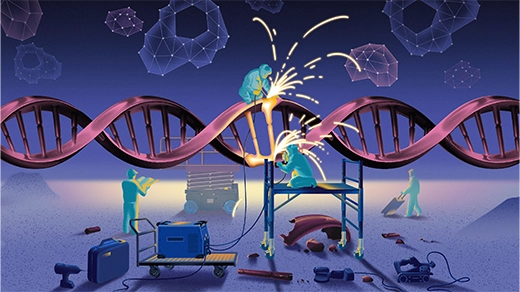
These mechanisms are essential not only to the evolutionary lineage of all known life, but also to promising technologies to treat genetic diseases. Scientists and doctors who experiment with gene editing must rely on DNA’s natural self-editing and repair tools to insert, delete, or mutate genes to study and treat disease.

So perhaps instead of a master blueprint protected behind glass, it’s better to imagine DNA as a beloved cookbook that is constantly in use. While it’s open on the kitchen counter, it’s bound to get splattered with sauce — or even have a page ripped. But spills can be wiped off. Torn pages can be taped up. And a smear obscuring an odd ingredient might even improve a recipe.

Do the Twist

To understand how DNA gets damaged so easily, we need to see its structure, beyond the impossible elegance of the double helix. Most DNA is packed into chromosomes, dense structures formed by long, delicate filaments of DNA wrapped tightly around proteins. If you were to unwrap the DNA and untwist its double helix, you’d see a ladder made of nucleotides: the building blocks of DNA.

A single DNA strand — one side rail and half of each rung — encodes a specific arrangement of the four nucleotides, also known as bases. Each is a complex molecule represented by a single letter: A, T, G, or C. Across from it is a backup on the opposite, complementary strand, made up of each nucleotide’s natural partner (A’s partner is T, and G’s is C). The “rungs” of the DNA ladder are held together with relatively weak, transient bonds that allow the helix to be opened and closed like a zipper, so enzymes can access, read, and copy the code.


Source link

Previous Post
Building better brain models | Opinion

Building better brain models | Opinion