

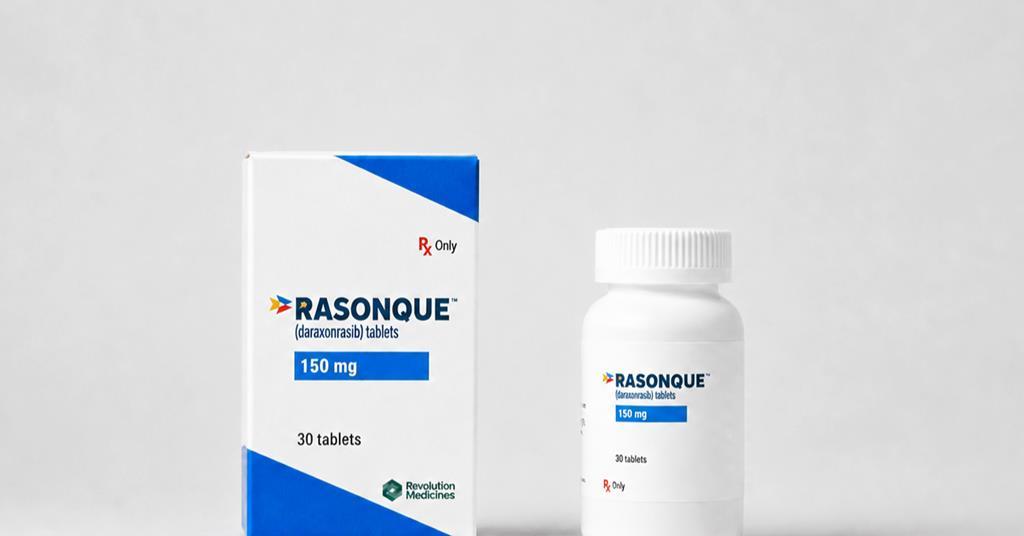
A first-of-its-kind drug has received approval from the US Food and Drug Administration (FDA) for treatment of metastatic pancreatic cancer. The new drug, daraxonrasib (Rasonque), blocks Ras proteins, which are linked to many cancer types and were once thought to be ‘undruggable’.
Pancreatic cancer is a devastating disease with a five-year survival rate of just 8% for patients suffering from its most common form. Clinical trials showed that pancreatic cancer patients who were given a daily dose of daraxonrasib in pill form survived for a median of 13 months, compared to 7 months for those undergoing standard chemotherapy.
‘This is such an important moment for pancreatic cancer,’ says Stephanie Dougan, a cancer immunologist at the Dana-Farber Cancer Institute in Boston, US. ‘It’s the first time we’ve had a drug that works.’
In healthy cells, activation of a protein called K-Ras initiates a signalling cascade that turns on genes for cell growth and division. However, mutations in one amino acid can make K-Ras permanently active, leading to the uncontrolled cell proliferation seen in many cancers.
Daraxonrasib, developed by California-based Revolution Medicines, works as a molecular glue that binds to another protein that is present in most cells. This produces a complex that blocks the K-Ras protein, turning off its signalling and stopping cancer growth.
Mutated K-Ras is present in 90% of pancreatic cancers, around 40% of colorectal and up to 30% of lung cancers. ‘Ras mutations are the most common mutations in all cancers,’ says Channing Der, a Ras oncogene researcher at the University of North Carolina at Chapel Hill, US, whose lab has worked with Revolution Medicines, including on two key studies in 2024 on Ras-inhibitors. ‘This new drug is opening the door to treating other cancers, in particular lung and colorectal cancer.’
Der contributed to the discovery of K-Ras in 1982 , when it emerged as an obvious target for cancer therapies. But it came to be viewed as undruggable, partly because it lacked promising crevices for small molecules to bind to. The new approach relies on the drug binding to a ubiquitous protein, cyclophilin A. ‘Rather than a tiny molecule, which cannot find a pocket on Ras, we now have a huge binary complex that grabs it,’ says Der.
A significant step forward
Unlike two previous FDA-approved Ras inhibitors, which each target one specific mutation, daraxonrasib binds to all three Ras proteins in the body. This makes daraxonrasib potentially effective no matter which Ras mutation is driving a patient’s cancer.
By interfering with Ras proteins in normal tissues, daraxonrasib also causes side effects, including rashes and gastrointestinal symptoms. ‘Normal cells are also targeted but normal cells don’t have the same dependency on Ras signalling as cancer cells, so you get a nice therapeutic window,’ says Dougan. However, she notes that there are signs that cancer cells eventually develop resistance to Ras inhibition, meaning that it is not a cure.
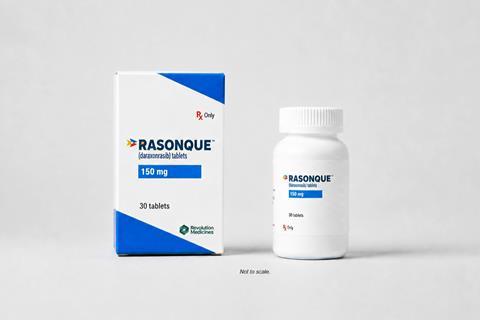
Despite this, the daraxonrasib approval is seen as a significant step forward for pancreatic cancer treatment. ‘The standard of care for pancreatic cancer are two largely ineffective chemotherapy regimens, which are quite toxic,’ says Der, who adds that many patients are bedridden as a result. Dougan notes that while a minority of patients have successful surgeries, in most cases the cancer will have already spread beyond the pancreas.
The new drug is approved for patients who have not responded to other therapies, but there is optimism that data will support earlier use. ‘This drug is so good that I expect it to move to first line therapy,’ says Dougan. ‘It is a huge quality of life difference to be able to take something oral that has fewer side effects [than chemotherapy].’
According to analysis by Der and his colleagues, there are currently 79 anti-Ras drugs in over 200 clinical trials and more approvals are expected, with 16 in phase 3 clinical trials . ‘Daraxonrasib is not the only show in town,’ says Der. ‘I am excited about the progress that will happen in the coming months.’
‘There was such nihilism in pancreatic cancer. Many companies wouldn’t even run trials because they always fail,’ says Dougan. She hopes daraxonrasib might allow immunotherapies to achieve more success. ‘The tumours are going to be regressing or stable for six months. That gives the T-cells a chance to do something,’ she says. Der also hopes that treatments involving daraxonrasib used alongside other cancer drugs could prove effective, noting that most successful cancer treatments are combination medicines.