





Water is crucial for life to flourish, which is why it’s something scientists search for first on other planets – but can we really be sure what water looks like in alien environments?
In a new study published in Communications Chemistry, researchers in the US put water under the kind of pressure it would experience on planets like Uranus or Neptune and found that its fundamental atomic structure changes in response.
In short, the water becomes less symmetrical and more warped, atomically – which has implications for how it conducts heat, influences magnetic fields, and affects the density of a planet, all of which are important for telescope observations and interpretations.
This kind of transformation has previously been predicted in simulations, but this appears to be the first time scientists have been able to observe it in the lab.
“Water beyond Earth-like conditions has more complex behavior than we ever previously imagined,” says physicist Ashkan Salamat, from the University of Nevada, Las Vegas.
“It’s amazing how water can behave under pressure.”
The researchers placed a tiny water droplet between two diamond tips to apply the pressure, cranking it up to beyond 222 gigapascals (GPa).
That’s about 2.2 million times the pressure we feel walking around on Earth.
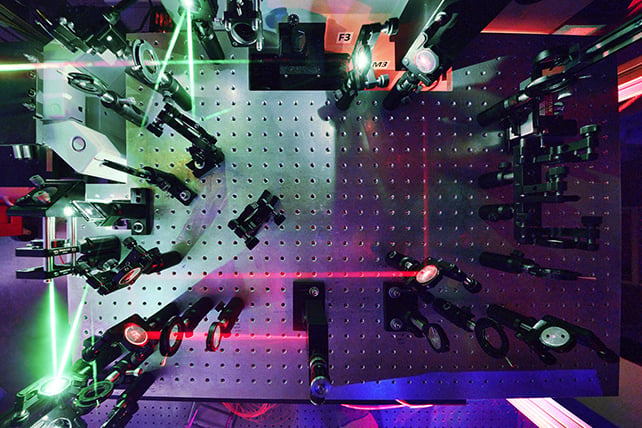
X-ray diffraction was used to identify chemical changes in the water at the smallest scales, based on how X-rays scattered as they passed through the water.
Ordinarily, you would expect squashed atoms to become more symmetrical as they bunch up in tighter arrangements, but that’s not what happened here. The ice’s crystal structure became more lopsided and stretched.
That gives us a glimpse into what’s happening elsewhere in the Universe – though it’s worth bearing in mind that only the pressure matched the conditions on some other planets, not the temperature.
“We can’t enter the crust or atmospheres of these planets because of distance, but we have data from things like the Voyager program,” says Salamat.
“We have an idea of their compositions, and interior pressure and temperatures. And in labs like mine, we can mimic the chemistry and experiment with what could be occurring inside these planets.”
The experiments also tell us more about ice-X, one of more than 20 types of ice that scientists know of.
Here, the team pushed ice-X beyond its known limits, creating something that looks new – though further study will be needed to know for sure.

frameborder=”0″ allow=”accelerometer; autoplay; clipboard-write; encrypted-media; gyroscope; picture-in-picture; web-share” referrerpolicy=”strict-origin-when-cross-origin” allowfullscreen>
Ice-X forms gradually across a broad range of pressures, shifting into a highly symmetrical structure at around 50 GPa, in terms of its oxygen and hydrogen atoms.
Now scientists have a better idea of what the upper limit of ice-X might be.
“This transition marks the onset of a new regime of structural complexity in high-pressure H2O, redefining the upper stability limit of ice-X,” write the researchers in their published paper.
Studying far-off planets involves a lot of educated guesswork and careful interpretation of what telescopes report back, and this study can help. It gives us a solid reading on what water on Neptune (for example) might actually be like.
If the structure of water is different, then the chemical reactions that it causes might be too: there might be rock and metal compounds that aren’t found anywhere on Earth.
That information isn’t just helpful when it comes to running models of life on other planets, but in knowing what to expect when we get there – if our probes and spaceships are going to make it deeper into the Solar System.
“Understanding the mechanisms of our Solar System and our observable Universe is critical for the endeavor of human knowledge,” says Salamat.
“When we eventually get to these worlds, what are we going to see? We’re really the initial pioneers in trying to answer these questions in the laboratory.”
The research has been published in Communications Chemistry.
This article was fact-checked by Rebecca Dyer and edited by Rebecca Dyer. While we pride ourselves on our process, we are only human. If you spot a mistake, please let us know.


