


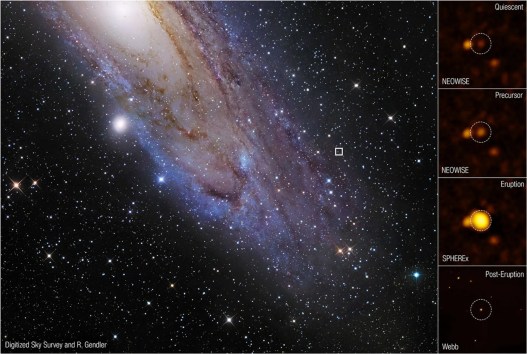


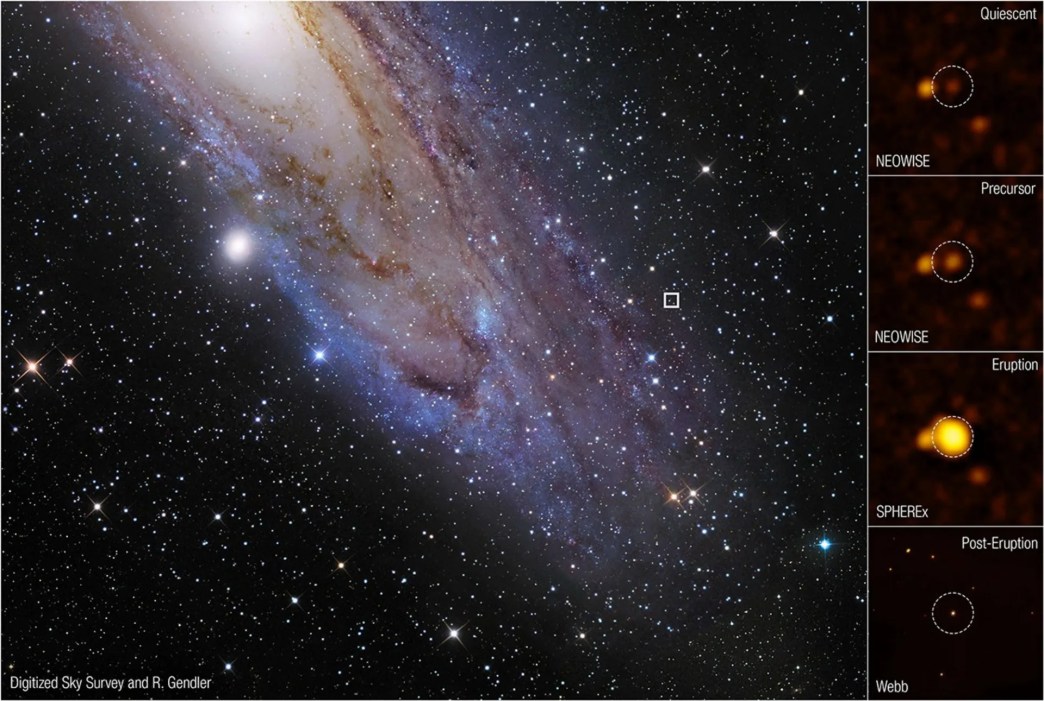
Our telescopes and their data-scanning algorithms are getting more and more powerful over time. As such, previously never-before-seen celestial sights are now regularly coming into view. The latest example: a pair of stars merging, where one of the pair is at a particularly late stage of life, and surrounded with a diffuse, extended cloud of gas, something that’s called common envelope evolution (CEE).
In this particular case, a super-giant star, around seven times the mass of our sun, swallowed up a smaller star with around a tenth of the mass, creating an incredibly bright eruption. A team of astronomers, via the James Webb Space Telescope, was able to analyze the system’s behavior before, during, and after the merger, which is unprecedented. Until now, the existence of CEEs has mostly been a theoretical idea.
It all happened in the Andromeda galaxy, a nearby neighbor of the Milky Way, some 2.5 million light-years away. The newly single star has been nicknamed Bao, and it may have been rejuvenated by the extra-stellar material (it’s still too early to tell).
Read more: “These Stars Swallowed Their Earth-like Planets”
The whole process—from the smaller star getting snagged on the outer edges of the larger one to being completely engulfed—took just seven years, a relatively speedy resolution for something that can take centuries. A full record of the merger has been published in Nature, marking the culmination of observations that began back in 2023. “We thought it would take centuries for an outburst to happen, and then one day it erupted,” study author Nadia Blagorodnova said in a statement. “We were flabbergasted.”
The common envelope evolution is so-called because the two stars involved share parts of their gas cloud with the other. This time around, when the smaller star’s envelope came into contact with its much larger neighbor, it lost its orbital energy and was pulled in.
But CEE scenarios don’t always end in mergers. It’s thought that both stars can sometimes transform into other states, including black holes and supernovae explosions.
Thanks, though, to some diligent stargazing and sky-mapping, we know exactly how this one played out. And as study author Kishalay De put it, “These surveys are opening up completely new avenues to study dying stars and perhaps even discover new phenomena we haven’t seen before.”
Enjoying Nautilus? Subscribe to our free newsletter.
Lead Image: NASA/ESA/CSA/STScI/Viraj Karambelkar (Columbia)/Kishalay De (Columbia)


