






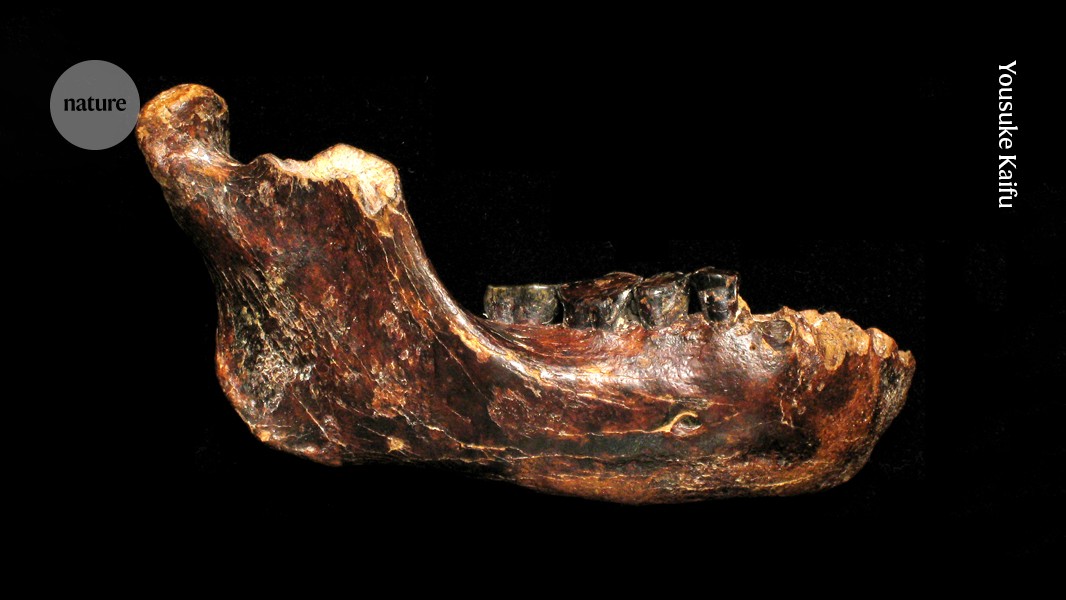
In 2025, researchers used protein analysis to show that a jawbone recovered from ocean sediments off the coast of Taiwan belonged to a Denisovan.Credit: Yousuke Kaifu
An abandoned quarry in southwestern China has given scientists a portal into the Stone Age. The site’s trove of fossils and artefacts provides an unprecedented glimpse into the lives and abilities of the mysterious ancient humans called Denisovans.
Evidence from the site indicates that Denisovans crafted bone tools similar to those made by their relatives, the Neanderthals. The items also suggest that Denisovans, who lived at the site for at least 30,000 years, and possibly as long as 120,000 years, were skilled hunters of animals such as deer. No other site provides such a long, clear record of behaviour and technology that are closely connected to Denisovans.
“This site’s the full package,” says Ben Marwick, an archaeologist at the University of Washington in Seattle who was not involved in the study. “It’s the first site that we have with a long, rich sequence that’s uniquely associated with Denisovans,” he says.
Details of the finds were published today in Nature1,2.
New bones, new homes
The Denisovans were first described in 2010, after researchers sequenced genetic material from a finger bone found in Denisova Cave in Siberia and found that the DNA did not match that of any other known human species. Ancient proteins, which are hardier than ancient DNA, have since proved most reliable for identifying Denisovan remains. Jawbones found on the Tibetan Plateau and in sediments dredged from the Taiwan Strait stretched the Denisovans’ known territory south and east of Siberia. And in 2025, scientists finally put a face to the extinct people, with the confirmation that a skull found near Harbin in northeastern China was from a Denisovan.
Who were the ancient Denisovans? Fossils reveal secrets about the mysterious humans
In 2019, workers starting an ecological restoration of a quarry in southwestern China’s Yunnan Province stumbled on bones and stone tools. Scientists eventually excavated thousands of objects from a cavern called Bianfu Cave that is within the quarry. Five pieces of bone in the cave turned out to belong to Denisovans, according to an analysis of protein fragments in the samples: two curved wedges of skull, a portion of a lower arm bone and two teeth.
Qiaomei Fu, a palaeogeneticist at the Institute of Vertebrate Paleontology and Paleoanthropology in Beijing, who led the protein work, says that the Denisovan fossils were discovered in two different layers of cave sediment. “This is not just an occasional fossil,” she says. Rather, the remains suggests that the archaic people lived in the region for an extended period between 167,000 and 134,000 years ago.
Fu says that the southwestern location of Bianfu is also significant because it is closer, compared with previous sites, to regions where Denisovans and modern humans might have intermingled. Among the modern-day humans with the highest percentages of Denisovan DNA in their genomes — the result of ancient trysts — are people living in Papua New Guinea and nearby islands3.
Bones speak
The Bianfu Cave arm bone, part of a radius, is one of only a few Denisovan bones from below the head.


%20SOURCE%20Julian%20Chokkattu(2).jpg "The Fairphone (Gen 6+) Review: Finally in the US")


