

Key Insights
- The first molecular glue degraders to target Ikaros proteins were serendipitously discovered and approved before their full mode of action was known.
- Researchers have worked hard to develop more selective degraders that can hit just one of these highly homologous proteins.
- As it becomes more feasible to predict and design degraders, researchers are also finding that it sometimes it is more effective to design molecules that can go after multiple targets.
In ancient Greek mythology, Ikaros was the boy whose father’s clever engineering gave him wings. In chemical biology, Ikaros is a character in a different story.
The Ikaros family contains five proteins, also known as Ikaros zinc finger (IKZF) proteins. Each IKZF is a transcription factor, a protein that controls the expression of genes—in this case, genes that give immune cells their identity.
Transcription factors have a powerful ability to change the chemistry within a cell, but for many years they were considered undruggable. The Ikaros family was the first to show that transcription factors could in fact be modified by medicines. In recent years, academia and industry chemists have worked to design new molecules that can target Ikaros as a way to treat cancer.
But there’s a choice to be made. Do you design your molecule to target a specific member of the Ikaros family or all of them at once? The answer depends on disease, cell type, and more—and drug developers are taking bets both narrow and broad. Christina Woo, a chemist at Harvard who has worked in the field for some time, says it’s helpful to break down Ikaros degrader discovery into three successive waves.
The first wave: IKZF1 and 3 degraders
In 2006, when the immunomodulating drug lenalidomide was approved as a treatment for the blood cancer multiple myeloma, no one knew quite how it worked. Studies showed that the drug killed cancer cells and altered the activity of the immune system, but the molecular basis for its clinical success was unexplained.
That changed in 2013, when two teams of researchers discovered that the drug works by degrading IKZF1 and 3, also called Ikaros and Aiolos, respectively (Science, 2013, DOI: 10.1126/science.1244851 and 10.1126/science.1244917). Lenalidomide is a molecular glue degrader that binds to the E3 ubiquitin ligase protein cereblon; it then remodels the surface of cereblon, giving it a new ability to bind to IKZF1 and its homologue, IKZF3. (Lenalidomide also has a milder effect on a handful of other proteins.)
All five of the transcription factors in the Ikaros family have zinc fingers—a motif that binds to DNA and can give a protein its specificity for certain genes. Cereblon that is resurfaced by lenalidomide acquires the ability to bind to a zinc finger that is identical between IKZF1 and 3. As a result, the ligase can tag these proteins for destruction.
Removing these two transcription factors works on multiple myeloma because this type of cancer descends from immune stem cells, which depend on genes that the Ikaros family regulates. Without IKZF1 and 3, myeloma cells in the bone marrow can’t proliferate as well.
Lenalidomide and its structural analog, pomalidomide, unfortunately have some drawbacks. For example, the drugs have off-target toxicity and are susceptible to resistance mechanisms.
Andrew Hirsch, CEO of the targeted degrader start-up C4 Therapeutics, attributes the molecules’ off-target effects to their chance discovery and to the fact that “no one knew the mechanism of action when they were first developed.” But he adds that, despite their downsides, the drugs are “foundational to multiple myeloma treatment.”
Some companies believe that improving on degraders of IKZF 1 and 3, targets with proven efficacy, could produce a better drug with fewer side effects. C4 is developing a next-generation degrader, cemsidomide, that the company hopes could become best in class. Meanwhile, Helioson is working on an IKZF1 and 3 degrader conjugated to an antibody for targeted delivery.
Over time, researchers have also found that, besides blocking myeloma proliferation, IKZF1 and 3 degraders work by a second mechanism: lifting the brakes on production of an immunosuppressive cytokine. This gives the immune system a better chance of recognizing the blood cancer and mounting a defense. Some teams are working to bring this mechanism to cancers that do not originate in immune cells—but achieving that may require bringing in other IKZFs.
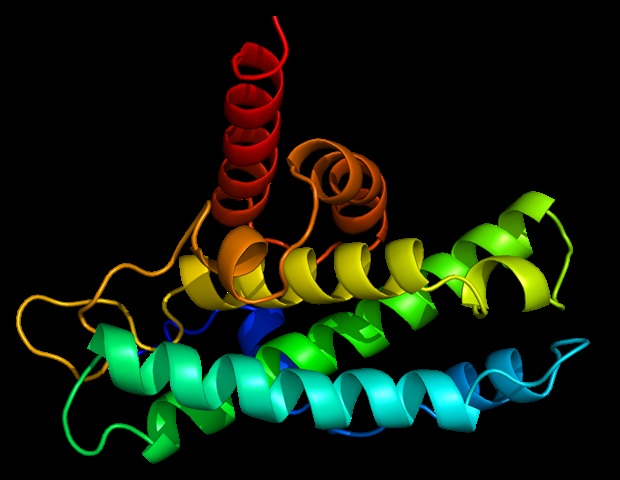
A crystal structure of DNA damage binding IKZF1 (green) and cereblon (orange) bound to the zinc finger domain of IKZF2 (beige) is shown with a degrader compound. Credit:
RCSB Protein Data Bank
The second wave: IKZF2 degraders
Though lenalidomide and pomalidomide have not proved effective in treating solid tumors, researchers still hope to use IKZF degraders to reawaken a functional immune response. Specifically, medicinal chemists want to engage effector T cells, which can recognize and kill cancerous or virus-infected cells.
To prevent effectors from killing indiscriminately, a second type of T cells, called regulators, tamp down the effectors’ activity. Many tumors exploit these regulators to survive. Within and around such a tumor, there are too many regulatory T cells, which overwhelm the effector T cells. Finding ways to reawaken effectors through immunotherapy is one of the hottest areas in cancer biology.
IKZF2, or helios, is highly expressed in regulatory T cells, which makes it a promising target for getting regulators our of effectors’ way. In 2021, chemists at the Dana Farber Cancer Institute reported that with the right molecular glue to modify it, cereblon can also grab hold of IKZF2 (Nat. Chem. Biol. 2021, DOI: 10.1038/s41589-021-00802-w). The team found that destabilizing IKZF2 and 4 could reduce the stability of regulatory T cells and bump up inflammatory signaling.
But while the Dana Farber team’s molecule degraded IKZF2 and 4 preferentially, it still hit the other IKZFs. Just as IKZF1 and 3 share an identical zinc finger, so do IKZF2 and 4. And the two motifs differ by just a single amino acid. Could chemists develop a degrader of just IKZF2, sparing the other closely related members of the family?
Around the same time, Novartis ran a campaign to design a degrader that hit IKZF2 more potently than IKZF4 and spared IKZF1 and 3 altogether. The molecule they landed on, DKY709, was effective enough in animal cancer models for the company to launch a Phase 1 trial (Cell Chem. Biol. 2023, DOI: 10.1016/j.chembiol.2023.02.005).
Novartis dropped the molecule in 2023 after a portfolio review, according to company spokesperson Kevin Jiang. But plenty of others have continued to work on the protein. Chemists led by University of Michigan pharmacologist Shaomeng Wang, for example, published on an IKZF2 degrader last year. The group reported that the protein both reduces human regulatory T regs and boosts the proliferation of effectors (Nat. Comms. 2025, DOI: 10.1038/s41467-025-58431-z). SK Life Science Labs is looking for a partner to develop that molecule.
But some groups have found that it’s more effective to hit IKZF2 in combination with other proteins. Those groups include Michael Kharas at Memorial Sloan Kettering Cancer Center and Woo at Harvard. During a joint Zoom interview with C&EN, Woo and Kharas explained how their labs teamed up to develop degraders after Kharas’s group identified IKZF2 as a promising target in leukemia (Cell Stem Cell 2018, DOI: 10.1016/j.stem.2018.10.016).
“We were testing a bunch of molecules in this space with the idea to target helios,” Kharas says. But the researchers found that the most effective compounds in their campaign also degraded casein kinase-1α (CK-1α), which is also a minor target of lenalidomide (Cancer Cell 2023, DOI: 10.1016/j.ccell.2023.02.010).
CK-1α shares a structural subdomain called a G loop with the IKZF proteins’ zinc fingers. In fact, some chemists have tried to design out CK-1α degradation from IKZF degraders.
“Everyone always wants to have the one targeted therapy,” Kharas says. But, he adds, polypharmacology sometimes “provides better therapeutics.”
Lenalidomide was approved to treat multiple myeloma before researchers knew that it works by driving degradation of IKZF1 and IKZF3.

The third wave: Pan-IKZF degraders
According to a presentation during the first disclosures session at the American Chemical Society Spring 2026 meeting, a story similar to that of Kharas and Woo played out in the research labs at US drugmaker Bristol Myers Squibb (BMS). According to BMS chemist Emily Cherney, the company was working to develop an IKZF2 and 4 degrader but realized that candidate molecules that also degrade the rest of the family could enhance solid-tumor treatment.
“Careful profiling of the pan-degraders identified during our discovery efforts on selective IKZF2/4 . . . allowed the team to tailor a unique pan-degrader profile with optimal immune modulatory pharmacology,” a BMS spokesperson writes in an email.
“The IKZF proteins really act in concert with one another with respect to immune biology,” says Neil Bence, head of the BMS protein homeostasis thematic research center. He says that while each IKZF has its signature pattern of expression in certain cells, they also heterodimerize when expressed together and that when one is degraded, others may compensate for its absence.
“It’s through dealing with the family in concert and getting the appropriate blend of the degradation profile that we can, we believe, fully maximize the anti-tumor immune activity of this mechanism,” Bence says.
BMS-986482 interacts with the zinc fingers from all the IKZFs, though in different ways. With all four proteins, the compound forms a hydrogen bond with an asparagine residue, according to a BMS spokesperson. With IKZF2 and 4, it forms an additional π bond with a histidine residue. The molecule also catalyzes different degradation dynamics downstream.
BMS is testing this drug candidate by itself and in combination with monoclonal antibodies targeting other cancer proteins.
The company isn’t alone in developing pan-IKZF degraders. According to Nathanael Gray, a Stanford chemical biologist who co-led the development of the first IKZF2 degrader, several pan-IKZF degrader campaigns are underway, and the molecules in question are diverse, differentiated by pharmacokinetics, kinetics of degradation, and potency. At least one has been published: an IKZF1/2/3 degrader from a group based at the Beijing Institute of Pharmacology and Toxicology that did not respond to a request for comment.
Adding targets beyond IKZFs
Most of the protein targets described so far share a G-loop motif. But Woo says the universe of potential cereblon substrates is expanding well past that structure. She thinks the next wave of development, already beginning to take shape, will involve multitargeted degraders that go after proteins with and without the G loop at once.
Woo says that when she and Kharas first tried to publish their data about the molecule that degrades CK-1a and IKZF, “there was some skepticism about going after multitargeted degraders in parts of the field.”
Polypharmacology has always been part of the molecular glue story, however. And now it’s a core strategy for companies hoping to bring new glues to patients—especially as researchers are finding it easier than ever to design glues for “very structurally, disparate targets,” Woo says.
“And then the question is, how do you decide which are the two things, or multiple things, you want to hit?” Kharas says. “And I think . . . that’s a matter of doing the experiments.”
UPDATE
This story was updated on April 30, 2026, to use the generic name of C4 Therapeutics’ degrader of IKZF1 and 3. The compound was called CFT7455 earlier in development, but is currently known as cemsidomide.

Laurel Oldach is a senior editor and life sciences reporter at C&EN.
2026 American Chemical Society