


Nature can hide some of its more spectacular displays in the weirdest places.
At first glance, Australia’s endangered green and golden bell frog (Ranoidea aurea) looks pretty much like any normal frog – a little more patterned than the usual Australian tree frog, but otherwise nothing out of the ordinary.
When it kicks out its hind legs, though, it reveals it’s been sitting on a surprise.
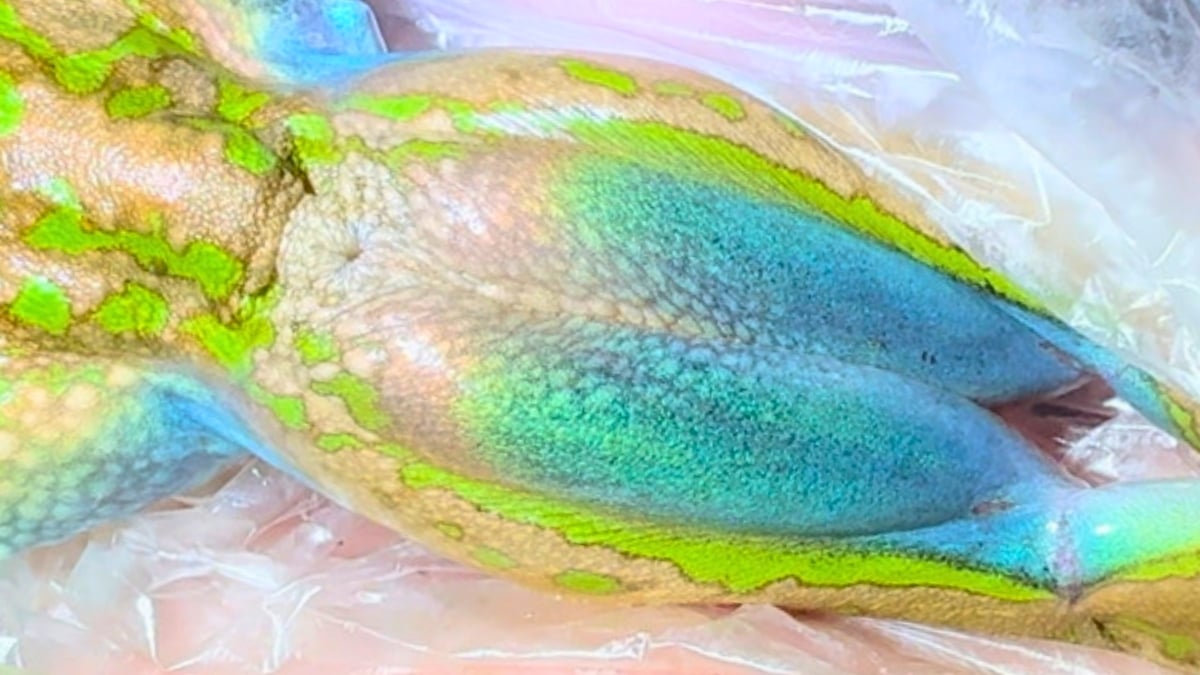
As the frog leaps, its powerful thighs flash a blink-and-you’ll-miss-it blue that scientists have now identified as true structural iridescence.
“Iridescence occurs when color changes according to the angle from which it is viewed,” says conservation biologist John Gould of the University of Newcastle in Australia, who has detailed the discovery in Austral Ecology.
“Two people standing in different locations can look at the same patch of tissue at the same time and see different colors. It’s a remarkable optical effect, but it’s very rarely documented in amphibians.”
Nature has two main ways of producing color, and both depend on how materials interact with light.
Pigment-containing cells, such as melanocytes in skin, produce color chemically.
Pigment molecules absorb some wavelengths of light while allowing others to be reflected or scattered back to your eyes. Xanthophores, for example, are cells found in many cold-blooded vertebrates that contain yellow pigments that absorb blue light, leaving the tissue looking yellow.
Iridophores, on the other hand, produce color physically.
Instead of pigments, iridophores contain microscopic crystal structures roughly the size of visible wavelengths of light. These structures reflect and interfere with light in ways that determine which colors emerge, sometimes changing with the viewing angle to produce iridescence.
Frogs like the green and golden bell frog have both systems in their skin.
In fact, that’s what makes the frog green. Its skin consists of a xanthophore layer over a layer of iridophores that reflect blue light under the yellow pigment, creating the vivid green coloration. This is actually fairly normal for amphibians.
Previous research has established that those iridophores contain tiny crystal platelets that interact with light.
But many researchers thought the blue color these structures produced arose through incoherent scattering.
This is when there’s no order to the arrangement of the structures, so light scatters off them willy-nilly, every which way. Because shorter wavelengths – those at the blue end of the visible spectrum – scatter more efficiently than longer ones, the material appears blue, a phenomenon known as the Tyndall effect.
Gould was conducting capture-mark-recapture fieldwork on Kooragang Island in Australia when he noticed something odd about the frogs’ badonkadonks.

When he extended and gently rotated the animals’ hind legs, their thighs didn’t just shimmer with blue light, but also green, turquoise, and maybe even a hint of warmer hues.
This simply doesn’t happen with the Tyndall effect. It happens with coherent scattering – when the microscopic structures are precisely arranged so that reflected light waves reinforce or cancel one another, producing different hues depending on the viewing angle.
That’s iridescence.
It’s the same general optical trick that makes opals shimmer, water condensation sparkle with rainbow colors, and many insects glisten like tiny jewels.
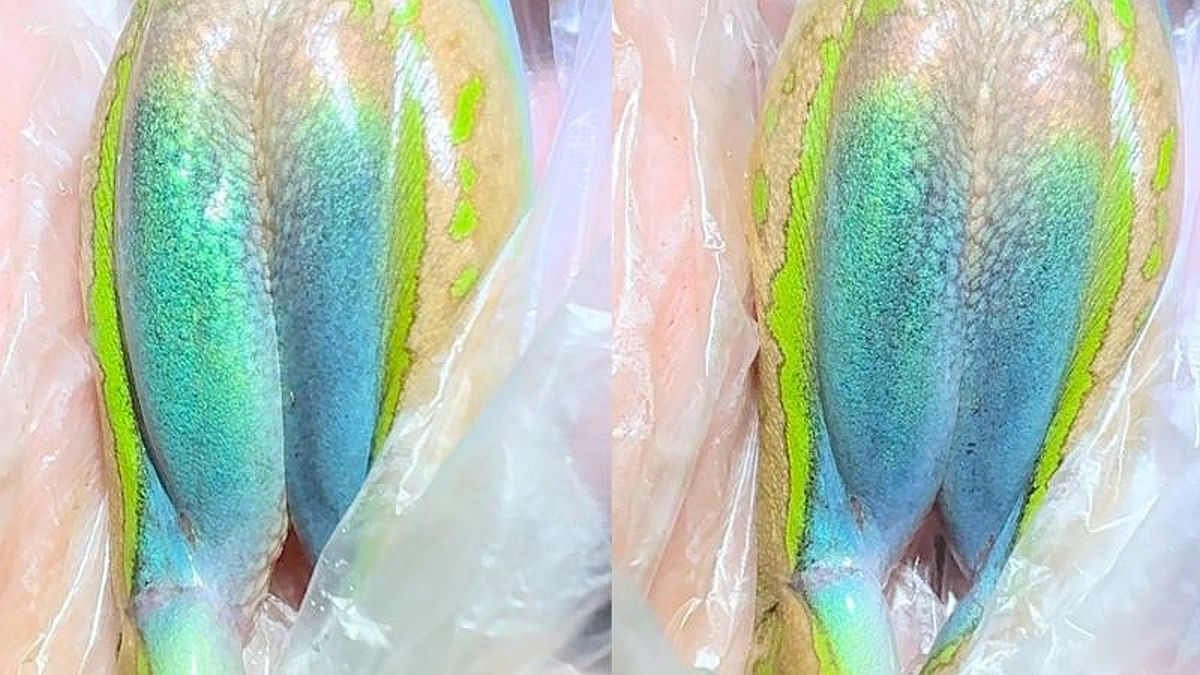
“True iridescence only occurs when these microscopic structures are ordered as opposed to completely random, similar to what we see in butterfly wings,” Gould says.
“The presence of iridescence in this frog shows the blue color isn’t being produced through random scattering alone. Instead, it indicates that ordered reflective platelets are responsible for creating the structural blue color.”
The discovery raises more questions than it answers, though.
For one, if the iridophores are present across the frog’s entire skin, as its green coloration would suggest, why does the shimmer occur only on its back legs?
And then there’s the big one: Why does it have disco legs at all? Gould believes it may be part of the frog’s survival toolkit.

“The blue inner thigh is already thought to play an important role in anti-predator defense,” he says.
“Our findings suggest that iridescence may enhance that visual signal, making it even more conspicuous and attention-grabbing when the frog moves.”
Related: A Breathtaking New Type of Opal Has Been Found… in Common Seaweed
According to Gould’s review of the scientific literature, only a handful of amphibian species have been documented displaying true iridescence.
This new discovery, found hiding under a frog’s butt, suggests there may be many more right under our noses.
“Given the green and golden bell frog is such a well-known Australian species, our finding highlights how much remains to be discovered in the animal kingdom,” Gould says.
The discovery has been published in Austral Ecology.
This article was fact-checked by Rachel Garner and edited by Clare Watson. While we pride ourselves on our process, we are only human. If you spot a mistake, please let us know.