

Dark Mode Light Mode
Venting Doesn't Reduce Anger, But Something Else Does, Research Finds
Scientists Capture a Fundamental Energy-Transfer Reaction in Remarkable Detail
Join us on a journey where chemistry meets creativity, and the wonders of science unfold. Quench your intellectual thirst with thought-provoking articles that transcend the boundaries of conventional knowledge.

Scientists Capture a Fundamental Energy-Transfer Reaction in Remarkable Detail

Scientists Capture a Fundamental Energy-Transfer Reaction in Remarkable Detail Scientists Capture a Fundamental Energy-Transfer Reaction in Remarkable Detail


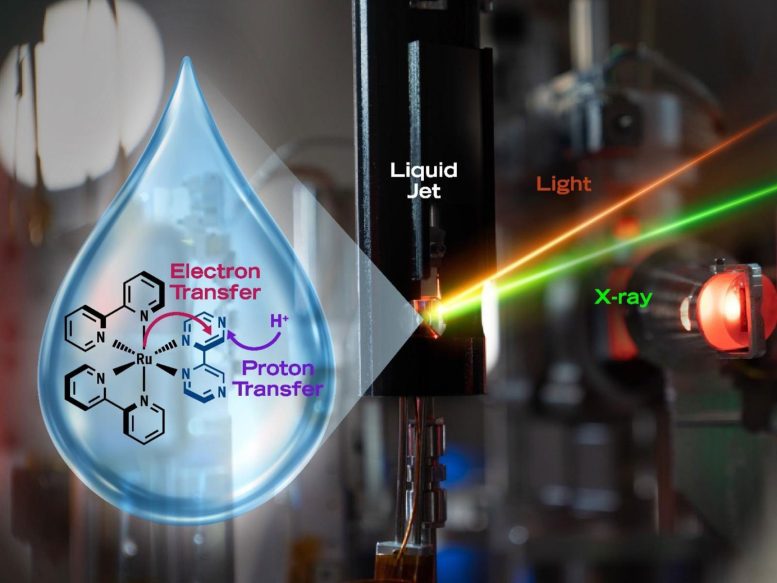
Illustration shows the solvated molecular complex, light-induced electron and proton transfer, and the X-ray probes. Credit: Illustration by Jeff London | Pacific Northwest National Laboratory; photo credit: D.J. Hoffman, C.Y. Hampton/SLAC

Researchers captured how a molecule and its surrounding water reorganize together during a rapid energy-transfer reaction that plays a key role in nature.

A chemical process central to photosynthesis, metabolism, and other forms of energy conversion has now been captured in unusual detail, revealing how a molecule and the water around it change together as a proton and electron are transferred.

Using two complementary ultrafast X-ray techniques, researchers tracked changes inside a light-activated molecule while observing how the surrounding network of water molecules reorganized. Combined with advanced computer simulations, the measurements showed how gaining a proton reshaped the molecule’s electronic structure at specific sites while altering its surrounding environment.

“We have captured for the first time how electronic changes associated with proton transfer are coupled to reorganization of the surrounding solvent,” said Elisa Biasin, an experimental chemical physicist at Pacific Northwest National Laboratory. “This gives us a new way to understand how molecules and their environments evolve together during fundamental chemical transformations.”

The process is known as proton-coupled electron transfer, or PCET. It involves the coordinated movement of positively charged protons and negatively charged electrons during a chemical reaction. Nature relies on PCET in processes including photosynthesis and the metabolism of food.

Moving protons and electrons in a coordinated way can allow molecules to bypass energetically costly intermediate steps, making reactions faster and more energy efficient. Similar chemistry is also important to technologies such as catalysts, fuel cells, and flow batteries.

Why this reaction is so hard to watch

Yet observing PCET as it happens is difficult. Electrons move extraordinarily quickly, protons can move almost as fast, and the water surrounding reacting molecules can rearrange on similarly short timescales. Previous experiments could reveal parts of this activity, but not molecular electronic changes and solvent reorganization together with both local and structural sensitivity.

Researchers led by the Department of Energy’s Pacific Northwest National Laboratory, working with scientists at SLAC National Accelerator Laboratory and several academic institutions, tackled that problem using ultrafast X-ray measurements at SLAC’s Linac Coherent Light Source. The findings were published in Nature Communications.

A model molecule isolates the moving parts

For the experiment, the researchers chose a well-studied ruthenium-based molecular complex that absorbs light and, under acidic conditions, captures a proton from its surroundings. Its relatively straightforward behavior allowed the team to isolate the electron, proton, and solvent changes they wanted to examine without additional rearrangements complicating the measurements.

“We identified the metal complex used in this study because it does not undergo additional electronic and structural rearrangements that complicate interpretation of X-ray signals, allowing us to isolate signals associated with the electron, proton, and solvent motion,” said Christopher Larsen, a co-investigator and senior lecturer at the University of Auckland, New Zealand.

Before conducting the X-ray experiments, the team used time-resolved characterization techniques at the University of Geneva to determine the most suitable conditions and timescales for the measurements.

At SLAC, the researchers combined two techniques that provided complementary views of the reaction. Element-specific X-ray absorption spectroscopy using the chemRIXS instrument revealed electronic changes at particular sites in the molecule. Time-resolved X-ray scattering using the X-ray Correlation Spectroscopy, or XCS, instrument tracked structural rearrangements involving atoms in the molecule and the surrounding solvent.

Together, the measurements connected localized changes in the molecule’s electronic structure with the broader reorganization of the water network as the molecule gained a proton.

Interpreting those signals required extensive theoretical modeling. First author Abdullah Kahraman, a former PNNL postdoctoral associate who worked on the project at SLAC, said combining the measurements with theory was essential.

“Understanding the photochemistry of this complex required us to push the limits of our data analysis. By combining X-ray absorption spectroscopy with precise theoretical modeling, we gained an unprecedented look into the real-time electronic changes driving these reactions,” said Kahraman, who worked on the project at SLAC while he was a PNNL postdoctoral associate.

PNNL theorists Niranjan (Niri) Govind and Amity Andersen supplied complementary calculations. Govind used time-dependent density functional theory, while Andersen carried out molecular dynamics simulations. The calculations helped translate the complex X-ray signals into a molecular-level picture of the reaction.

Govind highlighted the role theory played in interpreting the experiment.

“While this was an experiment-driven discovery, our theoretical work provided the molecular-level interpretation needed to translate the X-ray measurements into a detailed picture of the underlying coordination between proton, electron, and solvent motion.”

The approach could help researchers investigate questions that remain unresolved in more complicated PCET reactions. In some cases, scientists still debate whether proton and electron movements occur together or in separate steps, which molecular sites are involved, and how the surrounding water network helps a proton move from one location to another.

“Are they happening together or not? At which molecular site? And how is the water network facilitating the proton hop?” Biasin asked. “These are some of the possible open questions. To answer them, you need ultra-fast time resolution, chemical and structural sensitivity, and alignment with theory. We have made a step forward to shed light on these questions.”

The proton still cannot be seen directly

One important limitation remains: the researchers could not directly observe the proton. X-ray scattering is much more sensitive to atoms containing many electrons, making a proton difficult to detect directly.

“X-ray scattering mostly sees atoms that are rich with electrons, and so the proton is not seen directly,” Biasin said. “But we observe the local reorganization of the electronic structure, together with the global reorganization of the water networks, and we can draw conclusions based on the agreement between data and calculations.”

Instead, the researchers drew conclusions about the proton’s role from the electronic and structural changes they measured and from the agreement between those observations and their calculations.

A framework for more complex chemistry

The combined approach now offers a framework for examining PCET in more complex chemical systems, where separating the motion of electrons, protons, molecules, and their surrounding environment becomes more difficult.

“Many of the most important chemical reactions involve electrons, protons, and their surrounding environment moving together on ultrafast timescales,” said Roberto Alonso Mori, senior scientist at SLAC and a coauthor on the study. “By combining complementary X-ray techniques at LCLS, this work provides a uniquely complete view of these coupled processes, opening new opportunities to understand and ultimately control the chemistry that underpins energy conversion and catalysis.”

More powerful X-ray capabilities could allow researchers to extend the method to chemical systems with greater complexity and practical relevance. David Hoffman, a SLAC staff scientist and study coauthor, pointed to the upgraded LCLS-II facility as an important next step.

“This is an important first step in combining X-ray scattering and spectroscopy to study these complicated processes in a model system. With the better signal-to-noise offered by the LCLS-II upgrade, we can use these methods to solve real problems in catalysis and energy harvesting.”

Reference: “Electronic and solvent reorganization in proton-coupled electron transfer captured by ultrafast X-rays” by Abdullah Kahraman, Michael Sachs, Soumen Ghosh, Benjamin I. Poulter, Estefanía Sucre-Rosales, Elizabeth S. Ryland, Douglas Garratt, Sumana L. Raj, Natalia Powers-Riggs, Subhradip Kundu, Christina Y. Hampton, David J. Hoffman, Giacomo Coslovich, Georgi L. Dakovski, Patrick L. Kramer, Matthieu Chollet, Roberto Alonso-Mori, Tim B. van Driel, Sang-Jun Lee, Kristjan Kunnus, Amy A. Cordones, Robert W. Schoenlein, Eric Vauthey, Amity Andersen, Niranjan Govind, Christopher B. Larsen and Elisa Biasin, 26 August 2026, Nature Communications.
DOI: 10.1038/s41467-026-75943-4

This research was supported by the DOE Office of Science, Basic Energy Sciences, Chemical Sciences, Geosciences, and Biosciences Division, through the Condensed Phase and Interfacial Molecular Science (CPIMS) program and the Atomic, Molecular, and Optical Sciences (AMOS) program at PNNL. Use of the Linac Coherent Light Source at SLAC National Accelerator Laboratory is supported by the DOE Office of Science. A portion of the research was conducted at the Environmental Molecular Sciences Laboratory, a DOE Office of Science user facility located at PNNL.

Never miss a breakthrough: Join the SciTechDaily newsletter.
Follow us on Google and Google News.




Source link

Keep Up to Date with the Most Important News

By pressing the Subscribe button, you confirm that you have read and are agreeing to our Privacy Policy and Terms of Use
Add a comment Add a comment

Leave a Reply

Your email address will not be published. Required fields are marked *

Previous Post
Venting Doesn’t Reduce Anger, But Something Else Does, Research Finds

Venting Doesn't Reduce Anger, But Something Else Does, Research Finds

Advertisement