




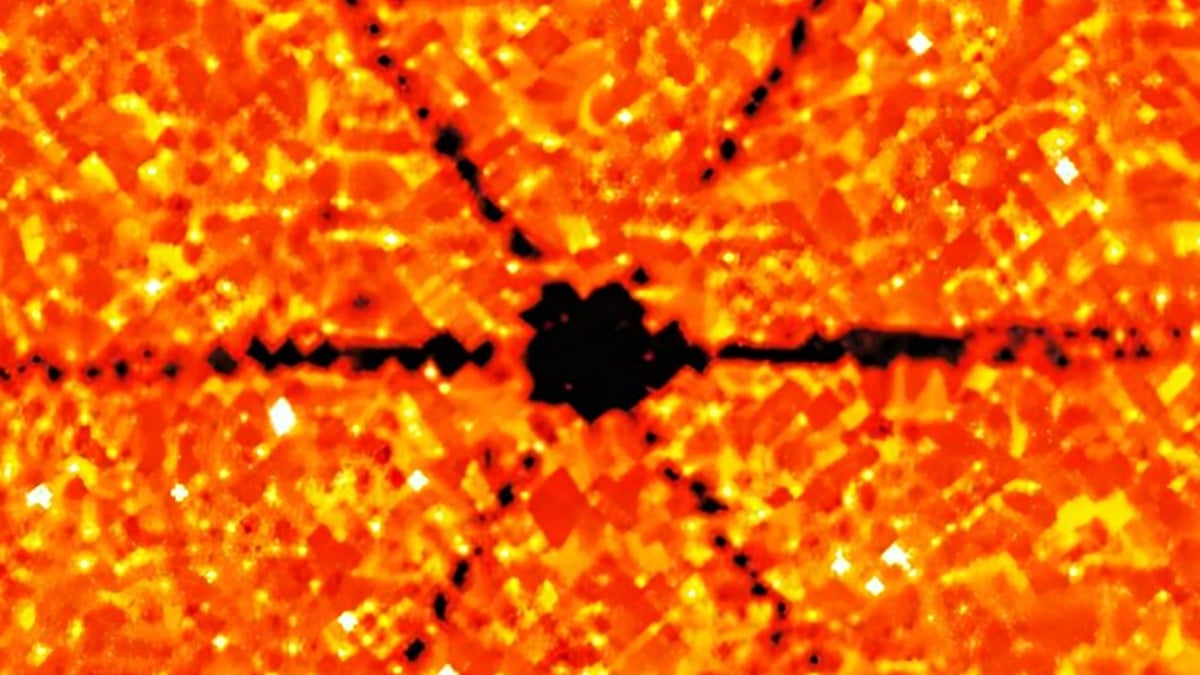
We’ve got another notable first in the field of physics to report: A specific type of quantum behavior in waves of heat has now been observed at room temperature, rather than at the ultra-low cryogenic temperatures that are usually required.
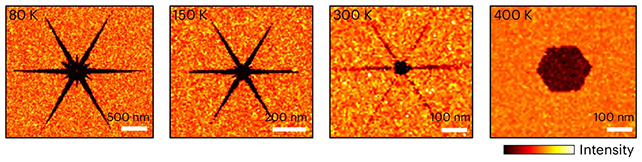
The quantum behavior is phonon focusing, which is where atomic-level, heat-carrying vibrations (the quantum packets known as phonons) travel through a non-metallic material in specific patterns, like rays from a star.
Crucially, this is different from the standard behavior of heat-transporting phonons at room temperature, where the heat spreads out evenly in all directions (a classical rather than quantum way of moving).
It means, potentially, that we can control heat much more precisely in next-generation, quantum-level electronics, and overcome previous bottlenecks. The experiment and observations have been reported in Nature Physics by a team from the University of California, Los Angeles.
“This is a fundamental observation that enables us to think about thermal management in a new way,” says mechanical and aerospace engineer Yongjie Hu.
“By enabling heat to be guided, focused and redistributed with nanoscale precision at room temperature, the discovery establishes a foundation for quantum thermal engineering.”
To get this to happen, the researchers made a couple of key choices. The first was to use boron arsenide (BAs) as the material to heat up, a recently discovered semiconductor that’s an exceptionally good transporter of heat.
It’s also unusual in how much freedom it gives phonons to travel without colliding into each other. At the same time, its crystalline structure offers natural ‘funnels’ for phonons to travel down – both perfect characteristics for an experiment like this.
The second key choice was the use of a nanoscale gold probe that worked as both the heat source and a precise sensor for mapping heat propagation – enabling the researchers to create phonon focusing at around 300 kelvin (about 27 °C or 80 °F).

“These exotic, ray-like temperature profiles concentrated along symmetry directions are markedly distinct from those of classical heat transfer,” write the researchers in their published paper.
“More broadly, the results indicate that wave-governed exotic and quantum transport phenomena, long thought to be confined to cryogenic settings, can become experimentally accessible at technologically relevant temperatures in advanced materials.”
Through further modeling and testing, the researchers determined that the material’s atomic orientation (or 3D arrangement) could create different ray patterns. That’s another sign that this could give us genuine control over the way heat moves in materials.
The phonons were observed traveling for 250 nanometers at room temperature, too small to see with the naked eye, but a huge distance for this type of experiment – solid evidence for genuine phonon focusing.
“Comprehensive validation and quantitative analysis of the temperature-dependent experiments further confirm the robustness, reproducibility and nanoscale resolution of the technique,” write the researchers in their published paper.
While this is all high-level physics for now, there could eventually be some very real practical applications of the technology, particularly when it comes to electronics and quantum technologies.
From regular laptops to quantum computers, heat can hold back processing power and scalability. Even though the research done here is a specific proof of concept, demonstrated in a carefully controlled experimental setup, it points to a future where heat can be more efficiently managed and controlled.
Related: 6,100-Qubit Processor Shatters Quantum Computing Record
The room temperature aspect, as we’ve seen with other quantum technologies and experiments, is a significant threshold that gets us closer to making next-level computing power an everyday reality. Now the challenge is expanding it out of the lab.
“Looking ahead, the discovery of ambient phonon wave dynamics, together with the ability to directionally control heat flow and precisely tailor phonon coupling to other energy carriers, could open new frontiers beyond classical thermal-management frameworks,” write the researchers.
The research has been published in Nature Physics.
This article was fact-checked by Fiona MacDonald and edited by Fiona MacDonald. While we pride ourselves on our process, we are only human. If you spot a mistake, please let us know.