Tag: Science

  • Fast, rewritable computing with DNA origami registers

    Fast, rewritable computing with DNA origami registers

    [ad_1]

    Fast, rewritable computing with DNA origami registers
    Folded, origami-like DNA attached to a glass surface, as shown in this illustration, store data for fast, rewritable DNA-based computation. Credit: Adapted from ACS Central Science 2024, DOI: 10.1021/acscentsci.4c01557

    DNA stores the instructions for life and, along with enzymes and other molecules, computes everything from hair color to risk of developing diseases. Harnessing that prowess and immense storage capacity could lead to DNA-based computers that are faster and smaller than today’s silicon-based versions.

    As a step toward that goal, researchers report in ACS Central Science a fast, sequential DNA computing method that is also rewritable—just like current computers.

    “DNA computing as a liquid computing paradigm has unique application scenarios and offers the potential for massive data storage and processing of digital files stored in DNA,” says Fei Wang, a co-author of the study.

    In living organisms, DNA expression occurs sequentially: Genes are transcribed into RNA, which is translated into proteins. This process happens to many genes simultaneously and repeatedly. If researchers can duplicate this complex, elegant dance in DNA-based computers, these devices could be more powerful than current silicon-based machines.

    Researchers have demonstrated sequential DNA computing for very focused, specialized tasks. But until recently, not much progress had been made in developing more general and programmable DNA devices that could be used and reused for various applications.

    In previous research, Chunhai Fan, Wang and colleagues developed a programmable DNA integrated circuit with many logic gates that act as instructions for the circuit’s operations. Here’s how it worked:

    • Data, 0 or 1, was represented by a short piece of single-stranded DNA, called an oligonucleotide, that contained a series of bases: adenine, thymine, guanine and cytosine. (In nature, the sequence of bases codes for a gene.)
    • For example, two inputs of 1 (DNA strands 1 and 2) would interact with an OR logic gate DNA molecule.
    • Then in a fluid-filled tube, the input oligonucleotide interacted with a logic gate DNA molecule and generated an output oligonucleotide.
    • The output oligonucleotide bound to a different single-stranded DNA that was folded into an origami-like structure, called a register in computer lingo.
    • The oligonucleotide was “read” by reviewing its base sequence, released and used in a vial containing the next gate, and so on.

    This process took hours, and someone had to manually transfer the oligonucleotide from one gate to another vial for the next computing operation. So the team, along with Hui Lv and Sisi Jia, wanted to speed things up.

    To make the reaction processes more efficient and compact, the team first placed the DNA origami register onto a solid glass 2D surface. The output oligonucleotide floating in liquid from a specific logic gate then attached to the glass-mounted register.

    After the output oligonucleotide was read and the logic gate instructions determined, it detached, which reset the register so it could be rewritten, thereby avoiding the need to move or replace registers.

    The researchers also designed an amplifier that boosted the output signal so all the pieces—the gates, oligonucleotides and registers—could find one another more easily. In a proof-of-concept experiment, all the DNA computing reactions took place in a single tube within 90 minutes.

    “This research paves the way for developing large-scale DNA computing circuits with high speed and lays the foundation for visual debugging and automated execution of DNA molecular algorithms,” says Wang.

    More information:
    High-Speed Sequential DNA Computing Using a Solid-State DNA Origami Register, ACS Central Science (2024). DOI: 10.1021/acscentsci.4c01557. pubs.acs.org/doi/abs/10.1021/acscentsci.4c01557

    Provided by
    American Chemical Society


    Citation:
    Fast, rewritable computing with DNA origami registers (2024, December 11)
    retrieved 11 December 2024
    from https://phys.org/news/2024-12-fast-rewritable-dna-origami-registers.html

    This document is subject to copyright. Apart from any fair dealing for the purpose of private study or research, no
    part may be reproduced without the written permission. The content is provided for information purposes only.


    [ad_2]

    Source link

  • Uncovering pigments and techniques used to paint the Berlin Wall

    Uncovering pigments and techniques used to paint the Berlin Wall

    [ad_1]

    Uncovering the pigments and techniques used to paint the Berlin Wall
    Close examination of these chips, labeled according to their blue, yellow or red color, that once belonged to art on the Berlin Wall reveals brushstrokes, multiple layers and the pigments used. Credit: Adapted from the Journal of the American Chemical Society 2024, DOI: 10.1021/jacs.4c12611

    Street art takes many forms, and the vibrant murals on the Berlin Wall both before and after its fall are expressions of people’s opinions. But there was often secrecy around the processes for creating the paintings, which makes them hard to preserve. Now, researchers reporting in the Journal of the American Chemical Society have uncovered information about this historic site from paint chips by combining a handheld detector and artificial intelligence (AI) data analysis.

    “The research highlights the powerful impact of the synergy between chemistry and deep learning in quantifying matter, exemplified in this case by pigments that make street art so captivating,” says Francesco Armetta, a co-author of the study.

    To restore or conserve art, it’s important to collect information on the materials and application techniques. But the painters of the Berlin Wall didn’t document this. In previous studies of other historic artifacts, scientists brought fragments or even whole objects into the lab and, without destroying the samples, identified pigments on them using a technique known as Raman spectroscopy. Although handheld Raman devices are available for on-site investigations, they lack the precision of full-sized laboratory equipment.

    So, Armetta, Rosina Celeste Ponterio and colleagues wanted to develop an AI algorithm that could analyze the output of portable Raman devices to more accurately identify pigments and dyes. In an initial test of the new approach, they analyzed 15 paint chips from the Berlin Wall.

    The researchers first magnified the chips and observed that they all had two or three layers of paint with visible brush strokes. The third layer in contact with the masonry appeared white, which they suggest is from a base coat used to prepare the wall for painting.

    Next, the researchers used a handheld Raman spectrometer to analyze the chips and compared them to spectra collected from a commercial pigment spectra library. They identified the primary pigments in the samples as: azopigments (yellow- and red-colored chips), phthalocyanins (blue and green chips), lead chromate (green chips) and titanium white (white chips). These results were confirmed with other non-destructive techniques, including X-ray fluorescence and optical fiber reflectance spectroscopy.

    Then, the researchers mixed pigments from a commercial acrylic paint brand (used in Germany since the 1800s) with different ratios of titanium white, trying to match colors and the range of tints typical for painters. A knowledge of these ratios could help art conservators prepare the right materials for restoration, say the researchers.

    Using the mixtures’ handheld Raman spectral data, they trained a machine learning algorithm to determine the percentage of pigment. The approach indicated that the Berlin Wall paint chips contained titanium white and up to 75% of pigment, depending on the piece analyzed and according with the color tone. The researchers say these results indicate that their AI model could provide high-quality information for art conservation, forensics and materials science in settings where it’s hard to bring lab equipment to a site.

    More information:
    Francesco Armetta et al. Chemistry of Street Art: Neural Network for the Spectral Analysis of Berlin Wall Colors, Journal of the American Chemical Society (2024). DOI: 10.1021/jacs.4c12611. pubs.acs.org/doi/10.1021/jacs.4c12611

    Provided by
    American Chemical Society


    Citation:
    Uncovering pigments and techniques used to paint the Berlin Wall (2024, December 11)
    retrieved 11 December 2024
    from https://phys.org/news/2024-12-uncovering-pigments-techniques-berlin-wall.html

    This document is subject to copyright. Apart from any fair dealing for the purpose of private study or research, no
    part may be reproduced without the written permission. The content is provided for information purposes only.


    [ad_2]

    Source link

  • E. coli dons polymer ‘Superman cape’ for sustainable chemical production

    E. coli dons polymer ‘Superman cape’ for sustainable chemical production

    [ad_1]

    'Superman' bacteria offer a sustainable boost to chemical production
    Viability and proliferation investigations of polymer-grafted E. coli cells. Credit: Nature Catalysis (2024). DOI: 10.1038/s41929-024-01259-5

    Trillions of bacteria work in the chemical and pharmaceutical industries, helping produce everything from beer and facial creams to biodiesel and fertilizer. The pharmaceutical industry, in particular, relies heavily on bacteria for producing substances like insulin and penicillin.

    Harnessing bacteria’s industrial contributions has revolutionized global health, but their work comes at a high energy cost. Additionally, solvents and continuous production of new bacteria are often necessary, as they don’t last long in their jobs.

    Changzhu Wu, a chemist and associate professor at the Department of Physics, Chemistry, and Pharmacy, University of Southern Denmark, is focused on making industrial bacteria more robust and useful. His goal is to reduce the energy, time, and unwanted chemicals required to maintain bacteria, while also making them reusable so they can work longer before needing to be replaced.

    His latest innovation introduces a type of “super-powered” bacterium and is published in Nature Catalysis.

    “We took a common industrial bacterium, E. coli, and essentially gave it a ‘Superman cape’ to enhance its catalysis capabilities. This reduces energy use and makes the production process more sustainable,” Changzhu Wu explains.

    While E. coli is often associated with foodborne illness, it is widely used in the pharmaceutical industry to produce essential medicines like insulin and growth hormone through various chemical reactions.

    The industry uses vast quantities of E. coli, and replacing them takes a toll on the environment, energy, and time due to factors like high temperatures, extreme pH levels, UV radiation, and exposure to solvents.

    In developing his “Superman cape,” Changzhu Wu sought a material that could envelop the bacteria while still allowing them to interact with their environment to carry out the desired complex chemical reactions.

    The solution: a polymer coating that integrates with the bacterial cell membrane. Polymers are large molecules made up of billions of identical units called monomers.

    “We essentially grafted an E. coli bacterium’s cell membrane with polymers, achieving two important outcomes: First, the bacteria became stronger and more efficient, and could carry out complex chemical reactions more quickly. Second, the bacteria became more protected, allowing for multiple uses. So, it’s a kind of ‘Superman bacterium’ that is more sustainable,” explains Changzhu Wu.

    More information:
    Engineering living cells with polymers for recyclable photoenzymatic catalysis, Nature Catalysis (2024). DOI: 10.1038/s41929-024-01259-5. www.nature.com/articles/s41929-024-01259-5

    Provided by
    University of Southern Denmark


    Citation:
    E. coli dons polymer ‘Superman cape’ for sustainable chemical production (2024, December 11)
    retrieved 11 December 2024
    from https://phys.org/news/2024-12-coli-dons-polymer-superman-cape.html

    This document is subject to copyright. Apart from any fair dealing for the purpose of private study or research, no
    part may be reproduced without the written permission. The content is provided for information purposes only.


    [ad_2]

    Source link

  • Scientists examine how roasting affects the perfect brew

    Scientists examine how roasting affects the perfect brew

    [ad_1]

    Scientists examine how roasting affects the perfect brew
    How to get the perfect cup of coffee? Credit: MarkSweep/Wikimedia Commons. https://commons.wikimedia.org/wiki/File:Roasted_coffee_beans.jpg.

    A new study in published in Scientific Reports suggests that the perfect cup of coffee is influenced by a complex blend of variables such as bean processing method, brewing time, and grind size, not just the roast level.

    Caffeine content and extraction yield are two of the most vital variables for coffee enthusiasts, especially those who approach it with precision.

    Extraction yield is a measure of the amount of soluble material from the coffee grounds that gets dissolved in the brewed coffee. It essentially reflects the efficiency of the brewing process in extracting compounds from the coffee grounds.

    Led by Dr. Zachary R. Lindsey, Assistant Professor of Physics at Berry College, U.S., the study focuses on how the degree of roast affects these two variables. Phys.org spoke to Dr. Lindsey, a self-proclaimed coffee nerd about the study.

    “Over 20 years ago, I heard a barista claim that dark roasts have more caffeine, but a decade later, I was exposed to the contrasting idea that light roasts were the king of caffeine. Yet, I couldn’t find any convincing data.”

    “It wasn’t until I picked up coffee roasting as a hobby in 2022 that I started to see the missing pieces of the puzzle. Luckily, two passionate undergraduate students on my research team were also intrigued by this mystery, and we got to work,” said Dr. Lindsey.

    Choice of coffee, roast, and brew method

    The researchers chose Ethiopian coffee to conduct their study. Ethiopia has a long tradition of producing coffee dating back centuries as it is the country where Coffee arabica, aka the coffee plant, originates.

    In this, they are investigating natural and washed processed coffee.

    In the natural method, the coffee cherries are dried with the seeds still inside. The seeds are separated after drying, resulting in fruity and complex flavors in the coffee beans. On the other hand, in the washed method, the seeds are separated from the coffee cherries and then dried, leading to a cleaner and brighter flavor profile.

    The researchers then used five different degrees of roasts for the green coffee beans, choosing a brewing time of one, two, and ten minutes.

    The researchers chose the AeroPress brewing method with a 15:1 water-to-coffee ratio. The AeroPress is a pressure-based brewing method, similar to an espresso machine, but on a smaller scale. The AeroPress steeps the coffee and uses pressure to extract the brew through a paper filter.

    Dr. Lindsey explained the choice behind the AeroPress, saying, “When selecting a brew method, the main goal was to implement a procedure that could consistently produce brews within a wide range of extraction yields by only varying the brew time.”

    “The AeroPress stood out as a means to achieve these desired outcomes with minimal variation across all roast batches.”

    Overall, the researchers had 30 unique combinations of brewed coffee to study.

    Analyzing the coffee

    The researchers used three analysis techniques to analyze caffeine content and extraction yield.

    To measure compounds like caffeine, chlorogenic acids, and other soluble compounds in the brewed coffee, they used high-performance liquid chromatography (HPLC).

    Scientists examine how roasting affects the perfect brew
    SEM image of roasted coffee seed (left) and overlaid ellipses mapped to pores (right) for determination of fractional porosity (scale bar = 100 μm). Credit: Scientific Reports (2024). DOI: 10.1038/s41598-024-80385-3

    This method separates different compounds in the coffee based on their interactions with a standard material, quantifying individual concentrations.

    Next, they used refractometry. This method measures the bending of light through the brewed coffee, indicating the extraction yield, i.e., how much soluble material is dissolved from the coffee grounds.

    Finally, they used scanning electron microscopy (SEM) to observe the surface of the coffee beans and grounds. This helped them to examine the grain size and porosity. SEM provides information about the impact of roasting on the physical features of the coffee beans.

    “SEM allows for a straightforward characterization approach that provides two-dimensional information about the structure of the roasted coffee. The evolving porosity of the roasting coffee plays a pivotal role in compound mobility during roasting and brewing,” explained Dr. Lindsey.

    Porosity, caffeine, and extraction

    The researchers found that caffeine content in the brewed coffee depended on the roasting process and the extraction yield.

    “During roasting, the volume and porosity of the coffee seeds increase as the roast progresses, which makes it easier for compounds to move in or out of the system,” explained Dr. Lindsey.

    A greater porosity implies more of the inner surface area of the coffee grounds is exposed, making it easier for water to penetrate and dissolve compounds like caffeine and flavors. This has an impact on the entire extraction process that occurs during brewing.

    For the caffeine content, the researchers found that when using identical brewing setups, light and medium roasts had a higher caffeine content than darker roasts. This is due to the caffeine loss during roasting, resulting in typically lower extraction yields for darker roasts.

    Conversely, they found that the darker roast’s caffeine content was higher when the extraction yield was kept consistent for all the roasts.

    “However, darker roasts consistently exhibited lower extraction yields than light and medium roasts, so it was not always possible to achieve a common extraction yield for all degrees of roast,” added Dr. Lindsey.

    Discover the latest in science, tech, and space with over 100,000 subscribers who rely on Phys.org for daily insights.
    Sign up for our free newsletter and get updates on breakthroughs,
    innovations, and research that matter—daily or weekly.

    New insights

    The competing mechanisms of increased porosity improving extraction efficiency and darker roasts losing extractable compounds revealed a unique insight contradicting previous assumptions.

    Caffeine sublimation—the process of caffeine transitioning directly from a solid to a gas—occurs at higher temperatures than previously thought.

    “Although the interplay between roast degree and caffeine content has been addressed over 20 times in the literature, the prevailing theory is that caffeine remains stable during the roasting process.”

    “However, we establish a clear relationship between roast degree, caffeine content, and extraction yield,” said Dr. Lindsey.

    The researchers plan to extend this work to study the relationship between roast degree and extraction yield for decaffeinated coffees. They also aim to test it with percolation-based brewing methods to see if they yield similar results.

    The bottom line is, if you want a cup of coffee with the maximum caffeine content choose a medium roast, says Dr. Lindsey.

    More information:
    Zachary R. Lindsey et al, Caffeine content in filter coffee brews as a function of degree of roast and extraction yield, Scientific Reports (2024). DOI: 10.1038/s41598-024-80385-3

    © 2024 Science X Network

    Citation:
    Scientists examine how roasting affects the perfect brew (2024, December 11)
    retrieved 11 December 2024
    from https://phys.org/news/2024-12-scientists-roasting-affects-brew.html

    This document is subject to copyright. Apart from any fair dealing for the purpose of private study or research, no
    part may be reproduced without the written permission. The content is provided for information purposes only.


    [ad_2]

    Source link

  • US Meat, Milk Prices Should Spike if Donald Trump Carries Out Mass Deportation Schemes

    US Meat, Milk Prices Should Spike if Donald Trump Carries Out Mass Deportation Schemes

    [ad_1]

    In recent earnings calls, shareholders in some publicly traded meat companies have asked whether the Trump administration’s deportation plans—among other issues—may pose a challenge to their industry. “We’ve been there before. It did not impact our business,” said Tim Klein, CEO of National Beef, which is owned by the Brazilian food company Marfrig, in response to a question from a shareholder. In response to a similar question in a Tyson Foods earnings call, CEO Donnie King said, “There’s a lot that we don’t know at this point, but I would remind you that we’ve successfully operated this business for over 90 years, no matter the party in control.”

    It’s not clear whether the Trump regime would target meatpacking facilities operated by the biggest firms in the industry, given the favorable treatment these companies received at times during the first Trump presidency. During the Covid-19 pandemic, President Trump issued an executive order that allowed plants to keep operating, even as meatpackers were some of the hardest hit by infections. The US House Select Committee on the Coronavirus Crisis later found that Tyson’s legal department drafted a text of the proposed order.

    “These large meatpacking companies prevented additional protections from being put in place to protect workers, in part by engaging in a concerted effort with Trump administration political officials to insulate themselves from oversight, to force workers to remain in dangerous conditions, and to shield themselves from liability for any resulting worker illness or death,” the committee concluded in the report released in December 2022.

    The supply of labor is tight in meatpacking plants and the farming industry as a whole, says Cesar Escalante, a professor at the University of Georgia’s College of Agriculture & Environmental Sciences. The industry is in need of more workers, says Escalante, who argues that the US should expand the H-2A seasonal agricultural worker visa scheme to include more livestock workers. Smaller farms are more likely to be affected by a lack of workers, says Escalante, while larger farms may switch to mechanization.

    If meatpacking workers are deported en masse, then that could translate into a rise in prices for consumers. A report from Texas A&M Agrilife Research estimates that eliminating immigrant labor on US dairy farms would nearly double retail milk prices. It’s not clear what the impact of Trump’s deportation plan would be on meat or food prices more generally, because so much about the plan remains unknown. “We don’t know yet how this is all going to pan out,” Hubbard says.

    [ad_2]

    Source link

  • Enigmatic Alpine avalanches to get a boost as Earth warms

    Enigmatic Alpine avalanches to get a boost as Earth warms

    [ad_1]

    Nature, Published online: 11 December 2024; doi:10.1038/d41586-024-04009-6

    Climate change could raise the frequency of ‘wet-snow avalanches’ at high elevations in the Swiss Alps.

    [ad_2]

    Source link

  • Self-organized patterning of crocodile head scales by compressive folding

    Self-organized patterning of crocodile head scales by compressive folding

    [ad_1]

    Animal husbandry

    Fertilized crocodile eggs (imported from Seronera Crocodile Farm) were transported to the University of Geneva and incubated at 31 °C in moist vermiculite. All treated and non-treated crocodile embryos were fixed and stored in 10% neutral buffered formalin (NBF). All non-fluorescence imaging of embryonic crocodile samples was undertaken using the Keyence VHX 7000 digital microscope. Imaging of hatched crocodile specimens was undertaken using an overhead-mounted Nikon D800 camera. Maintenance of, and experiments with, crocodile embryos and juveniles were approved by the Geneva Canton ethical regulation authority (authorization GE10619B) and performed according to Swiss law. The sample sizes are specified in figure legends and the Supplementary Information. Randomization and blinding was not required.

    Nanoindentation

    A Piuma nanoindenter (Optics11) was used to acquire stiffness measurements (effective Young’s modulus, Pa) of embryonic crocodile skin surface. When comparing measurements in two skin samples, a change in epidermal keratinization will produce a change in surface stiffness, which is very likely to be correlated with a change of the same sign in the effective overall Young’s modulus of the whole multilayered epidermis. In other words, an increase in epidermal surface stiffness is very likely accompanied by an increased stiffness of the whole epidermis. Freshly dissected upper jaws were positioned lateral side upwards, submerged in PBS. A probe with a tip radius of 99 µm and stiffness rating of 0.48 N m−1 was used to indent at a depth of 2,000 nm. Only measurements from load-displacement curves with a Hertzian contact model fit of ≥95% were subsequently analysed. Each biological replicate for the embryonic nanoindentation series was indented 10 times (Fig. 1c) or 5 times (Fig. 2f). These indentation points were positioned in a single row with each point separated by 120 µm. Plots showing the mean effective Young’s modulus values for each biological replicate with s.d. are presented. Statistical analysis was undertaken in Prism 9 (GraphPad).

    Confocal microscopy

    Confocal microscopy was used for embryonic crocodile samples stained with the Fast Green FCF dye (Sigma-Aldrich) according to a protocol of whole-mount collagen staining25. Image acquisition was undertaken as previously described25, using the SP8 microscope (Leica Microsystems), with a ×63 oil-immersion objective (numerical aperture, 1.4). Fast Green was excited at 627 nm and the signal was detected in the range of 630–730 nm. Image reconstruction was undertaken using Imaris (Oxford Instruments).

    H&E staining

    Fixed embryonic crocodile samples were dissected and embedded in paraffin as previously described24. Paraffin sections were cut at 10 µm with a RM2255 microtome (Leica Microsystems) before staining with haematoxylin and eosin (H&E). Slides were imaged using an automated slide scanner (3DHISTECH).

    In ovo intravenous EGF injections in crocodiles

    The injection of crocodile eggs was undertaken in accordance with our previously published work20,21 (https://youtu.be/qCYWSgbffnY). Crocodile eggs were incubated until the appropriate developmental stage and then cleaned with 70% ethanol. Eggs were candled to identify a suitable vein for injection, and a detailing saw (Micromot 50/E, Proxxon) was used to remove the shell while keeping the underlying membrane intact. The eggshell was then removed using fine forceps, and mineral oil was applied to the membrane with a cotton bud, thereby increasing membrane transparency to allow clear visualization of the underlying veins. The samples were injected with either 30 µl of PBS as a control or 30 µl of PBS containing recombinant murine EGF (PeproTech). Different doses of EGF were injected (0.625 µg, 1.5 µg or 2 µg). Patent Blue was also added to the solution to enable visualization of the solution entering the vein during injection. Injections were undertaken using a Hamilton syringe attached to a micromanipulator (MM33 right, Marzhauser). Once injected, the eggs were cleaned to remove excess mineral oil, and the eggshell window was covered with adhesive tape. Treated embryos were then returned to their incubator. The samples were each injected three times over the course of 10 days for each experiment (Fig. 2a). At collection, the embryos were treated with an intravenous injection of EdU to label proliferating cells (Baseclick); embryo collection and fixation were undertaken 3 h after EdU injection. Some EGF-treated embryos were used for nanoindentation at the end of the experiment, and some others were incubated until hatching. Embryos were subsequently fixed in 10% NBF at 4 °C and imaged with a Keyence VHX 7000 digital microscope. Every embryo injected with EGF exhibited modified head-scale patterning. All of the replicates from these experiments are shown in Supplementary Fig. 4 and are summarized in Supplementary Table 1.

    The drug that we use here (EGF) has the remarkable property of specifically promoting epidermal growth and differentiation without exhibiting strong deleterious effects in other aspects of in vivo embryonic development. Further validation of the parameters involved in the compression-folding process of crocodile head-scale patterning will require the identification of other drugs that would specifically affect one parameter at the time. For example, it would be particularly interesting to pharmacologically perturb the 3D architecture of collagen in developing crocodile embryos to investigate the corresponding effects on skin folding of the dorsal versus lateral upper jaw surface. Unfortunately, drugs currently known to effect collagen organization (such as β-aminoproprionitrile, BAPN) are highly toxic in vivo as they strongly affect the development of multiple connective tissues such as skin, bones and blood vessels. Given the great difficulties of experimentation with crocodile embryos, the screening of drugs that could, in vivo, specifically affect one mechanical parameter at a time in the skin, could be initially performed in a more classical model (such as the chicken) with more reliable source of embryos.

    LSFM

    The upper and lower jaws of fixed embryonic crocodile samples were dissected, dehydrated into methanol, and bleached with hydrogen peroxide, before rehydration and permeabilization in PBS with Triton X-100 (Sigma-Aldrich) (PBST). For nuclear staining, the samples were incubated in either TO-PRO-3 iodide or YO-PRO-1 iodide (3:1,000, Thermo Fisher Scientific) for 6 h. EdU-positive cells (EdU+) were detected using the EdU detection kit manufacturer’s guidelines (Baseclick). The samples were then dehydrated into methanol and collagen staining was undertaken in anhydrous conditions with the same Fast Green protocol25 as for confocal microscopy (see above). Samples were then cleared according to the iDISCO+ protocol37. Upper and lower jaw samples were imaged separately using a light-sheet microscope (Ultramicroscope Blaze, Miltenyi Biotec). Selected specimens were restained with Alizarin Red in potassium hydroxide (KOH) and re-imaged to visualize the developing calcified bone matrix (Extended Data Fig. 1b). Image stacks were processed using ImageJ38, before rendering with the Redshift engine of Houdini (SideFX) and the Unreal Engine (Epic Games). A summary of replicates used for LSFM is shown in Supplementary Table 5. Each sample includes both upper and lower jaws, which we scanned separately.

    3D reconstructions of hatched crocodiles

    Using our custom-built imaging system39, combining a robotic arm, high-resolution camera and illumination basket of light-emitting diodes, we combine ‘photometric stereo’ and ‘structure from motion’ to reconstruct the precise 3D surface mesh and colour-texture of hatched crocodile heads (Fig. 5b–e and Extended Data Fig. 6a–d). To compare the polygonal scale sizes among individuals, we first compute the minimum principle curvature of the meshes. Then, the folding network of each sample is computed by applying a skeletonization algorithm40, followed by graph simplification (using MATLAB R2021a), on the negative curvature regions of the mesh. Using the colour texture of meshes, the folding networks were manually completed and cleaned using Houdini (SideFX).

    Segmentation of LSFM data

    Using TO-PRO-3, YO-PRO-1, EdU, Alizarin Red and Fast Green staining (see above), we segmented the light-sheet microscopy data to extract (in both the upper and lower jaws) the geometry of the epidermis, dermis and bone tissues (Supplementary Video 6), as well as the dominant orientations of the dermal collagen fibres, and the distribution of proliferating cells in the dermis and epidermis. The segmented data were used to build a finite element model (FEM, see below) of the crocodile head.

    Cell nuclei staining signal enables precise segmentation of the epidermis from the dermis because the former exhibits a higher cell density (Fig. 3a). More specifically, the 3D image generated by LSFM on the basis of the TO-PRO-3/YO-PRO-1 fluorescence signal was subjected to 3D Canny’s edge detection41 in MATLAB-R2021a, generating a 3D binary image in which non-zero voxels form point clouds corresponding to two 3D surfaces: the surface of the epidermis and the epidermis–dermis boundary. For each of these two surfaces, we compute at each point the surface normal vector from the intensity gradient. The position of points and their corresponding normal vectors are then fed to a screened Poisson surface reconstruction algorithm42 in Meshlab43 to reconstruct triangular surface meshes, which effectively represent the initial point clouds in a much lighter format: 3D meshes are much easier to manipulate, for example, with the Laplacian smoothing algorithm to filter out the artifactual stair-step patterns in the original voxelized data format. The epidermis surface and the epidermis–dermis boundaries allow for computing the epidermis thickness across each control and treated sample at different developmental stages.

    Collagen network 3D architecture is likely to become instrumental in biomechanical modelling25,26 because it endows tissues with distinctive mechanical properties such as anisotropic response to homogeneous stress. Thus, we assess the orientation(s) of collagen fibres in the dermis across the face and jaws of developing crocodile embryos (Fig. 3b). To this end, we use our recently published whole-mount Fast Green staining method, which provides unmatched visualization of 3D collagen network architecture via confocal or light-sheet microscopy25. In brief, (1) the two most dominant orientation(s) of populations of collagen fibres were identified by determining the dominant 3D Fast Fourier transform coefficients in each of 13,000 homogeneously distributed dermal samples (cubic patches of 50 × 50 × 50 voxels) of 3D light-sheet images (Supplementary Note 1); (2) smoothing of the spatial variation of fibres orientations was achieved with an exact optimization procedure using a fibre axis mismatch energy functional (Supplementary Note 2); and (3) the two dominant fibre orientations, both tangential to the dermis mid-plane, were interpolated using spectral least-squares approximation (Supplementary Note 3).

    After standard EdU labelling and detection (Supplementary Video 3), we used a 3D principal curvatures approach36 (on the fluorescence signal) to segment proliferating cells in the jaws of an embryonic crocodile at E51, that is, at the onset of head-scale emergence (Fig. 3c). This approach is highly efficient for individually segmenting cells when they are grouped (that is, in contact). As the signal intensity is embedded in a 3D domain, three signal principal curvatures k1,2,3 are computed (in MATLAB) for each voxel, and voxels characterized by ks > kthreshold, where \({k}_{s}={({k}_{1}^{+}{k}_{2}^{+}{k}_{3}^{+})}^{\frac{1}{3}}\) and \({k}_{i}^{+}=\max ({k}_{i},0)\) are stored. The centroid of the connected voxels is considered as the location of an EdU+ cell. We then compute the density of EdU+ cells, separately for the dermis and the epidermis, by choosing sampling points in the corresponding segmented tissue layers. The space surrounding each sampling point is limited to a box of 80 × 80 × 80 voxels clipped by the layer boundaries. The density of EdU+ cells at a sampling point is computed as the number of cells inside the clipped box divided by its volume. In our numerical model, densities of proliferating cells are represented as a space-dependent growth function. We transfer this information to the 3D model using a spectral least-squares approximation approach to interpolate data on the spatial modes of the target mesh (details are provided in Supplementary Note 3).

    For segmenting bone tissue, we use either the 3D Canny’s edge detection of the (very strong) Alizarin Red signal or a semi-automatic procedure for samples with (weaker) Fast Green or EdU signals. In the latter case, we (1) choose several sections in the x, y and z directions and manually mark the separation between the dermis and the bone, (2) store the coordinates of all profile points as a 3D point cloud and compute their normal with Variational Implicit Point Set Surface44 and (3) use screened Poisson surface reconstruction42 from Meshlab43 to generate the mesh corresponding to the bone surface.

    A biomechanical model of head-scale emergence

    We use the segmented data to build a 3D finite-element numerical growth model. Triangular meshes were generated, both for upper and lower jaws, at the surface boundaries of the epidermis, dermis and bone of embryos before the onset of head-scale patterning (Fig. 1b and see above). The epidermis surface and the epidermis–dermis interface were smoothed to remove any artificial local deformations associated with sample preparation, including dehydration into methanol. The 3D volume of each of the three layers was represented as a tetrahedral mesh generated with TetGen45 (Extended Data Fig. 8a).

    During simulated growth, the deformation of tetrahedral elements is realized through finite-strain theory in which the bulk material configuration at current time t is represented as the spatial coordinates of a collection of points in the form of a vector variable x = x(X,t), where X is the spatial coordinates of these points at a reference configuration, that is, at t = 0 (Extended Data Fig. 8b). The coordinates between the current and the reference configurations are connected by the deformation gradient map, F—that is, a second-order tensor that incorporates the elastic and growth deformations. The elastic energy and the mechanical stress stored in each tetrahedral element is then calculated from the neo-Hookean material model, known to behave appropriately under large deformations30,31,46, and allowing the incorporation of anisotropic material, such as collagen fibres47 (Supplementary Note 4). The direction of fibres, as well as the spatial pattern of cell proliferation density, both inferred from LSFM data (Fig. 3b,c), are fed to the mechanical model. However, the elastic moduli, fibre stiffness and final amount of growth are considered as unknown parameters. Note that the absolute values of stiffness are irrelevant in the numerical simulations as the model key parameters are the fibre stiffness relative to the dermis and epidermis moduli, as well as the ratio of epidermis to dermis stiffnesses (Young’s moduli).

    Numerical simulations and parameter optimization

    To perform numerical simulations, the mechanical model formulation described above is discretized for tetrahedral elements using the FEM and integrated with contact and viscous forces (Supplementary Note 5). The final model is then implemented in an in-house application that uses NVIDIA GPUs for high-performance computation. For that purpose, we used the CUDA programming language to develop intensive-computation kernels, whereas C++ is used for data management, geometry processing, input/output operations and the graphical user interface. Our application integrates the following open-source libraries: Dear ImGui (https://github.com/ocornut/imgui, MIT licence) for the graphical user interface, CUDA C++ Core Libraries (https://github.com/NVIDIA/cccl, Apache-2.0, FreeBSD, BSD-3-Clause licences) for parallel algorithms, Eigen (https://gitlab.com/libeigen/eigen, MPL-2.0, BSD licences) for linear algebra and libigl (https://github.com/libigl/libigl, GPL-3.0, MPL-2.0 licences) for geometry processing. The simulation input is a tetrahedral mesh that defines the geometry of the crocodile head (epidermis, dermis and bone layers). Moreover, a set of model parameters are used: in addition to the dermal collagen fibres orientation and stiffness, we include, both for epidermis and dermis, the Young’s modulus and Poisson’s ratio, the growth rate functions and the cell proliferation pattern. The deformation of the skin is then computed and the final geometry is generated as a tetrahedral mesh.

    The mechanical model is integrated with a Bayesian optimization process (bayesopt library from MATLAB R2021a with parallel sampling), that is, a machine-learning global minimization algorithm. The optimality criterion consists of the distance between the metrics (integrating multiple topological and geometrical features, see below) of the steady-state simulated geometry versus LSFM-acquired meshes. To compute the metrics of a folding network, we first compute the minimum principle curvature of the corresponding surface mesh representing the epidermis boundary. We then segment the skin folds by applying a skeletonization algorithm40, followed by graph simplification (using MATLAB R2021a), on the negative curvature regions of the mesh. Next, we compute the following geometrical and topological features of the network: number of domains (cycles), perimeters of domains, lengths of edges, curvatures of edges and lengths of incomplete edges. The final metrics is a vector of which the components are the means of these features, normalized to the diagonal length of its bounding box. Given that components within a metrics vector may differ significantly among each other, we need to normalize them properly. For this purpose, we use LSFM data to compute the metrics of controls at E64 and treated individuals (2 μg EGF) at E64. We then compute the interindividual (that is, among all individuals) mean and s.d. of each component (Fig. 2e). We finally normalize the components of any newly computed metrics by subtracting the interindividual mean and dividing by the interindividual s.d.

    Finding optimal parameter values for control and treated targets is performed in two steps. First, we use an E64 control target mesh and perform optimization on the six-dimensional parameter space, including epidermis Young’s modulus, Eepidermis (keeping Edermis = 1); epidermis and dermis Poisson’s ratios, vepidermis/dermis; dermis tangential growth values, \({G}_{T,{\rm{dermis}}}^{+/-}\) (keeping \({G}_{T,{\rm{epidermis}}}^{+/-}\) at 80% of the dermis values); and the fibre stiffness, k1 (k2 being set to 0). Second, using a 2 μg EGF-treated target, we perform another optimization on the three-dimensional parameter space including epidermis-related parameters, that is, Eepidermis, vepidermis and \({\lambda }_{T,{\rm{epidermis}}}^{{\rm{EGF}}}\) (additional epidermal tangential growth induced by EGF). See Supplementary Notes 4 and 6 for the definitions of parameters and Supplementary Table 4 for the complete list of parameter values. To minimize the distance between the metrics vectors of the simulated versus LSFM target geometry (control or treated), we use a Gaussian process (that is, a generalization of the multivariate normal distribution to infinite dimensions) in the optimization loop to approximate posterior mean and variance functions from which the objective function is sampled (Extended Data Fig. 8d). The posterior functions are updated at each iteration according to Bayesian inference and this information is then used to compute the expectation of the improvement function, which measures the chance of observing an objective (that is, the distance between simulation and observation) smaller than the minimum objective observed so far (Supplementary Note 7). The optimization process, which typically takes a few thousand iterations, continues until no more improvement is observed in the last 500 iterations.

    Reporting summary

    Further information on research design is available in the Nature Portfolio Reporting Summary linked to this article.

    [ad_2]

    Source link

  • Meyers, M. A. & Chawla, K. K. Mechanical Behavior of Materials 2nd edn (Cambridge Univ. Press, 2008).


    Google Scholar
     

  • Miao, J., Ishikawa, T., Robinson, I. K. & Murnane, M. M. Science 348, 530–535 (2015).

    Article 
    PubMed 

    Google Scholar
     

  • Withers, P. J. et al. Nature Rev. Methods Primers 1, 18 (2021).

    Article 

    Google Scholar
     

  • Ade, H. & Hsiao, B. Science 262, 1427–1429 (1993).

    Article 
    PubMed 

    Google Scholar
     

  • Gomonay, O., Baltz, V., Brataas, A. & Tserkovnyak, Y. Nature Phys. 14, 213–216 (2018).

    Article 

    Google Scholar
     

[ad_2]

Source link

  • The AI revolution is running out of data. What can researchers do?

    The AI revolution is running out of data. What can researchers do?

    [ad_1]

    The Internet is a vast ocean of human knowledge, but it isn’t infinite. And artificial intelligence (AI) researchers have nearly sucked it dry.

    The past decade of explosive improvement in AI has been driven in large part by making neural networks bigger and training them on ever-more data. This scaling has proved surprisingly effective at making large language models (LLMs) — such as those that power the chatbot ChatGPT — both more capable of replicating conversational language and of developing emergent properties such as reasoning. But some specialists say that we are now approaching the limits of scaling. That’s in part because of the ballooning energy requirements for computing. But it’s also because LLM developers are running out of the conventional data sets used to train their models.

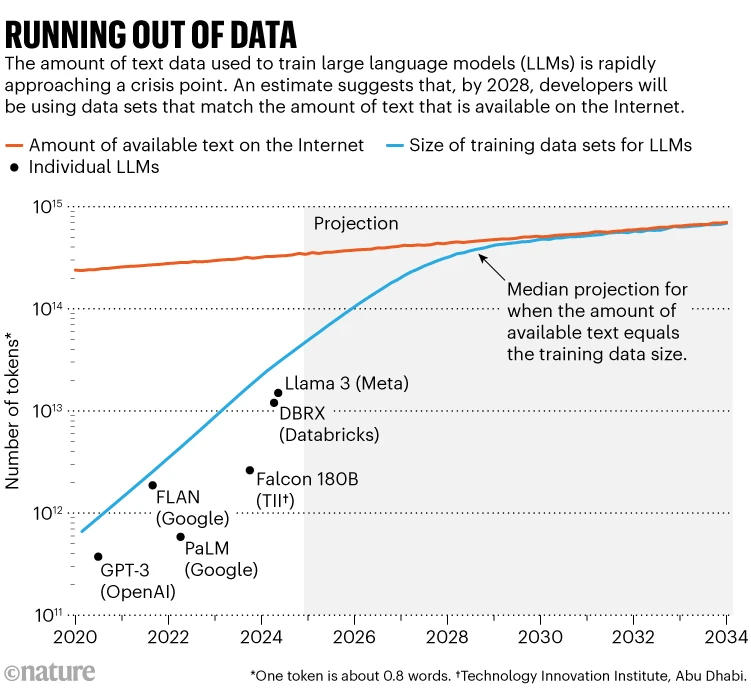
    A prominent study1 made headlines this year by putting a number on this problem: researchers at Epoch AI, a virtual research institute, projected that, by around 2028, the typical size of data set used to train an AI model will reach the same size as the total estimated stock of public online text. In other words, AI is likely to run out of training data in about four years’ time (see ‘Running out of data’). At the same time, data owners — such as newspaper publishers — are starting to crack down on how their content can be used, tightening access even more. That’s causing a crisis in the size of the ‘data commons’, says Shayne Longpre, an AI researcher at the Massachusetts Institute of Technology in Cambridge who leads the Data Provenance Initiative, a grass-roots organization that conducts audits of AI data sets.

    The imminent bottleneck in training data could be starting to pinch. “I strongly suspect that’s already happening,” says Longpre.

    Running out of data: Chart showing projections of the amount of text data used to train large language models and the amount of available text on the Internet, suggesting that by 2028, developers will be using data sets that match the total amount of text that is available.

    Source: Ref. 1

    Although specialists say there’s a chance that these restrictions might slow down the rapid improvement in AI systems, developers are finding workarounds. “I don’t think anyone is panicking at the large AI companies,” says Pablo Villalobos, a Madrid-based researcher at Epoch AI and lead author of the study forecasting a 2028 data crash. “Or at least they don’t e-mail me if they are.”

    For example, prominent AI companies such as OpenAI and Anthropic, both in San Francisco, California, have publicly acknowledged the issue while suggesting that they have plans to work around it, including generating new data and finding unconventional data sources. A spokesperson for OpenAI, told Nature: “We use numerous sources, including publicly available data and partnerships for non-public data, synthetic data generation and data from AI trainers.”

    Even so, the data crunch might force an upheaval in the types of generative AI model that people build, possibly shifting the landscape away from big, all-purpose LLMs to smaller, more specialized models.

    Trillions of words

    LLM development over the past decade has shown its voracious appetite for data. Although some developers don’t publish the specifications of their latest models, Villalobos estimates that the number of ‘tokens’, or parts of words, used to train LLMs has risen 100-fold since 2020, from hundreds of billions to tens of trillions.

    That could be a good chunk of what’s on the Internet, although the grand total is so vast that it’s hard to pin down — Villalobos estimates the total Internet stock of text data today at 3,100 trillion tokens. Various services use web crawlers to scrape this content, then eliminate duplications and filter out undesirable content (such as pornography) to produce cleaner data sets: a common one called RedPajama contains tens of trillions of words. Some companies or academics do the crawling and cleaning themselves to make bespoke data sets to train LLMs. A small proportion of the Internet is considered to be of high quality, such as human-edited, socially acceptable text that might be found in books or journalism.

    The rate at which usable Internet content is increasing is surprisingly slow: Villalobos’s paper estimates that it is growing at less than 10% per year, while the size of AI training data sets is more than doubling annually. Projecting these trends shows the lines converging around 2028.

    At the same time, content providers are increasingly including software code or refining their terms of use to block web crawlers or AI companies from scraping their data for training. Longpre and his colleagues released a preprint this July showing a sharp increase in how many data providers block specific crawlers from accessing their websites2. In the highest-quality, most-often-used web content across three main cleaned data sets, the number of tokens restricted from crawlers rose from less than 3% in 2023 to 20–33% in 2024.

    Several lawsuits are now under way attempting to win compensation for the providers of data being used in AI training. In December 2023, The New York Times sued OpenAI and its partner Microsoft for copyright infringement; in April this year, eight newspapers owned by Alden Global Capital in New York City jointly filed a similar lawsuit. The counterargument is that an AI should be allowed to read and learn from online content in the same way as a person, and that this constitutes fair use of the material. OpenAI has said publicly that it thinks The New York Times lawsuit is “without merit”.

    If courts uphold the idea that content providers deserve financial compensation, it will make it harder for both AI developers and researchers to get what they need — including academics, who don’t have deep pockets. “Academics will be most hit by these deals,” says Longpre. “There are many, very pro-social, pro-democratic benefits of having an open web,” he adds.

    Finding data

    [ad_2]

    Source link

  • Five countries having a clear impact on the latest materials-science research

    Five countries having a clear impact on the latest materials-science research

    [ad_1]

    Materials science is a field that is seeing strong growth in the Nature Index. From 2019 to 2023, there was a 25% increase in the number of articles in the database related to the subject and last year these papers represented 27.2% of all research in its journals. In terms of the countries publishing this research, China now represents around half of global output. But other Asian nations, and some outside the region too, are making significant contributions. Here, we focus on five countries whose materials-science output over the period is noticeable for variety of reasons. South Korea has consistently maintained a top-five position by growing its Share, India is a rapidly emerging force in the field, Singapore stands out as a key location despite its size, and two European nations — Italy and Denmark — seem to be bucking the trend for Western countries losing Share.

    South Korea

    Population (2023): 51.71 million

    GDP per capita (2022): US$32,395

    Researchers (full-time equivalent) per million inhabitants (2021): 9,081.9

    Nature Index materials science rank: 5

    South Korea is an important player in materials science and has ranked fifth by Share in the field every year from 2019 to 2023. The field is a clear priority for the country, as reflected by its proportion of materials-science Share relative to its overall Nature Index output (49.7%), a figure that is higher than China (45.7%) and more than three times higher than that of the United States (15.4%).

    The quality of its materials-science output is shown by South Korea-based researchers authoring the most highly cited Nature Index paper in the field in 2023. The scientists, mainly from the Ulsan National Institute of Science and Technology, developed a perovskite solar cell with a certified power-conversion efficiency of 25.7%. The article1, which was published in Nature, had been cited 972 times at the time of Nature Index’s data analysis.

    The country is a big spender on research and development (R&D) and has world-leading numbers of researchers relative to its population size, according to statistics from the United Nations cultural organization UNESCO. But with a birthrate that is also the lowest in the world and dwindling numbers of students going into higher education, South Korea has challenges to overcome to remain as a global leader in science.

    India

    Population (2023): 1.43 billion

    GDP per capita (2022): US$2,366

    Researchers (full-time equivalent) per million inhabitants (2020): 260.4

    Nature Index materials science rank: 7

    India’s ranking in materials science in the Nature Index has been steadily rising, climbing six places from 2019 to 2023 with its Share rising by 70% across this time period, from 234.11 in 2019 to 397.64 in 2023. Between 2022 and 2023, India’s percentage increase in Share was 33%, higher than China’s (22%), although these figures represent increases in Share of 97.85 for India and 1,879.29 for China.

    India also has the lowest article Count among the ten leading countries in materials science. This indicates that scientists from India are, on average, collaborating less with researchers in other countries on materials-science papers tracked by the Nature Index, which could be an area to improve in the coming years. India did not feature in any of the ten leading country pairs in materials science by bilateral collaboration score (CS), in contrast to China which features in seven of these.

    Given its large population and commitment to materials science as a priority area (its materials-science Share relative to overall Share is 26.6%), India has huge potential to further climb the rankings. But it might need to ensure it invests in retaining domestic talent before it moves to other countries. Although the Indian government has attracted science and technology students using large numbers of scholarships and fellowships, the country’s research expenditure (from government and non-government sources) as a percentage of GDP (0.64% in 2020–21) is much lower than major research systems such as China (2.56% in 2022) and the United States (3.59% in 2022). One way to boost this figure will be increased private investment, which at around 40% of total research spending is a relatively low proportion by international standards.

    Singapore

    Population (2023): 5.92 million

    GDP per capita (2022): US$88,429

    Researchers (full-time equivalent) per million inhabitants (2021): 7,425.8

    Nature Index materials science rank: 10

    Singapore is a country that has a very high concentration on materials science: among the leading 20 nations, it has the second-highest percentage for materials-science output as a proportion of overall output in Nature Index journals (48.6%). Although the city state is the smallest country in southeast Asia by surface area, its research collaboration with China in the subject is the second strongest in the world with a bilateral collaboration score (CS) of 400.2; effectively meaning the partnership produced 400 Nature Index papers together. Singapore’s contribution to this collaboration was also far from small: it represented around a third of the CS produced by the pair. The leading international institutional partnership in materials science involving Singapore in 2023 was between the National University of Singapore (NUS) and Tianjin University, China, with a CS of 43.04. The NUS was also the third highest non-Chinese academic institution for materials science in the world by Share, after the Massachusetts Institute of Technology and University of Tokyo

    The importance of the Singapore–China collaboration might reflect the city state’s ongoing engagement with China’s global infrastructure development strategy, the Belt and Road Initiative (BRI). A previous analysis by Nature Index showed Singapore as China’s strongest BRI partner. But country-specific trends in how researchers are identifying themselves on papers might mean high international collaboration scores between China and countries such as Singapore might in part be made up by Chinese researchers working with Chinese researchers.

    Italy

    Population (2023): 58.76 million

    GDP per capita (2022): US$35,069

    Researchers (full-time equivalent) per million inhabitants (2021): 2,677.8

    Nature Index materials science rank: 14

    Italy performs consistently in the rankings for materials science, placing 14th in the past three years, an improvement on one place from 2019 and 2020. Its Share of 217.13 was lower than Singapore (263.89) and South Korea (810.22) but it was the top-ranked European country for change in Share from 2019 to 2023, with a 13.5% increase across the period

    Its relatively strong performance in the field might reflect a prioritization of physical science more generally: it was ranked eighth globally for the subject with a Share of 634.19 in the Nature Index 2024 Research Leaders tables, ahead of Switzerland, India and Canada. Across all subjects, however, Italy ranks 11th in the world — below these three countries — with a Share of 1313.44.

    According to data from a 2021 survey funded by the European Commission — the Mobility Patterns and Career Paths of EU Researchers — researchers and PhD students from Italy move between countries significantly more than the European Union average, to seek better working conditions and pay, and advance their careers abroad. Talent retention, therefore, is something Italy might need to consider if it is looking to become one of the leading countries in materials science.

    Denmark

    Population (2023): 5.95 million

    GDP per capita (2022): US$67,790

    Researchers (full-time equivalent) per million inhabitants (2021): 7,707.7

    Nature Index materials science rank: 22

    Denmark has seen a steady increase in its Share in materials science across the five years of Nature Index’s latest analysis (2019 to 2023) with a rise of 15% across the period. But in terms of ranking, it dropped two places from 2022 to 2023 and might need to do more to break into the leading 20 countries given its relatively small output. There are also much bigger countries seeing large increases in Share: across the same period India saw its output increase by 70%, whereas China’s went up 85%.

    There is evidence that Denmark punches above its weight in the field, however: normalizing its Share for population gives it a higher figure per million people than the United States, United Kingdom or Germany. Denmark is a country keen to be a leader of the green transition and new technologies associated with this, often using its natural strengths such as connections to sea-related industries. In 2023, researchers from Aarhus University showed that chemical recycling approaches for thermoset epoxy resins and composites were achievable2. These materials are found in the shells of wind-turbine blades and this new approach could lead to a reduction in the number of wind-turbine blades sent to landfill.

    [ad_2]

    Source link