



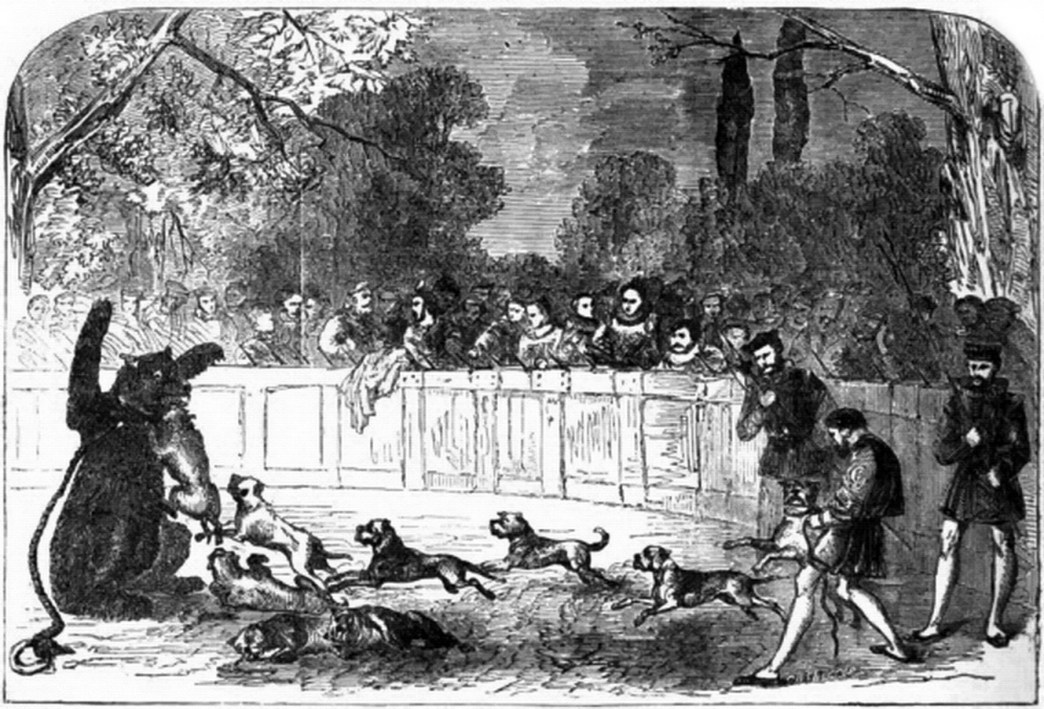
Imagine living in Elizabethan England. Sure, your life may have been a brutal slog (depending on the station of your birth), but there were still plenty of frivolities to enjoy. You could catch the latest Shakespeare play at the Globe Theatre, for example. Alternatively, you could head to the local bear-baiting pit and watch a pack of dogs tear apart a chained and muzzled bear.
While these two diversions weren’t exactly “both alike in dignity” (as the bard would say), they were both alike in popularity. According to a new paper published in Society and Animals, bear-baiting can trace its roots all the way back to the Norman invasion in 1066.
Examining literary accounts, depictions in books and other works, and archaeological evidence, British researchers determined that bear-baiting became a lot more common after William of Normandy conquered the country. In fact, tucked away in the lower margins of the Bayeux Tapestry chronicling the invasion, there’s a man with a sword facing a chained and muzzled bear.
Read more: “Italian Bears Softened by Centuries of Human Proximity”
According to the researchers, even though wild brown bears had died out in Great Britain centuries before, the animals were still imported as entertainment—and at considerable cost. Among the new evidence provided is the shoulder bone of a bear discovered in the 19th century which has been newly carbon dated to 1078-1155 CE—immediately after the Norman Conquest. Bear skin and bones from seven other archaeological sites throughout England have also been dated to around 1000-1300 CE, indicating the practice was widespread at the time.
“Our research demonstrates that the activity of baiting, while associated with marriages, aristocratic pastimes, and raucous festivities in medieval stories and sermons, was clearly popular entertainment among the general public as well, with bear bones indicative of live animals being found in a number of English towns,” study author Liam Lewis of Cardiff University explained in a statement. “This is despite bears needing to be imported to England from overseas and therefore presumably carrying costs for importation, travel, and sustenance.”
The researchers hypothesize that upper-class urbanites likely paid to import bears in an effort to earn soft power, but local lower classes bore some of the cost.
As you can imagine, bear-baiting was a particularly grisly form of entertainment, and that didn’t go unnoticed at the time. “It’s important to note that even at the early stages in the development of baiting as a custom in this region, writers were already critiquing such activities from a moral standpoint as a critique of excess,” the researchers wrote.
In fact, Parliament tried to ban blood sports like bear-baiting on Sundays in 1585, but Queen Elizabeth I—a big bear-baiting fan—exercised her royal veto. Although it began to die out earlier, it wasn’t until 1835 that the practice was explicitly prohibited by law in the U.K..
There is something of a humane coda to the brutal treatment of bears in England. In an effort to advance conversations about reintroducing the apex predators to the countryside, the Bristol Zoo started the Bear Wood project in 2019. There, from an elevated vantage point, onlookers can see how the animals existed in their natural habitat, as they did millennia ago in the wilds of Great Britain.
Enjoying Nautilus? Subscribe to our free newsletter.
Lead Image: Internet Archive