



Almost exactly a century ago, in October 1926, Cambridge University made a small but significant change to its statutes. It introduced the right for academics to take every seventh term off.
The word “sabbatical” comes from the Hebrew “shabbath,” meaning “rest.” Yet in an academic context, it usually means a rest from one kind of work, so that you can focus on another. Cambridge’s embrace of the sabbatical was a sign that the university didn’t only care about teaching students. It also wanted its scholars to carry out original research.
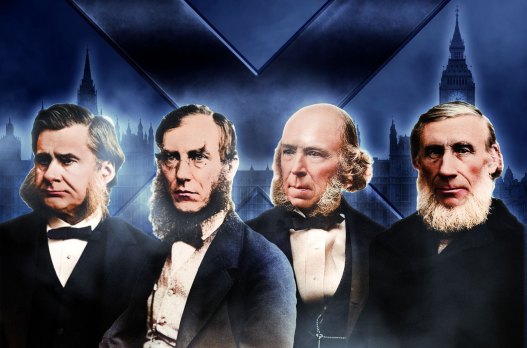
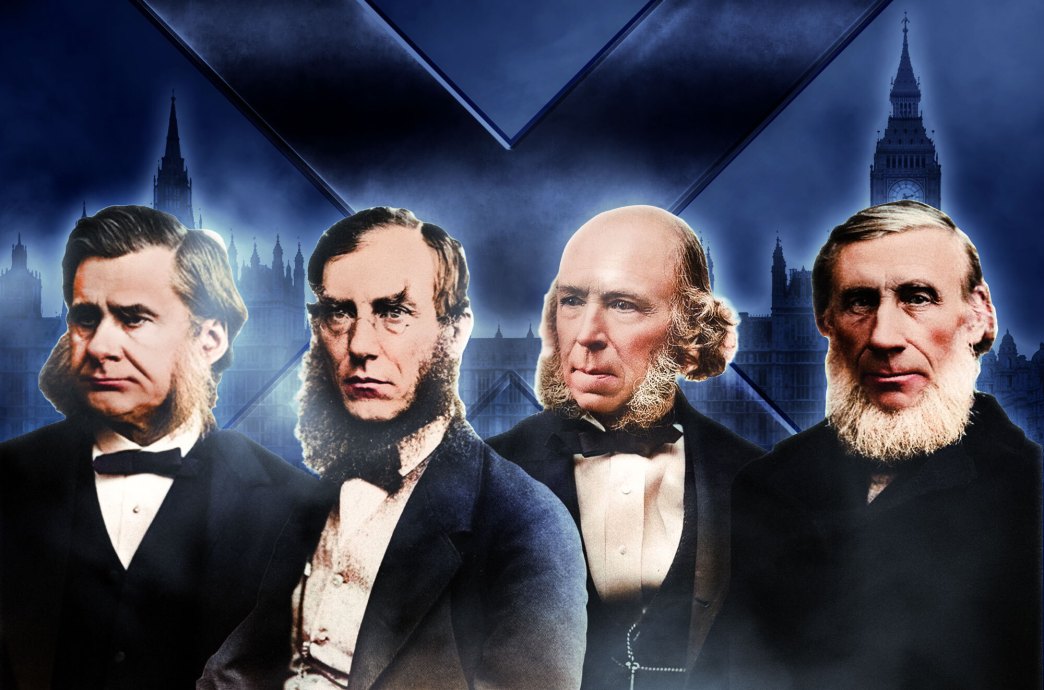
This innovation was just one milestone among many in the slow process by which the very purpose of our universities was gradually altered—a transformation that was driven by a mysterious-sounding group of British scientists who called themselves the “X Club.”
In the Middle Ages, when Oxford and Cambridge were created, their predominant function was to train students for a career in the church. Over the centuries, they became more like intellectual finishing schools. Yet the idea that it was the duty of professors also to do original research didn’t come into it, in any serious way, until the late 19th century.
Tell this to most academics now, and they won’t believe you. They assume that the division of their work between research and teaching is an ancient tradition. Not a bit of it.
I visited the archives in Cambridge’s University Library and looked at endowment documents for professorships, which go back to Tudor times. Before the 19th century, I found, they don’t say a thing about research. Take the Lucasian Chair of Mathematics, which since its birth in 1663 has been held by the likes of Sir Isaac Newton and Prof. Stephen Hawking. Its terms say only that the holder should give lectures and be at home on certain days to talk to students.
Fast-forward to 1864, though, and these assumptions are being called into question. That’s when nine British scientists formed a private club that met for dinner once a month at the St George’s Hotel in Mayfair. They called themselves the X Club to indicate that they embraced no doctrine. Yet they agreed about a couple of things. One was that Darwin was right. Another was that British science needed to be professionalized.
Although their interests varied widely, all nine members were men of high scientific distinction. There was the mild-mannered surgeon George Busk. Edward Frankland, who pioneered the new field of organometallic chemistry. The fastidious philosopher Herbert Spencer, who carried around a pair of ear plugs, so he could pop them in if he was ever losing an argument. Then there was Thomas Huxley, the biologist known as “Darwin’s bulldog” for his fierce support of evolutionary theory. The archaeologist John Lubbock, who coined the words “paleolithic” and “neolithic.” The passionate Irish physicist John Tyndall, who specialized in hair-raising feats of mountaineering. The botanist Joseph Dalton Hooker, who revolutionized and ran London’s Royal Botanical Gardens, Kew. And a pair of mathematicians: William Spottiswoode, the Queen’s Printer, and Thomas Hirst, who held the Chair of Mathematics at University College London.
Despite their erudition, these X Club members—or X-men, as we might call them—weren’t all business. They often picnicked at Maidenhead on the banks of the Thames River, and on one such outing they gave each other a range of jokey X-related nicknames. They became Xemplary Busk, Xpert Frankland, Xhaustive Spencer, Xalted Huxley, Xquisite Lubbock, Xcentric Tyndall, Xperienced Hooker, Xcellent Spottiswoode, and Xtravagant Hirst.
Coming from such a range of disciplines, they could say with authority that there was something rotten in the state of British science. The problem was: it was amateur. It wasn’t yet a profession. This meant that it needed, literally, to be professionalized.
In a speech he gave in 1874, Huxley lamented that in Britain, “It is better for a man’s worldly prospects to be a drunkard, than to be smitten with the divine dipsomania of the original investigator.” That was because a drunk might hold down a job. A researcher couldn’t, because there were no jobs available for him—or at least, not in Britain. As Huxley noted, the result was that we were “far behind France, and infinitely behind Germany.”
Around the same time, the poet and critic Matthew Arnold was dismayed when his German friends referred scathingly to Oxford University as a mere “gymnasium”—that is, a glorified secondary school, as opposed to a place for research. A similar anxiety surfaces in George Eliot’s novel Middlemarch, which was published in the early 1870s. It’s suggested at one point that the pedantic scholar, the Rev. Edward Casaubon, is an amateur, not least because he is apparently unaware that “the Germans have taken the lead in historical inquiries.”
Tyndall, Frankland, and Hirst knew the German system, having studied there. They knew Germany had taken a leap forward decades earlier by pioneering the twin-purpose university: places where professors divided their time between teaching and research. The result was, the country was now challenging British preeminence, not only in science but also in industry and military might. In short, this was becoming a matter of national importance.
The way Huxley saw it, there were two possible solutions for Britain. The first was to create a series of government-funded laboratories. The second was to follow the example of the Germans and introduce research as a formal duty of university scholars.
To talk about the X-men, I arranged to meet the University College London science historian, Frank James, at the British Library. First of all, he confirmed that, when the Club formed, research wasn’t a priority at universities. “So long as you gave your lectures, they couldn’t care less.” Then he added that, of the two ways to professionalize science, Huxley would never have gone for the state-run labs option. “That’s because he was worried about state interference in science.”
This left Huxley and his friends focused on the second option. In pursuit of that idea, the X-men set about seizing control of the most important scientific bodies in the country. And they did so with a staggering level of success. Take the Royal Society. During the 1870s, two out of three of its presidents were X-men: Xperienced Hooker and Xcellent Spottiswoode.
Or consider another grand science organization of the time, the Royal Institution on Albemarle Street. As it happens, this is where I am writing these paragraphs. The reason is, I work for the London Institute for Mathematical Sciences, which occupies rooms on the Royal Institution’s second floor. Which explains why I was already aware that one X-man had held the helm here: Xcentric Tyndall, who took over the running of the place from Michael Faraday in 1867. Then a thought occurred to me. I jumped up and nipped out onto the staircase landing, which is just outside our entrance, to see if I had remembered right.
The walls of the stairs are hung with portraits of past officers of the Royal Institution. And there they were—four more X-men. Xalted Huxley and Xpert Frankland were professors here. Xemplary Busk and Xcellent Spottiswoode served as Treasurer and Secretary.
So, the X Club had the Royal Society and the Royal Institution under its thumb. Yet to carve out a space for research at universities, its key target for infiltration would have to be the Devonshire Commission. This was a team of nine experts, led by the Duke of Devonshire, that the government selected in the early 1870s to investigate the state of British universities. Lo and behold, Lubbock and Huxley turned up among their number. In a Commission report, X-men Frankland wrote that the weakness of British science “lies in the entire non-recognition of original research by any of our Universities.”
The recommendations of the Devonshire Commission led to the Universities of Oxford and Cambridge Act, which was put before parliament in 1877. Previous legislation had defined the essence of universities as “religion” and “learning.” The new bill proposed that it should be redefined in the statutes as the advancement of “religion, learning, and research.”
But not everyone was convinced. At the eleventh hour, Lord Francis Hervey, MP for Bury St Edmunds, moved to delete the word “research” to preserve “the English character” of our universities. In any case, he asserted, it had only been introduced “to conciliate a small and enthusiastic clique,” by which one can only assume that he meant the members of the X Club. Lord Hervey’s quibble was a characteristic reflex of British amateurishness.
Luckily, the War Minister, Gathorne Hardy, disagreed. He put it to the House that research wouldn’t “pervert the purposes of the University.” Nor would it damage teaching. On the contrary, it would most likely strengthen it, since students would have access to the latest advances in their subject. Given his ministerial brief, Hardy may also have hoped that the support of science would bolster Britain’s military might.
The House voted. Hervey lost and Hardy won. The historic Act was passed.
Its aim was the transformation of British universities, and it was understood on those terms. Regarding the change to the statutes, Nature declared, “It is impossible to overestimate the good these words will do to the cause of research in England.” The journal, whose foundation in 1869 was itself a sign of the new seriousness in British science, declared that in Cambridge the statutory phrase should be posted “in letters of gold on the Senate House.”
A document doesn’t transform a culture overnight. The new statutes only initiated the process. But the starter’s pistol had been fired, and it had the fingerprints of the X-men all over it.
The process of carving out a space for researchers was a slow one—and it continues to this day. Later milestones included the acceptance of the sabbatical as a statutory right of university academics. There was also the introduction of PhDs, which were brought in by Oxford in 1917 and Cambridge in 1919, becoming a prerequisite of a professorship in the 1970s.
Yet even now, a career where you’re paid to do research usually requires spending half your time teaching students. That’s the case except at a tiny handful of non-university institutes like the London Institute for Mathematical Sciences, where you can devote yourself to research full-time.
The members of the X Club never actually called themselves “X-men.” But they were intellectual superheroes. The next time you’re in central London, you can pay a visit to the hotel where the X-men used to meet. Brown’s Hotel on Albemarle Street is what used to be the St George’s Hotel. The glossy history book on display at the reception desk has a paragraph about the X Club connection. The Donovan Bar on the ground floor is the perfect place for a cocktail or a coffee.
Thus revitalized, pop across the road and explore the excellent free museum at the Royal Institution. Be sure to climb the stairs until you find the portraits of Busk, Frankland, Huxley, and Spottiswoode. That door to your left is the entrance to the London Institute for Mathematical Sciences. If you’re feeling Xtrovert, you can drop in and say Hi.
Enjoying Nautilus? Subscribe to our free newsletter.
Lead Image: Wikimedia Commons


