

You might not notice it gazing out from the shore, but water ages. As it gets older, it loses the oxygen dissolved in it, used up by marine life, bacteria, and chemical reactions – and without a trip to the surface and the open air, it can’t get that oxygen back.
We know that warmer water holds less oxygen, and that climate change will therefore ‘age’ the oceans faster, with potentially dramatic effects on underwater ecosystems.
What hasn’t been clear so far is how this shift is going to play out over different regions.
To get more clarity, a team led by researchers from the University of California, San Diego ran a simplified ocean circulation model 100 years into the future, looking at how warming might affect different parts of the ocean and its oxygen levels.
The team’s results, published in AGU Advances, identify and explain what seems to be a paradoxical future scenario: ‘young’ water getting older, and ‘old’ water getting younger in the years ahead.
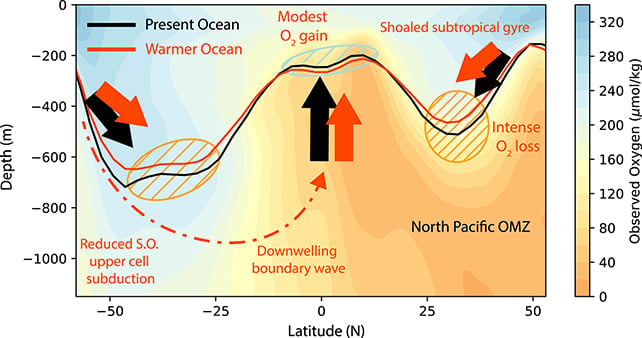
This turns out to be particularly pronounced in what’s known as the upper Pacific thermocline, around 200–1,000 meters (656–3,281 feet deep), sitting as a transition layer below the warm and well-mixed surface layer and the colder, deeper ocean.
In the briefest of terms, warming temperatures lead to less circulation between these layers, but the effects of that slowing down vary from place to place.
“We use idealized model simulations to isolate and illustrate the warming-induced circulation changes that drive the ‘young get older, but old get younger’ pattern in the Pacific thermocline under projected climate change,” write the researchers in their published paper.
Warmer water is less dense than cold water, which causes the layering. As the ocean heats up, the temperature difference between the top and bottom of the ocean increases, making the layers less likely to interact.
However, wind patterns mean different parts of the Pacific behave in different ways. In the subtropical North Pacific, the thermocline is mostly affected by younger and fresher water from above being mixed in – as this mixing slows down, the water gets older.

frameborder=”0″ allow=”accelerometer; autoplay; clipboard-write; encrypted-media; gyroscope; picture-in-picture; web-share” referrerpolicy=”strict-origin-when-cross-origin” allowfullscreen>
In the tropical Pacific, the thermocline is more impacted by older, less fresh water from below. The researchers showed that this mixing will slow down as well, which means these water regions get younger.
And that second result could be put down to a ‘remote control’ effect from the warming Southern Ocean around Antarctica, the study determined.
“This meridional contrast in oxygen and age change arises from a slowdown of vertical velocities driven by a combination of Pacific basin and remote Southern Ocean heat forcing,” write the researchers.
While previous studies have predicted shifting oxygen levels in the Pacific, the findings here give a more granular look at what’s likely to happen in different parts of the ocean, and the extent to which vertical water circulation will slow down.
“Clarifying this physical explanation informs our confidence in the climate projections and how we compare them to observed deoxygenation,” write the researchers.
While this study doesn’t extend to an analysis of how ocean ecosystems might be affected, the researchers do say that the North Pacific could see the most significant change in terms of how habitable the waters are for marine life.
The news for current low-oxygen zones is slightly better, in that oxygen loss over the next century shouldn’t be too drastic – although these patches of water are already starting off in a worse state as far as habitation goes.
Future studies building on this research will need to use more detailed models and predictions – incorporating changes in wind patterns, for example – to get the full picture of what the next century looks like for the Pacific.
“These warming-induced circulation changes play a key role in shaping the Pacific Ocean’s physical, biogeochemical, and ecosystem response to anthropogenic climate change,” write the researchers.
The research has been published in AGU Advances.
This article was fact-checked by Fiona MacDonald and edited by Fiona MacDonald. While we pride ourselves on our process, we are only human. If you spot a mistake, please let us know.

_case.jpg?w=95&resize=95,95&ssl=1 "Nothing’s New Headphone (1) Pro Are Made for the Studio")