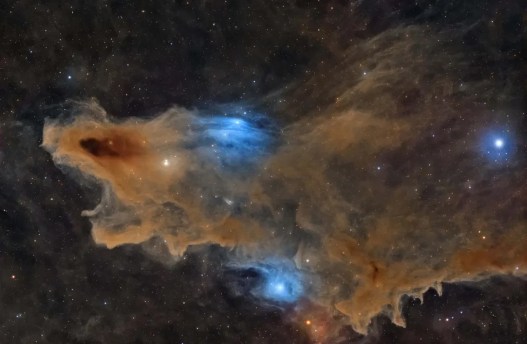
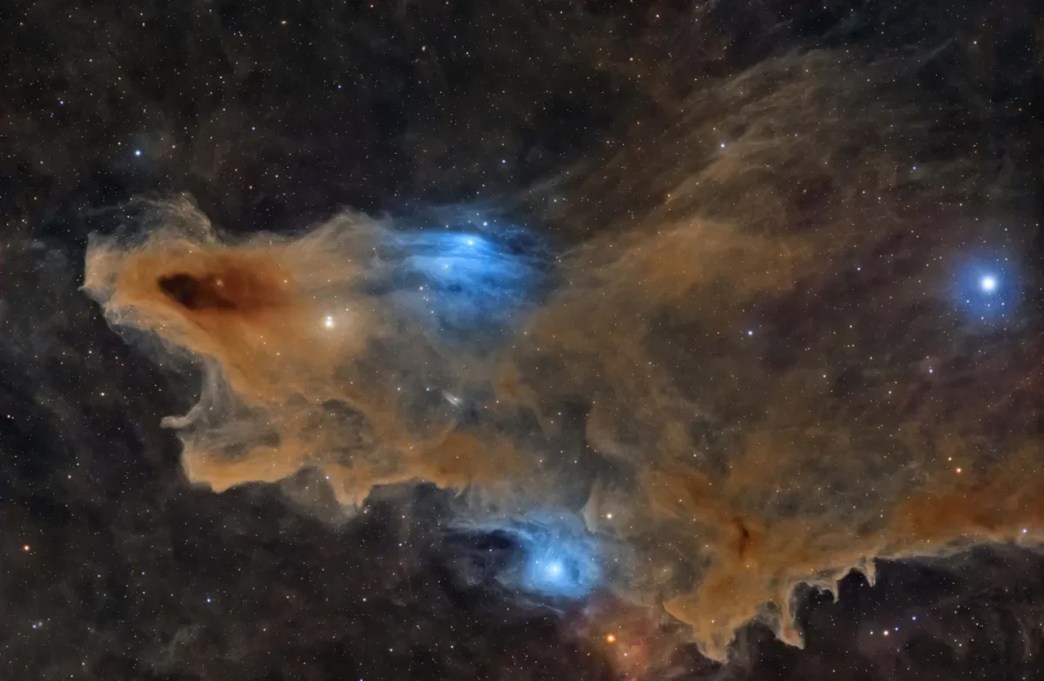
Behold the majestic “shark” nebula—or Lynds Dark Nebula 1235—a silhouette of interstellar gas and dust that stretches about 15 light-years from head to tail. That’s roughly the distance from the Sun to its closest stellar neighbor Proxima Centauri. And back again. Twice.
Lynds Dark Nebula 1235 was first spotted in the 1960s, though it’s come back into public consciousness thanks to this shot by photographer Ali Alobaidly, which just won first prize in the Royal Observatory Greenwich’s ZWO Astronomy Photographer of the Year competition. The judges described Alobaidly’s image as “perfectly rendered” and “at the very forefront of modern-day astrophotography.”
Read more: “This Lion-Like Nebula Has Cosmic Dust for a Mane and a Dying Star for a Face”
“The fine nebulosity captured is exquisite,” competition judge and BBC Sky at Night Magazine art editor Steve Marsh said in a statement. “You can zoom in to a very high magnification, and there is never a drop in quality.”
Getting the spectacular shot was no easy feat. Alobaidly lugged more than 330 pounds of camping and photography gear out into the Al Salmy Desert in western Kuwait, patiently capturing frames across two nights in August 2025. The photograph was taken using two paired lens telescopes, each fitted with a monochrome camera that ran through red, green, and blue filters in turn. The full exposure time combined in the image is more than 28 hours.
Processing matters in a picture like this too, and the image was later carefully adjusted to bring out the details and reduce noise.
As for what’s in the shot, the nebula is around 650 light-years away, in a constellation called Cepheus. Most of the silhouette is made from interstellar dust clumping together to block out the light from stars farther away.
It’s thought that stars are forming here, and you can see three young stars shown by the bright blue dots, lighting up the dust around them. As for the dark “eye of the shark,” that’s a patch of dust packed tightly enough to block out background light. With gravity continuing to build in this region, we may see a star born in the eons to come.
There’s something about stars and space dust taking on recognizable shapes that makes them even more dramatic than normal—a little bit like spotting a cloud in a specific form.
“This predator drifts silently through space, camouflaged against the faint glow of the background stars, lit only by nearby blue-coloured reflection nebulae,” Alobaidly said. “Unlike its oceanic cousins, the Shark Nebula doesn’t bite, but it does photobomb astrophotographers with a molecular cloud big enough to make Earth look like a speck of plankton.”
Enjoying Nautilus? Subscribe to our free newsletter.
Lead Image: Ali Alobaidly