.jpg "Thieves Stole ‘Nvidia’ Trailers. They Got 20 Tons of Sand")


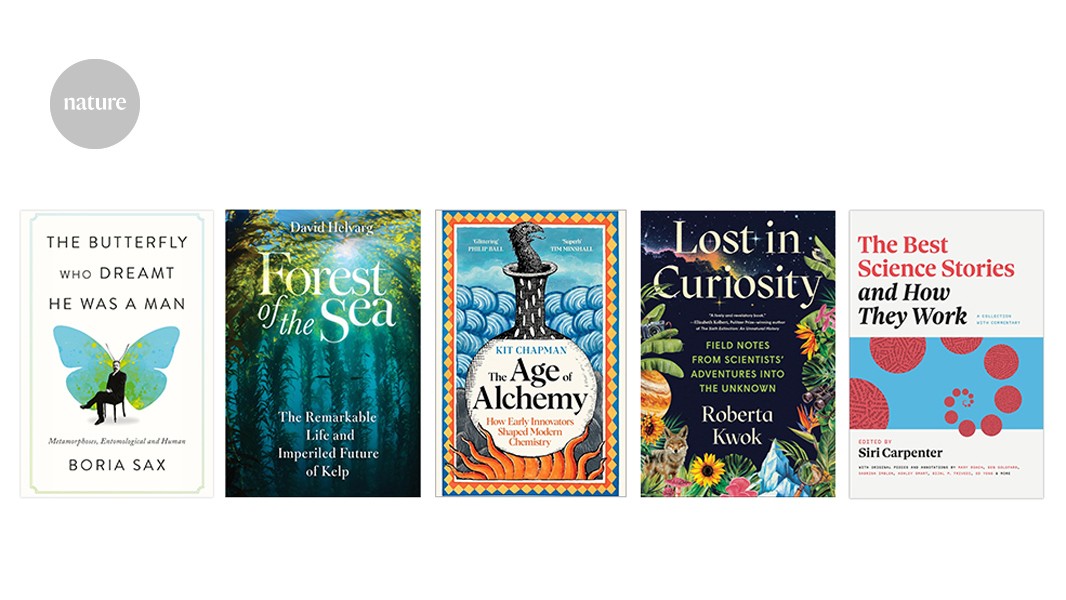
The Best Science Stories and How They Work
Ed. Siri Carpenter Univ. Chicago Press (2026)
“It’s all too easy to misperceive science journalism as existing in a bubble,” writes science journalist Siri Carpenter, introducing her edited collection. It reprints 11 wide-ranging science articles by different writers, published across newspapers, magazines and journals, including Nature. Each comes with a commentary by another science writer and an interview about the article between author and commentator. The result is an illuminating take on how to compose high-quality science journalism beyond the bubble.

Forest of the Sea
David Helvarg Island (2026)
Cold-water kelp forests are “as mysterious to most people as the depths of the Mariana Trench”, remarks journalist, author and marine conservationist David Helvarg. Yet, he notes, they cover an area larger than the Amazon rainforest and enrich the waters around many of the world’s coastlines. They also absorb enormous amounts of carbon dioxide and, along with mangroves, salt marshes and seagrasses, produce 20% of the world’s oxygen. Helvarg’s pioneering book is a plea to save kelp from continuing human destruction.

The Age of Alchemy
Kit Chapman Profile (2026)
In 1901, when chemist Frederick Soddy discovered the radioactive decay of thorium into radium, he shouted to his collaborator, physicist Ernest Rutherford: “This is transmutation!” Rutherford snapped back: “For Mike’s sake, Soddy, don’t call it transmutation. They’ll have our heads off as alchemists.” By then, alchemy — once practised by numerous scientists — was regarded with contempt. But as science writer Kit Chapman argues in his lively history, chemistry “could never have existed” without its mystical predecessor.

Lost in Curiosity
Roberta Kwok Sourcebooks (2026)