Dark Mode Light Mode

Keep Up to Date with the Most Important News

By pressing the Subscribe button, you confirm that you have read and are agreeing to our Privacy Policy and Terms of Use
Extreme Space Weather Could Delay Your Next Flight
Scientists Melted a Diamond, And It Really Didn’t Go The Way They Expected
Chemistry in Pictures: Look deeply into my nose
Join us on a journey where chemistry meets creativity, and the wonders of science unfold. Quench your intellectual thirst with thought-provoking articles that transcend the boundaries of conventional knowledge.

Scientists Melted a Diamond, And It Really Didn’t Go The Way They Expected

Scientists Melted a Diamond, And It Really Didn’t Go The Way They Expected Scientists Melted a Diamond, And It Really Didn’t Go The Way They Expected


Heist movies may refer to diamonds as ice, but the two solids don’t actually have a lot in common.

From the way their atoms are arranged inside to how they even form in the first place (intense pressure and heat deep underground for diamond, cold for ice), it’s hard to think of two substances that have such strong differences while maintaining a superficial similarity.

It might, therefore, surprise you to learn that diamond – the hardest known naturally occurring mineral on Earth – is able to melt.

But even this, diamond does really weirdly, according to a team of physicists led by Marius Millot at the Lawrence Livermore National Laboratory (LLNL) in the US.

Basically, it stays in its familiar diamond crystal structure right up until the point it melts, when its carbon atoms tumble into disorder.

“We think that is because the sample does not have time to change when it only experiences a single shock,” Millot says. “It remains ‘trapped’ in the diamond structure.”

An illustration of cubic diamond melting into liquid carbon. (James Wickboldt/LLNL)

It’s not exactly easy to melt a diamond, but several experiments have done so over the years. In 2007, a team of scientists reported melting diamond using a laser to blast it with a shock wave at 750 gigapascals of pressure – more than twice the ambient pressure in Earth’s inner core, and 7.4 million times atmospheric pressure at sea level.

Follow-up experiments detailed in a 2009 paper led by LLNL physicist Jon Eggert directly measured diamond’s melting temperature.

As theoretical calculations improved, however, a problem emerged: the experimental melting temperature differed from quantum-mechanical predictions by about 20 percent.

“No matter what the theorists did – even with the most advanced computer simulation techniques – they could not reproduce the experiments,” Millot says.

Meanwhile, another question remained unanswered. Theory predicted that, at around a terapascal, the tightly regimented atomic lattice of diamond should temporarily shift into a form of carbon called BC8 prior to completely melting.

Earlier experiments had even been interpreted as evidence of this transition above about 900 gigapascals. However, newer simulations suggest that forming BC8 might be too difficult to accomplish during rapid compression.

Although the 2009 paper demonstrated diamond melting at pressures up to 1.1 terapascals, the experiment lacked the sensitivity to determine whether the predicted BC8 phase appeared along the way.

In the years since those experiments, however, the technology for watching matter under these fleeting extreme conditions has improved considerably. So Millot and his team took another crack at it.
Scientists Melted a Diamond, And It Really Didn't Go The Way They Expected
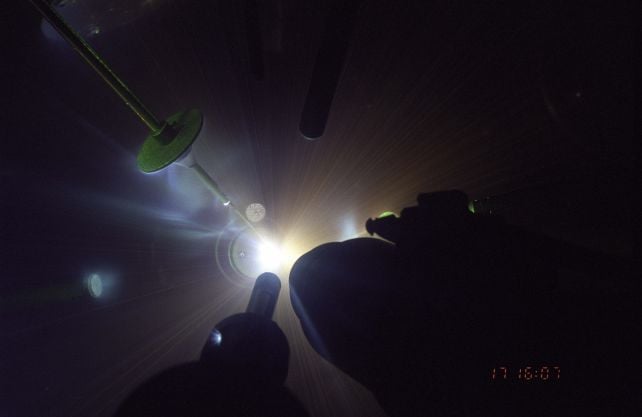
A diamond target at the center of an OMEGA laser shot designed to study diamond under extreme pressure. The bright white light is plasma produced during the experiment. (Eugene Kowaluk/LLE)

Using the OMEGA Laser Facility at the University of Rochester, the researchers used powerful laser pulses to drive shock waves through tiny diamond samples, creating pressures between 600 gigapascals and 1.8 terapascals.

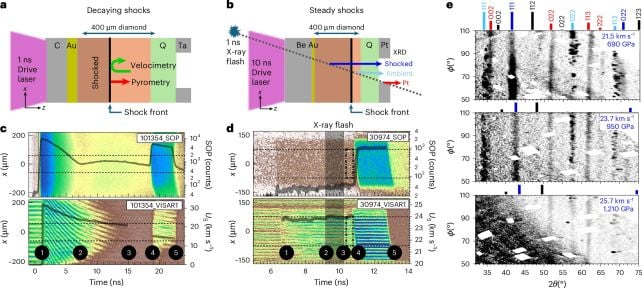
At the same time, the team measured how fast the shock moved, how hot and reflective the diamond became, and – crucially – used X-rays to observe how the crystal structure changed.

“We were able to take tiny diamond samples and shock compress them to temperatures hotter than the surface of the Sun and to pressures higher than the center of Neptune and Uranus – and still measure atomic structure, temperature, density and optical reflectivity,” Millot says.

The new measurements resolved the temperature problem.

They put diamond’s melting temperature at around 7,300 Kelvin and 1 terapascal, significantly lower than the old experimental measurements and in good agreement with theoretical calculations that had stubbornly refused to match the old result.

“While it was frustrating to discover that our original temperature measurements were off by more than 1,000 degrees, it is exciting to see such a dramatic improvement in data quality with our new diagnostics,” says Eggert.
Scientists Melted a Diamond, And It Really Didn't Go The Way They Expected
The experimental setup and X-ray diffraction measurements of diamond under increasing pressure. The diffraction signal from the shocked diamond weakens as pressure rises, disappearing as the diamond melts. (Millot et al., Nat. Phys., 2026)

The X-rays also revealed what happened to the diamond’s crystal structure as it melted – and here’s where things get really fun.

As the researchers dialed up the pressure, the diamond’s X-ray diffraction signal grew progressively weaker, indicating that less and less of the crystalline diamond remained as it melted, until it disappeared entirely.

But for as long as the team could still detect an atomic structure, it remained in the familiar cubic crystal lattice. The researchers found no sign of a substantial BC8 phase – solid diamond and liquid carbon simply coexisted until the process was complete.

This, they propose, is likely due to mechanisms suggested by earlier simulations. Although carbon might prefer the BC8 phase at the pressures involved, achieving it requires breaking and rearranging the diamond’s extremely strong carbon bonds – an energetically demanding process.

Under the experiment’s fleeting conditions, the diamond appears to melt before the transformation can take place.

And, strangely enough, this is where diamond starts to behave a little like ice after all.

Under these extreme pressures, solid diamond is less dense than the liquid carbon it melts into – much as ordinary ice is less dense than liquid water.

That means solid diamond could float on a pool of molten carbon. It also produces another counterintuitive effect: Over part of the melting range, increasing the pressure actually lowers the temperature at which diamond melts.

This is all really cool and really weird, but it also has practical applications.

Such experiments could tell us about the interiors of ice giant planets such as Uranus and Neptune, where carbon may experience pressure and temperature conditions similar to those recreated in the experiment.

Subscribe to ScienceAlert's free fact-checked newsletter

Closer to home, though, diamond is used in targets for inertial confinement fusion experiments, where tiny fuel capsules are compressed under similarly enormous pressures. More accurate information about how carbon behaves as those targets implode could therefore improve the computer models used to design fusion experiments.

Related: Finally, a Fusion Reaction Has Generated More Energy Than Absorbed by The Fuel

Indeed, in simulations incorporating the updated carbon model, the researchers found that the predicted fusion energy gain could increase by up to threefold.

“Our work indicates that we could use slightly slower initial shocks and still achieve full melting of the diamond in our NIF implosions,” Millot says.

“This is exciting because such a slower shock would make the fusion fuel more compressible. That in turn increases the maximum energy yield we could obtain with the same laser energy.”

The research has been published in Nature Physics.



Source link

Keep Up to Date with the Most Important News

By pressing the Subscribe button, you confirm that you have read and are agreeing to our Privacy Policy and Terms of Use
Add a comment Add a comment

Leave a Reply

Your email address will not be published. Required fields are marked *

Previous Post
Extreme Space Weather Could Delay Your Next Flight

Extreme Space Weather Could Delay Your Next Flight

Next Post
Chemistry in Pictures: Look deeply into my nose

Chemistry in Pictures: Look deeply into my nose

Advertisement