
In the unexplored expanses deep below the ocean waves, life finds many ways to thrive.
Sometimes that means evolving to metabolize volcanic chemistry instead of sunlight. Sometimes it’s glowing in the permanent darkness to attract prey.
And sometimes it means finding an unwitting bestie, clinging tight, and refusing to let go.
Thousands of meters below the Southeast Pacific Ocean, scientists have documented just such a partnership.
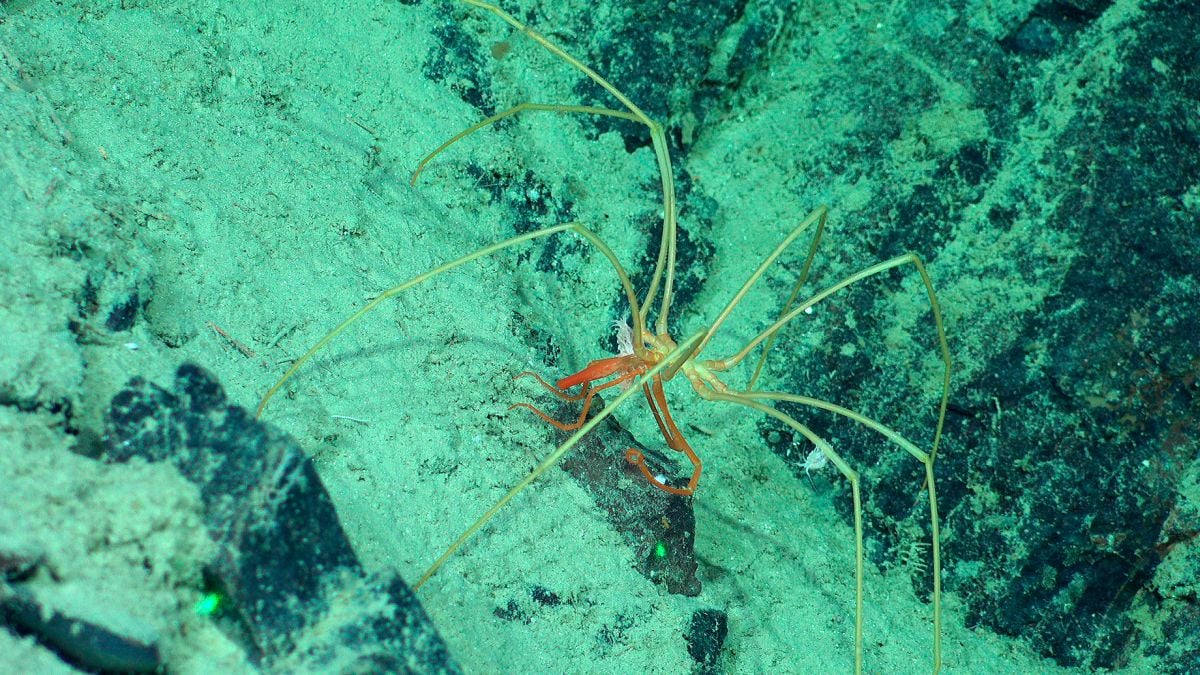
Clutching fast to spindly giant sea spiders (Colossendeis colossea) scuttling over the seafloor, researchers piloting a remotely operated vehicle spotted several amphipods (Mesopleustes abyssorum) – tiny crustaceans recorded throughout the world’s deep oceans.
That’s unusual enough – but the researchers spotted the behavior twice, four days and some 225 kilometers (140 miles) apart, suggesting this wasn’t simply a chance encounter, but that the amphipods may be deliberately seeking out the sea spiders.
And they may be getting more than a lift: The strange arrangement could offer both public transport and a hookup spot, all in one handy collection of elbows.
“Although the possibility that the interaction observed here is incidental cannot be discarded,” writes a team led by marine biologist Jorge Pérez-Schultheiss of the Invertebrate Zoology Area of the National Museum of Natural History in Chile, “its apparent specificity and recurrence within a relatively constrained search space suggest instead an underrecognized ecological strategy.”
The deep ocean is not the easiest place to eke out an existence.
Aside from the ambient conditions – cold, dark, and crushing – food can be scarce and sporadic, with large stretches between morsels. Finding a mate can prove difficult, too. The ocean is large, and amphipods are wee.
M. abyssorum poses a particularly interesting amphipod enigma. It isn’t very good at swimming, and doesn’t have a planktonic larval stage that helps carry it far and wide on ocean currents.
Yet it still gets around – recorded across the Pacific, Atlantic, Indian, and Southern oceans, at depths ranging from around 690 to 3,500 meters (2,264 to 11,483 feet).
That’s a puzzlingly vast range for an animal so poorly equipped to disperse itself. Scientists aren’t even sure whether M. abyssorum really is one extraordinarily widespread species, or several cryptic species masquerading as one.
But if it really does roam the world’s oceans, Pérez-Schultheiss and colleagues may have found at least one creative solution to their transportation problem.
Sea spiders, it turns out, make surprisingly good buses.
 frameborder=”0″ allow=”accelerometer; autoplay; clipboard-write; encrypted-media; gyroscope; picture-in-picture; web-share” referrerpolicy=”strict-origin-when-cross-origin” allowfullscreen>
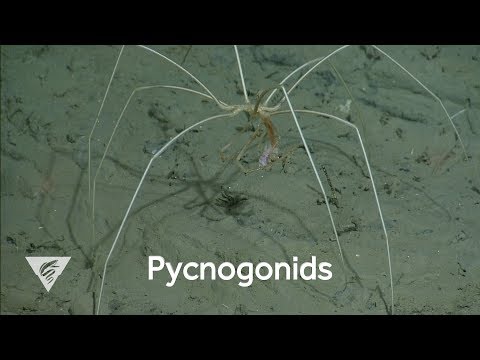
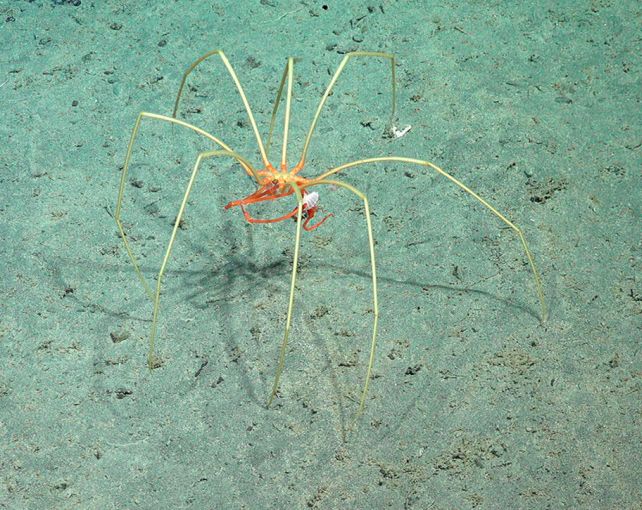
Giant sea spiders are neither true spiders nor particularly conventional-looking animals. Pycnogonids are marine arthropods that consist, to the casual observer, of an improbable collection of legs attached to really not very much body at all.
In fact, they have so much leg, and so little body, that their organs partially descend into their spindly limbs. But those legs are extremely handy.
Long-legged sea spiders like Colossendeis do use their legs for stalking across the seafloor … but they’re also surprisingly capable swimmers, spreading their enormous legs wide to catch currents that can carry them over considerable distances.
So imagine you’re a sea spider, living your best life thousands of meters down, and then one day an amphipod looks at you and thinks, “Oh, sweet, my Uber is here.”
That’s pretty much what Pérez-Schultheiss and his colleagues saw.
On 24 November 2024, the Schmidt Ocean Institute’s remotely operated vehicle SuBastian met a giant sea spider 3,155 meters deep on the Chilean margin. Clinging to its limbs were three M. abyssorum amphipods: two larger individuals attached near the front of the sea spider, and a smaller female farther back on one of its walking legs.
If that were all, it might be tempting merely to shrug the encounter off as an interesting oddity.
But then, four days later, some 225 kilometers away, at a depth of 2,698 meters, it happened again. This time, the researchers found two amphipods attached to a wandering Colossendeis.
It wasn’t just a casual grip, either. The crustaceans were tightly clutching the sea spiders’ legs using a long, claw-like structure at the end of their own limbs to maintain a remarkably firm grip – one that they stubbornly retained even after the animals were collected.
The researchers believe that this may be a deliberate strategy on the amphipods’ part. There’s even a name for it in the animal kingdom. Phoresis is a form of hitchhiking in which one animal uses another for transportation.
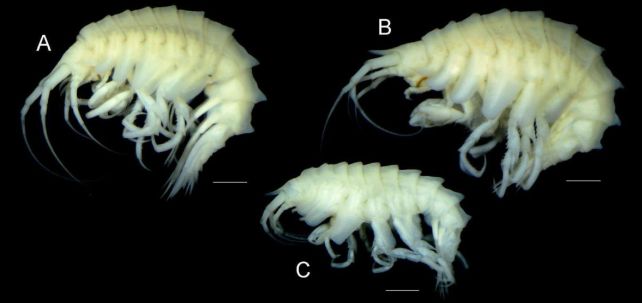
The researchers think M. abyssorum may be stealthily hitching rides on Colossendeis in just this way – a life hack that may allow a decidedly middling swimmer to scatter much farther than it could under its own steam.
If so, then this particular mode of amphipod travel may have been operating right under our noses for a very long time. An association between these two exact animals was originally reported in 1927 – alas, without photographic evidence – but received little attention in the ecological literature.
Now, they’ve been caught in the act, right where they live, to boot.
And transportation may not have been the only advantage to riding the spider bus.

In both cases, the two larger amphipods found close together were an adult male and female pair.
The third amphipod in the first encounter was a female – and she was carrying her eggs.
The researchers think hitching a ride on sea spiders may give widely scattered amphipods a convenient place to find each other and mate – a mobile meeting spot in the vastness of the deep sea.
Related: Deep Sea Scientists Hunting a Shipwreck Accidentally Stumbled Across The Ocean’s Own Backrooms
Of course, the sample size is tiny – two encounters are far from enough to establish the hypothesis as fact – nor is it clear whether M. abyssorum deliberately seeks out Colossendeis, or simply grabs onto whatever suitable structure it encounters.
Further exploration, the researchers say, will help shed light on this curious partnership.
“In ecosystems where energy sources are scarce and environmental conditions are extreme, even subtle biological associations may play critical roles in survival and resource acquisition,” they write.
The findings have been published in Ecology.
This article was fact-checked by Rachel Garner and edited by Rebecca Dyer. While we pride ourselves on our process, we are only human. If you spot a mistake, please let us know.